Facts
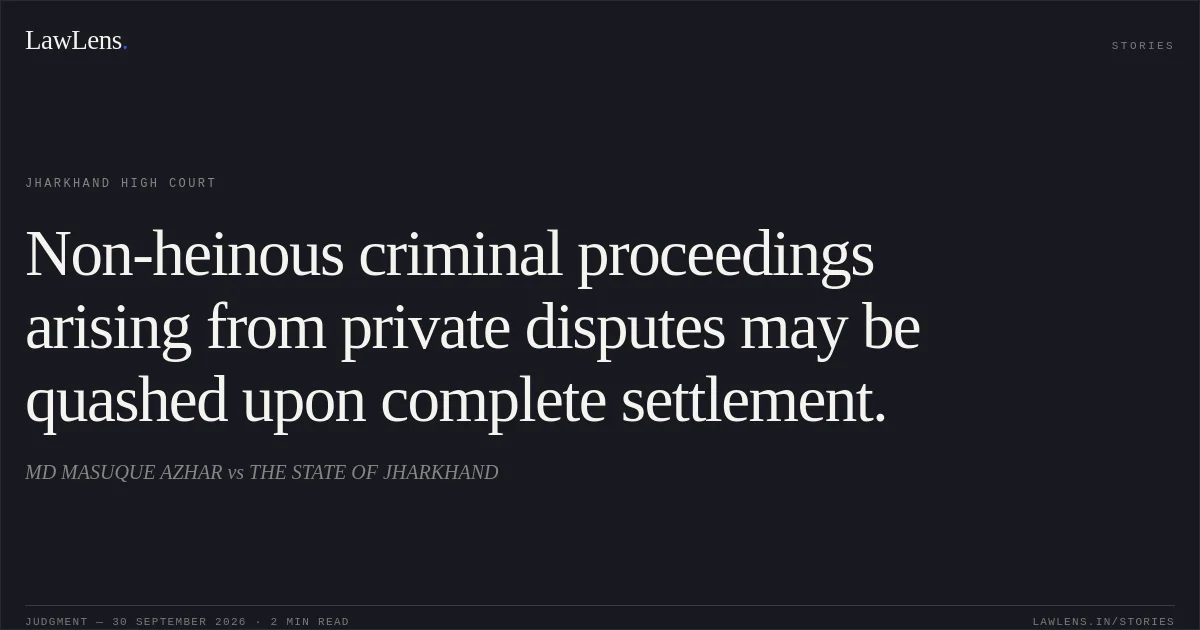
The petitioners invoked Section 528 of the Bharatiya Nagarik Suraksha Sanhita, 2023, seeking to quash the FIR and criminal proceedings in Jagannathpur (Pundag) P.S. Case No. 446 of 2025, registered under Sections 126(2), 115(2), 352, 351(2), 351(3) and 3(5) of the Bharatiya Nyaya Sanhita, 2023.
Source reference: p. 2, para. 2At the time of hearing, the investigation was ongoing and no charge-sheet had been filed.
Source reference: p. 2, para. 2The petitioners and opposite party No. 2 jointly stated that they had settled the dispute, and the complainant did not wish to proceed; the State did not oppose quashing.
Source reference: pp. 2–3, paras. 3–4The petitioners characterised the dispute as private and civil in flavour.
Source reference: p. 2, para. 3Issues
Whether the High Court should exercise its inherent jurisdiction under Section 528 BNSS to quash the FIR and criminal proceedings where the parties have settled a private dispute.
Source reference: pp. 2–3, paras. 1, 3–4Whether the nature of the offences and the effect of the compromise warranted quashing the proceedings.
Source reference: pp. 5–6, paras. 6–8Law Applied
Section 528 of the BNSS preserves the High Court’s inherent power to prevent abuse of the process of court and secure the ends of justice.
Source reference: p. 2, para. 1Relying on Parbatbhai Aahir @ Parbatbhai Bhimsinhbhai Karmur v. State of Gujarat, (2017) 9 SCC 641, and the principles in Gian Singh v. State of Punjab, (2012) 10 SCC 303, the Court reiterated that the power to quash on the basis of settlement is distinct from statutory compounding under Section 320 CrPC. The Court must consider the nature and gravity of the offence and the circumstances of the case. Heinous offences and offences with serious societal impact ordinarily cannot be quashed merely because the parties have settled; by contrast, where the dispute is predominantly private or civil in flavour, the Court may quash if the settlement makes conviction remote and bleak and continuation would cause oppression, prejudice or injustice.
Source reference: pp. 3–5, para. 5Reasoning
The Court found that the offences in this case were not heinous and did not involve serious offences of mental depravity; instead, they arose from a private dispute.
Source reference: p. 5, para. 6Given the complete settlement and the complainant’s decision not to proceed, the Court considered the prospect of conviction remote and bleak. It further concluded that continuing the prosecution would cause oppression and prejudice to the petitioners and result in injustice despite the settlement.
Source reference: p. 5, para. 7The State’s lack of objection was also recorded.
Source reference: p. 3, para. 4Holding
The Court held that the case was fit for exercise of its inherent jurisdiction and quashed the FIR and the entire criminal proceeding in Jagannathpur (Pundag) P.S. Case No. 446 of 2025, pending before the Judicial Magistrate First Class, Ranchi, qua the three petitioners.
The criminal miscellaneous petition was allowed, and the compromise application was disposed of; a separate interlocutory application was rejected as not pressed.
Source reference: pp. 2, 6, paras. 1, 10–11Acts & Sections Cited
8 provisions across 3 statutes referred to in this judgment. Each provision opens on LawLens.
Bharatiya Nagarik Suraksha Sanhita, 20231
Bharatiya Nyaya Sanhita, 20235
Code of Criminal Procedure, 19732
Original Court PDF
MD MASUQUE AZHARvsTHE STATE OF JHARKHAND
Click to open original judgment
Original judgment, available to read, download and summarize on LawLens.in