Facts
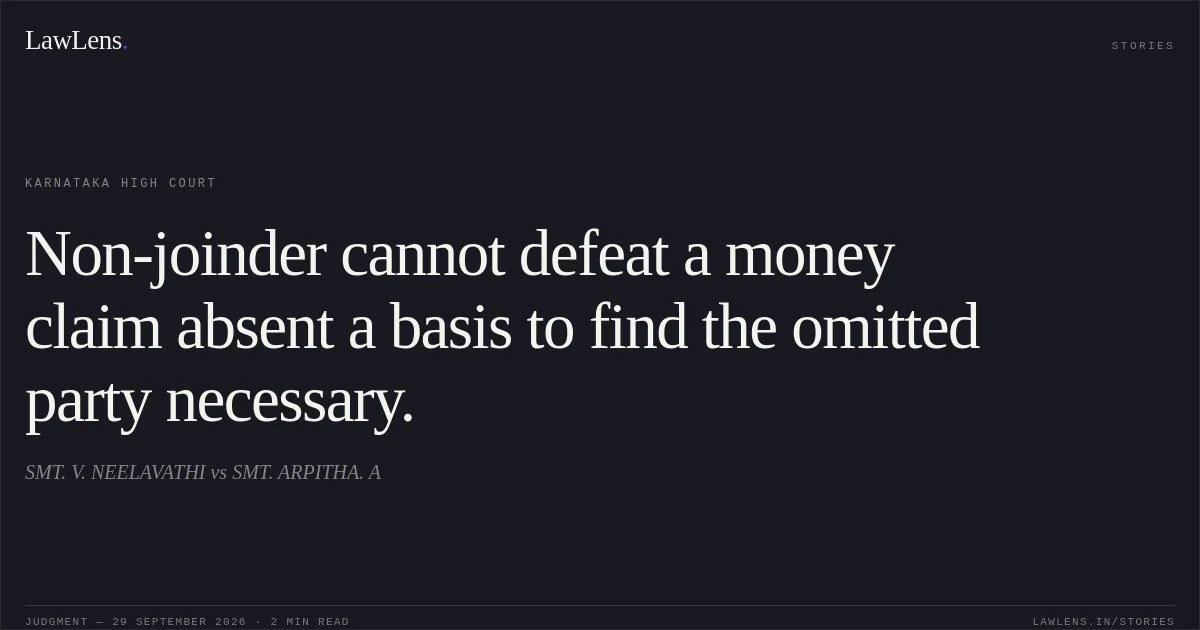
The original plaintiff sued the respondent for recovery of ₹10,00,000, pleading that he had advanced the loan to her.
Source reference: p.4–5, 7The trial court, after reserving the matter for judgment, observed that the respondent’s husband, Yohith Kumar, was the borrower and a necessary party.
Source reference: p.4–5, 7It ultimately dismissed the suit for non-joinder when the plaintiff did not implead him.
Source reference: p.4–5, 7The plaintiff’s legal representatives appealed, challenging the dismissal and the procedure followed by the trial court.
Source reference: p.1, 5–6Issues
Whether the trial court was justified in dismissing the suit for non-joinder of the respondent’s husband, when the plaint alleged that the loan was advanced to the respondent
Source reference: p.6–9Whether the trial court’s handling of the case—including raising the non-joinder issue after reserving the matter for judgment and without following the procedure contemplated by law—warranted setting aside the dismissal
Source reference: p.7–10Law Applied
The appeal was brought under Section 96 read with Order XLI Rule 1 of the Code of Civil Procedure, 1908 (CPC), which provides for a first appeal from an original decree.
Source reference: p.11The Court also invoked Section 151 CPC to direct refund of the appeal court fee.
Source reference: p.11It held that a court must follow the applicable CPC procedure and principles of natural justice before treating a person as a necessary party and dismissing a suit for non-joinder; the judgment cited no precedent or specific CPC provision governing non-joinder.
Source reference: no citationReasoning
The plaint alleged a transaction between the plaintiff and the respondent, not the respondent’s husband.
Source reference: p.6–8The trial court nevertheless assumed, without a stated evidentiary basis, that the husband had borrowed the money and was a necessary party.
Source reference: p.6–8The High Court further found that the trial court raised the issue after reserving the case for judgment and did not follow a proper process for determining it, such as considering the issue through the appropriate procedure and framing an issue during trial.
Source reference: p.8–10These steps were unjustified and contrary to procedural fairness, making dismissal for non-joinder unsustainable.
Source reference: p.8–10Holding
The High Court allowed the appeal, set aside the order dated 30 June 2026 dismissing the suit, and remanded the matter for consideration on the merits.
It directed the parties to appear before the trial court on 5 October 2026, without further notice, and ordered the suit to be disposed of within four months from that date.
Source reference: p.11The Registry was directed to refund the appeal court fee to the appellants upon proper identification.
Source reference: p.10–11Acts & Sections Cited
2 provisions across 1 statute referred to in this judgment. Each provision opens on LawLens.
Code of Civil Procedure, 19082
Original Court PDF
SMT. V. NEELAVATHIvsSMT. ARPITHA. A
Click to open original judgment
Original judgment, available to read, download and summarize on LawLens.in