Facts
The petitioner, Rizwana Akhtar, claimed to be the wife of Abdul Qudus, a deceased employee of the Postal Department. Abdul Qudus retired from service on 28 February 2006 and died on 29 November 2009. The petitioner sought family pension, but the respondents denied the claim on the ground that the deceased had not declared her as his wife in Form-3/7 or nominated her for family pension.
Source reference: p.2; para. 1The petitioner’s Original Application before the Central Administrative Tribunal, Patna Bench, in O.A. No. 50/394/2016 was dismissed on 16 July 2019 on that basis. She relied on a departmental letter dated 3 April 2014 indicating that her claim was under enquiry and would be considered after receipt of the enquiry report. Before the High Court, the respondents did not object to consideration of the claim, subject to verification of whether the petitioner was legally married to the deceased employee.
Source reference: p.2; para. 1; p.4; para. 4; p.4–5; paras. 4–5Issues
Whether the deceased employee’s failure to declare or nominate the petitioner as his wife in Form-3/7 disentitled her from claiming family pension under the applicable pension rules.
Source reference: p.2–4; paras. 1–3Whether the petitioner’s claim for family pension should be considered after an enquiry into and production of proof of her status as the legal wife of the deceased employee.
Source reference: p.4–5; paras. 4–6Law Applied
The Court applied Rule 54 of the Central Civil Services (Pension) Rules, particularly Rule 54(14)(b)(i), which defines “family” to include the wife of a male Government servant, and Rule 54(8)(ii), under which family pension becomes payable to the widow or widower of a deceased Government servant, failing which to an eligible child.
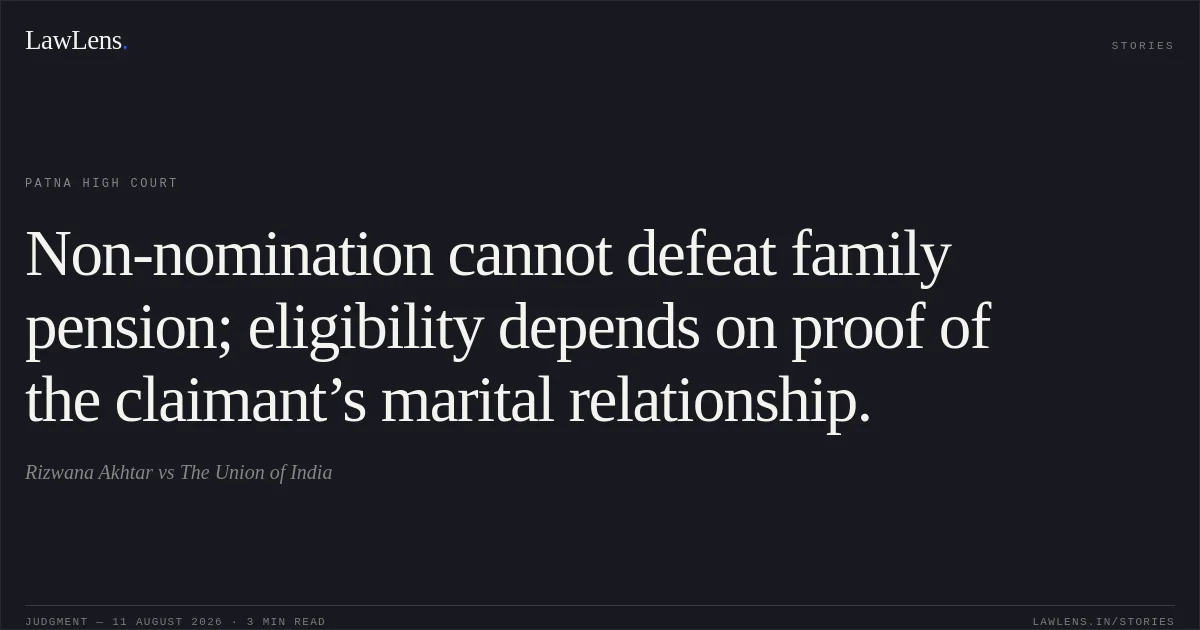
Source reference: p.2–3; para. 2Relying on G.L. Bhatia v. Union of India & Anr., (1999) 5 SCC 237, the Court held that where entitlement is governed by statutory pension provisions, an individual nomination contrary to those provisions cannot defeat the statutory right to family pension; the absence of nomination, or even separate residence without divorce, does not by itself disqualify the spouse.
Source reference: p.2–4; paras. 2–3Reasoning
The Tribunal had treated the omission of the petitioner’s name from Form-3/7 as conclusive against her claim. The High Court found that this approach was inconsistent with the statutory scheme and the principle in G.L. Bhatia, since family pension is determined by the applicable rules and not solely by the deceased employee’s nomination.
Source reference: p.2–4; paras. 1–3However, the Court did not conclusively determine that the petitioner was the deceased employee’s legal wife. In view of the respondents’ request for verification and the petitioner’s undertaking to produce documentary proof, the Court considered it appropriate to remit the matter for a fresh administrative determination by the Chief Postmaster General.
Source reference: p.4–5; paras. 4–6Holding
The High Court modified the CAT’s order dated 16 July 2019 and granted the petitioner liberty to submit, within four weeks, an appropriate representation accompanied by legal and documentary proof establishing that she was the deceased employee’s wife.
The Chief Postmaster General was directed to consider the representation in accordance with law, conduct the necessary enquiry, and pass a speaking and reasoned order within six weeks thereafter. The writ petition was accordingly disposed of, without granting immediate family pension but preserving the petitioner’s right to have her entitlement duly adjudicated.
Source reference: p.5; paras. 6–7Original Court PDF
Rizwana AkhtarvsThe Union of India
Click to open original judgment
Original judgment, available to read, download and summarize on LawLens.in