Facts
The petitioner (Official Assignee of a de-registered Co-operative Oil Industry) challenged orders passed by the Controlling Authority and the Appellate Authority (Industrial Court, Latur) under the Payment of Gratuity Act, 1972
Source reference: p. 5-6The respondents are former employees whose services were retrenched.
Source reference: p. 6After a considerable delay (approximately 30-31 years), the employees filed applications claiming they had not received the full amount of gratuity due to them
Source reference: p. 6, 8The petitioner appeared before the Controlling Authority but failed to file a reply, leading to ex-parte orders in favor of the employees
Source reference: p. 6Effectively, the petitioner argued that the claims were time-barred and that payments had already been made at the time of retrenchment, though no concrete documentary evidence (vouchers) was produced to prove such payments
Source reference: p. 7, 10Issues
1. Whether the applications for gratuity filed by the respondents were barred by limitation given the delay of over 30 years.
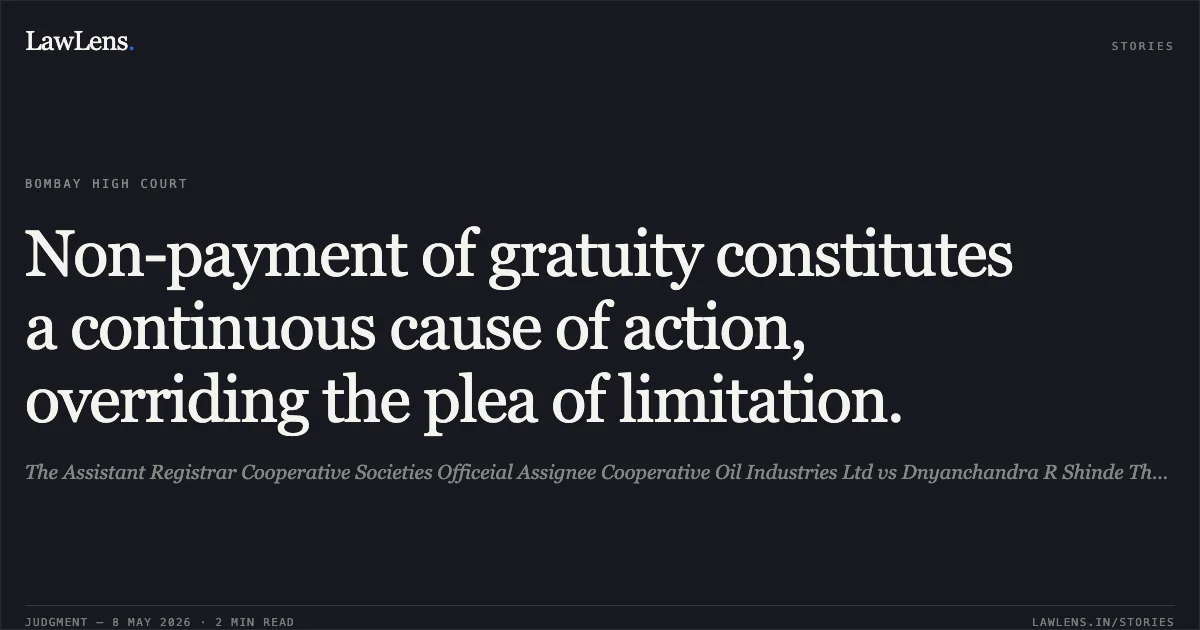
Source reference: p. 7, 92. Whether the non-payment or under-payment of gratuity constitutes a continuous cause of action.
Source reference: p. 93. Whether the matters should be remanded to the Controlling Authority to allow the petitioner to produce evidence of payment.
Source reference: p. 7, 10Law Applied
The Court applied the provisions of the Payment of Gratuity Act, 1972, characterizing it as "welfare legislation" intended to protect employees' rights
Source reference: p. 10Regarding limitation, the Court relied on the principle that the right to receive gratuity is a statutory right, and its non-payment constitutes a "continuous cause of action"
Source reference: p. 9State Bank of India, Goa v. Laxmikant Vithal Palekar & ors. (2010)
Source reference: p. 7-8Shivlingappa v. Management of Minerva Mills (2001)
Source reference: p. 7-8Reasoning
The Court rejected the petitioner’s argument on limitation, reasoning that since gratuity is a fundamental right of an employee, the failure of an employer to discharge this liability creates a subsisting and continuous cause of action
Source reference: p. 9The Court noted that despite having the opportunity to contest the matter before the Controlling Authority, the petitioner failed to file a reply or present evidence such as payment vouchers or account extracts that clearly proved the gratuity was paid
Source reference: p. 6, 10The Court observed that the respondents are now senior citizens (aged 70–80 years) and the petitioner’s claim of prior payment was not fortified by any document
Source reference: p. 9, 10Consequently, the Court found no merit in remanding the case, as it would only cause further hardship to the retired employees without a "certain" evidentiary basis from the petitioner
Source reference: p. 10Holding
The Court held that the claims were not time-barred due to the nature of the "continuous cause of action"
The High Court dismissed all the Writ Petitions, upholding the orders of the Controlling and Appellate Authorities.
Source reference: p. 11The respondents-employees were expressly permitted to withdraw the amounts deposited by the petitioner in the Court
Source reference: p. 11No relief of remand was granted
Source reference: p. 10Acts & Sections Cited
1 provisions across 1 statute referred to in this judgment. Linked provisions open on LawLens.
PAYMENT OF GRATUITY ACT, 19721
Original Court PDF
The Assistant Registrar Cooperative Societies Officeial Assignee Cooperative Oil Industries LtdvsDnyanchandra R Shinde Through Lrs Satyabhama Dnyanchandra Shinde
Click to open original judgment
Original judgment, available to read, download and summarize on LawLens.in