Facts
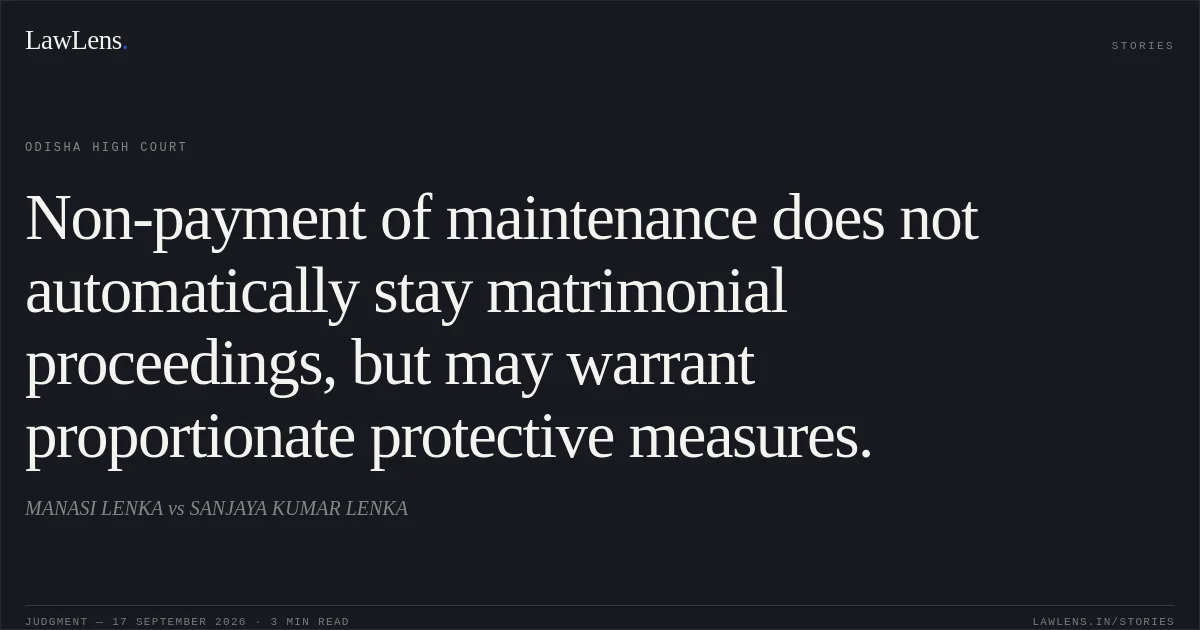
The petitioner-wife challenged the order dated 19 August 2026 by which the Family Court, Bhubaneswar rejected her application seeking stay of further proceedings in C.P. No. 23 of 2019, a divorce proceeding instituted by the respondent-husband under Section 13(1) of the Hindu Marriage Act, 1955.
Source reference: p.2, para. 1She sought the stay on the ground that the husband had failed to comply with interim and final maintenance orders passed in her separate proceeding under Section 125 Cr.P.C., being Cr.P. No. 210 of 2018.
Source reference: p.2, para. 1The maintenance proceeding was finally decided on 20 April 2026.
Source reference: p.3, para. 5During its pendency, the wife initiated five execution proceedings for recovery of interim maintenance arrears; one resulted in payment of Rs.1,87,000, while the status of the remaining proceedings was disputed.
Source reference: p.4, para. 6; p.5, para. 7The divorce proceeding was at the stage of arguments when the wife sought its stay until payment of the arrears.
Source reference: p.5, para. 8The husband contended that the interim maintenance arrears had been paid, that the final maintenance liability would be discharged shortly, and that non-payment in the separate proceeding had no bearing on the divorce proceeding.
Source reference: p.7, paras. 11.1–11.2Issues
Whether the Family Court’s order rejecting the wife’s application for stay suffered from jurisdictional error, material irregularity, perversity, or failure to exercise judicial discretion warranting interference under Articles 226 and 227 of the Constitution.
Source reference: p.8, para. 12(i)Whether a matrimonial proceeding under Section 13(1) of the Hindu Marriage Act can be stayed until recovery of arrears payable under interim and final maintenance orders passed in a separate proceeding under Section 125 Cr.P.C.
Source reference: p.8, para. 12(ii)Whether, notwithstanding the availability of execution remedies, the Family Court ought to have issued protective or case-management directions, including expeditious determination of the arrears and disposal of the execution proceedings, before permitting the divorce proceeding to reach final disposal.
Source reference: p.8, para. 12(iii)Law Applied
The Court applied Sections 18(2) and 18 of the Family Courts Act, 1984, Section 128 Cr.P.C., and the enforcement principles explained in Rajnesh v. Neha, (2021) 2 SCC 324, under which maintenance orders may be enforced through the applicable statutory procedures and, where appropriate, as money decrees under the CPC.
Source reference: pp.9–11, para. 14; p.11, para. 15It noted that wilful non-payment may, in an appropriate case, justify procedural measures such as striking off the defaulting party’s defence, as recognised in Kaushalya v. Mukesh Jain, (2020) 17 SCC 822, and that the inherent powers of the Family Court may be invoked to prevent abuse of process, as discussed in Mahesh v. Roopa, 2017 SCC OnLine Ker 17677.
Source reference: pp.10–11, para. 14; pp.12–14, paras. 17–18However, those authorities do not establish an automatic rule that every matrimonial proceeding must be stayed upon non-payment of maintenance; any procedural restraint must be based on wilful and contumacious default and must be proportionate.
Source reference: p.15, para. 19; p.16, para. 21The Court also relied on Rahul S. Shah v. Jinendra Kumar Gandhi, (2021) 6 SCC 418, emphasising expeditious disposal of execution proceedings.
Source reference: p.18, para. 26Reasoning
The Court held that the wife had an independent statutory remedy to enforce the maintenance orders through execution proceedings under Section 128 Cr.P.C. and the Family Courts Act.
Source reference: p.11, para. 15Accordingly, the alleged non-payment of maintenance did not automatically require the divorce proceeding to be stayed, particularly because the maintenance orders arose from a separate proceeding and the husband’s alleged default, its quantum, and the status of the execution cases were disputed.
Source reference: pp.14–16, paras. 18–21Nevertheless, the existence of an execution remedy did not prevent the Family Court from considering whether the default was wilful and contumacious or whether a proportionate protective direction was necessary to prevent the wife’s right to maintenance from becoming illusory.
Source reference: p.15, para. 20; p.16, para. 21The appropriate course was therefore to verify the actual arrears and the status of the execution proceedings, expedite recovery in accordance with law, and consider suitable procedural safeguards rather than impose an automatic stay.
Source reference: pp.16–18, paras. 23–26Holding
The Court held that non-compliance with interim or final maintenance orders passed in a separate Section 125 Cr.P.C. proceeding is not an automatic or inflexible ground for staying a pending divorce proceeding under Section 13(1) of the Hindu Marriage Act.
The writ petition was disposed of without costs.
Source reference: pp.16–18, paras. 23–27The Family Court was directed to verify the status of the execution proceedings and the amount outstanding under the interim and final maintenance orders, dispose of any pending execution proceedings expeditiously, and consider whether an appropriate protective direction was warranted in the divorce proceeding in light of the nature and extent of any wilful default.
Source reference: pp.16–18, paras. 23–27Acts & Sections Cited
13 provisions across 5 statutes referred to in this judgment. Each provision opens on LawLens.
Code of Criminal Procedure, 19732
Hindu Marriage Act, 19552
Family Courts Act, 19842
Code of Civil Procedure, 19086
Protection of Women from Domestic Violence Act, 20051
Original Court PDF
MANASI LENKAvsSANJAYA KUMAR LENKA
Click to open original judgment
Original judgment, available to read, download and summarize on LawLens.in