Facts
Respondent No.2, the landlord/managing partner of SSR Royale Developers, entered into a lease deed dated 29 May 2023 and a connected maintenance agreement with petitioner No.4, M/s Kids Clinic India Ltd., for operating a clinic in the leased premises.
Source reference: paras. 3, 7; pp. 4–9The maintenance agreement contained an arbitration clause.
Source reference: para. 7; pp. 8–9Rent was paid until February 2026, but rent for March to May 2026, amounting to approximately ₹11,70,858, allegedly remained unpaid after a dispute concerning transfer of the electricity meter/RR number.
Source reference: para. 8; pp. 9–10The landlord approached the police, alleging cheating, criminal breach of trust, criminal intimidation, insult, conspiracy and related offences.
Source reference: paras. 1, 3; pp. 3–5Crime No.358/2026 was registered under Sections 316(2), 318(4), 351(2), 352, 61(1), 319(2) read with Section 3(5) of the Bharatiya Nyaya Sanhita, 2023.
Source reference: paras. 1, 3; pp. 3–5The petitioners invoked the High Court’s inherent jurisdiction under Section 482 CrPC/Section 528 BNSS seeking quashing of the criminal proceedings.
Source reference: no citationIssues
1. Whether a landlord–tenant dispute concerning non-payment of three months’ rent, arising during the performance of an admitted lease and maintenance agreement, disclosed the ingredients of cheating, criminal breach of trust or other alleged offences under the BNS.
Source reference: paras. 8–15; pp. 9–162. Whether continuation of the criminal investigation, when the complainant’s grievance was essentially recovery of contractual dues and the agreements provided civil/arbitral remedies, amounted to abuse of the process of law warranting exercise of inherent jurisdiction.
Source reference: paras. 14–16, 20–22; pp. 14–16, 32–34Law Applied
The Court applied the principle that mere breach of contract or non-payment of money does not constitute cheating unless fraudulent or dishonest intention existed at the inception of the transaction, relying on G. Saminathan v. State, Hridaya Ranjan Prasad Verma v. State of Bihar, Dalip Kaur v. Jagnar Singh and Lalit Chaturvedi v. State of U.P.
Source reference: paras. 16.1, 16.3, 17, 19; pp. 16–32Criminal breach of trust requires entrustment or dominion over property followed by dishonest misappropriation or conversion; a contractual debt or unpaid rent does not, by itself, amount to entrusted property.
Source reference: paras. 12, 16.1, 16.3; pp. 13–14, 16–19The Court also relied on Delhi Race Club (1940) Ltd. v. State of U.P. for the distinction between cheating and criminal breach of trust, and on Indian Oil Corporation v. NEPC India Ltd. for the rule that criminal proceedings cannot be used as pressure for recovery of civil or commercial dues.
Source reference: paras. 16.1, 16.3; pp. 21–25Under the inherent jurisdiction preserved by Section 482 CrPC/Section 528 BNSS, criminal proceedings may be quashed where the allegations, even if accepted in their entirety, do not disclose a criminal offence or where continuation would constitute abuse of process.
Source reference: paras. 14–15, 20–22; pp. 14–16, 32–34Reasoning
The Court found that the petitioners entered the premises under a formally executed lease and that the landlord–tenant relationship, as well as payment of rent for nearly three years, was admitted.
Source reference: paras. 7, 10–11; pp. 6–13The complaint did not allege that the petitioners possessed a dishonest or fraudulent intention when the lease was executed in May 2023; subsequent non-payment of rent could not retrospectively establish cheating.
Source reference: para. 11; pp. 13–14Nor did the complaint identify any property entrusted to the petitioners and dishonestly misappropriated by them; the alleged unpaid rent was merely a contractual debt.
Source reference: para. 12; pp. 13–14The substance of the complaint was therefore recovery of ₹11,70,858 arising from a contractual dispute, for which civil remedies and the agreed arbitration mechanism were available.
Source reference: paras. 7–9, 13–15; pp. 8–16The Court held that the police could not be converted into a forum for enforcing private contractual obligations or recovering rent, and that giving the dispute a criminal colour constituted abuse of process.
Source reference: paras. 13–16, 20–21; pp. 14–16, 32–33Holding
The Court answered the issues in favour of the petitioners.
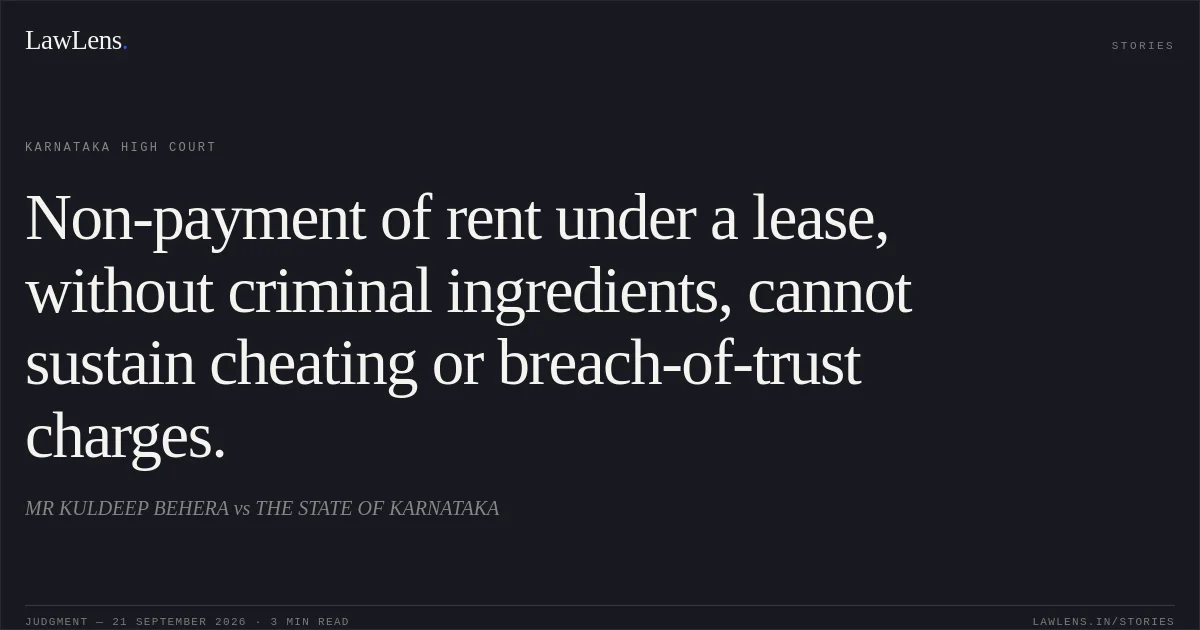
It held that the complaint disclosed, at most, a civil landlord–tenant dispute concerning unpaid rent and did not establish the foundational ingredients of cheating, criminal breach of trust or the other invoked offences.
Source reference: para. 22; p. 34The criminal petition was allowed, and the investigation in Crime No.358/2026 pending before the Additional Chief Judicial Magistrate, Bengaluru, was quashed.
Source reference: para. 22; p. 34Acts & Sections Cited
15 provisions across 5 statutes referred to in this judgment. Each provision opens on LawLens.
Code of Criminal Procedure, 19732
Bharatiya Nagarik Suraksha Sanhita, 20231
Bharatiya Nyaya Sanhita, 20237
Arbitration and Conciliation Act, 19961
Indian Penal Code, 18604
Original Court PDF
MR KULDEEP BEHERAvsTHE STATE OF KARNATAKA
Click to open original judgment
Original judgment, available to read, download and summarize on LawLens.in