Facts
The petitioners were office-bearers of the Darjeeling Tea Association (DTA), a registered non-profit association.
Source reference: paras. 2–3The opposite party, Kaushik Basu, had served as Secretary/Secretary General of the DTA since 2001 and was responsible for its day-to-day administration and documentation.
Source reference: paras. 2–3Following a change in the governing body in 2020, the DTA scrutinised its accounts and conducted a special audit, which allegedly disclosed unauthorised monetary benefits, unexplained cash vouchers, and misappropriation by the opposite party.
Source reference: paras. 3–5After the DTA accepted his resignation and sought possession of its office premises, its authorised representative lodged a police complaint against him.
Source reference: paras. 5–6Thereafter, the opposite party filed a complaint under Section 200 of the Code of Criminal Procedure, 1973 (CrPC), alleging that the petitioners had committed offences under Sections 406, 420, 408, 468, 120B and 34 of the Indian Penal Code, 1860 (IPC).
Source reference: paras. 5–6The Magistrate issued process against the petitioners under Section 406 IPC, while observing that offences under the other provisions were also prima facie disclosed.
Source reference: para. 6Issues
Whether the allegations in the complaint, even if accepted in their entirety, disclosed the essential ingredients of criminal breach of trust under Section 406 IPC against the petitioners?
Source reference: paras. 16–20Whether the complaint disclosed prima facie offences under Sections 420, 408, 468, 120B and 34 IPC so as to justify continuation of the criminal proceedings?
Source reference: paras. 17–18Whether continuation of the complaint proceedings amounted to an abuse of the process of law warranting exercise of the High Court’s inherent jurisdiction under Section 482 CrPC?
Source reference: paras. 13, 20–21Law Applied
The Court applied Section 406 IPC, read with Section 405 IPC, which requires entrustment of property or dominion over property and subsequent dishonest misappropriation, conversion, use, or disposal in violation of a legal direction or contract.
Source reference: para. 18Relying on Delhi Race Club (1940) Ltd. v. State of Uttar Pradesh, following S.W. Palanitkar v. State of Bihar, the Court reiterated these essential ingredients.
Source reference: para. 18It further relied on CBI, SPE, SIU(X), New Delhi v. Duncan Agro Industries Ltd. for the principle that the property involved in criminal breach of trust must belong to someone other than the accused, or the accused must hold it in trust for another.
Source reference: para. 19In relation to cheating under Section 420 IPC, the Court relied on State of Kerala v. A. Pareed Pillai and Hridaya Ranjan Prasad Verma v. State of Bihar, holding that dishonest or fraudulent intention must exist from the inception of the transaction and that a mere breach of contract or failure to fulfil a promise does not constitute cheating.
Source reference: para. 14The Court also referred to Satish Chandra Ratanlal Shah v. State of Gujarat and Pawan Kumar Sethia v. State of West Bengal against criminalising essentially civil or contractual disputes.
Source reference: para. 15While exercising jurisdiction under Section 482 CrPC, the Court observed that it should not conduct a mini-trial, but may intervene where the allegations and materials do not disclose any offence or where proceedings are manifestly motivated and constitute abuse of process.
Source reference: para. 13Reasoning
The complaint principally alleged that the DTA owed the opposite party amounts towards leave travel allowance, ex gratia payment, interest, and other employment-related benefits.
Source reference: paras. 12, 16The Court found that such claims arose from the alleged service relationship and monetary obligations of the association, not from any entrustment of property to the petitioners followed by dishonest misappropriation.
Source reference: paras. 16, 18–20Accordingly, the basic ingredients of Section 406 IPC were absent.
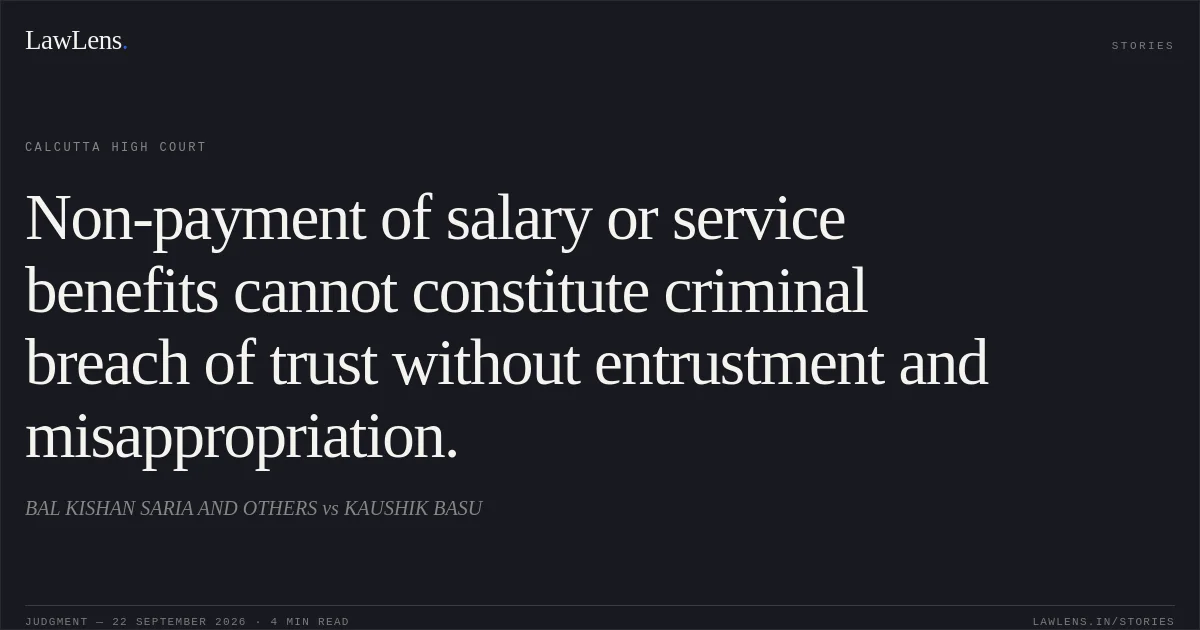
Source reference: paras. 16, 18–20The Court also noted that non-payment of salary or other contractual/service benefits cannot, by itself, constitute criminal breach of trust.
Source reference: para. 20The Magistrate’s order was internally inconsistent: although it referred to alleged offences under Sections 406, 420, 408, 468, 120B and 34 IPC, process was issued only under Section 406 IPC, indicating that sufficient prima facie material had not been identified for the remaining offences.
Source reference: para. 17The surrounding chronology—including the audit conducted by the DTA, the complaint lodged against the opposite party, the subsequent monetary claim, and the multiple criminal complaints filed against the petitioners—also supported the petitioners’ contention that the complaint was motivated by personal animosity and intended to exert pressure.
Source reference: para. 13The Court therefore held that any genuine monetary claim had to be pursued before a civil forum and that continuation of the criminal case would amount to abuse of process.
Source reference: para. 20Holding
The Court held that the complaint, taken at its highest, did not disclose the ingredients of criminal breach of trust under Section 406 IPC or the other alleged offences.
It further held that the dispute was essentially connected with alleged employment dues and was civil in nature, with no sufficient basis for attributing criminal intent to the petitioners.
Source reference: para. 20The revisional application was accordingly allowed, and Complaint Case No. 2064 of 2022 pending before the Judicial Magistrate, 9th Court, Alipore, South 24 Parganas, was quashed against all the petitioners.
Source reference: para. 21All connected applications were disposed of.
Source reference: para. 22Acts & Sections Cited
8 provisions across 2 statutes referred to in this judgment. Each provision opens on LawLens.
Indian Penal Code, 18607
Code of Criminal Procedure, 19731
Original Court PDF
BAL KISHAN SARIA AND OTHERSvsKAUSHIK BASU
Click to open original judgment
Original judgment, available to read, download and summarize on LawLens.in