Facts
The petitioners, high-ranking HR officials of Amalgam Steel Private Limited, sought to quash a criminal proceeding arising from a complaint by a former General Manager.
Source reference: p. 1The complainant alleged that following his voluntary resignation, the company paid him Rs. 14,37,204/- towards full and final settlement but withheld a balance of Rs. 2,50,220/-.
Source reference: p. 2A Magistrate took cognizance and issued summons under Sections 406, 417, and 34 of the Indian Penal Code (IPC).
Source reference: p. 2The petitioners contended that the dispute was purely civil and that non-payment of dues does not constitute a criminal offense.
Source reference: p. 2Issues
1. Whether the non-payment of the balance amount of a full and final settlement constitutes the offense of Criminal Breach of Trust under Section 406 of the IPC.
Source reference: para. 6-72. Whether the allegations make out a case of cheating under Section 417 of the IPC in the absence of evidence of fraudulent intent at the inception of the transaction.
Source reference: para. 8-10Law Applied
The Court primarily applied Section 406 (Punishment for criminal breach of trust) and Section 417 (Punishment for cheating) of the IPC.
Source reference: no citationRegarding Section 406, it relied on Ram Narain Popli v. CBI, establishing that "entrustment" and "dishonest misappropriation" are essential ingredients.
Source reference: para. 6For Section 417, the Court applied the principle from Uma Shankar Gopalika v. State of Bihar, which mandates that for an offense of cheating, deception must be played at the very inception of the transaction; a subsequent breach of contract does not suffice.
Source reference: para. 9It further noted the coordinate bench ruling in V.K. Mittal v. State of Jharkhand, holding that non-payment of salary alone does not amount to cheating or criminal breach of trust.
Source reference: para. 4Reasoning
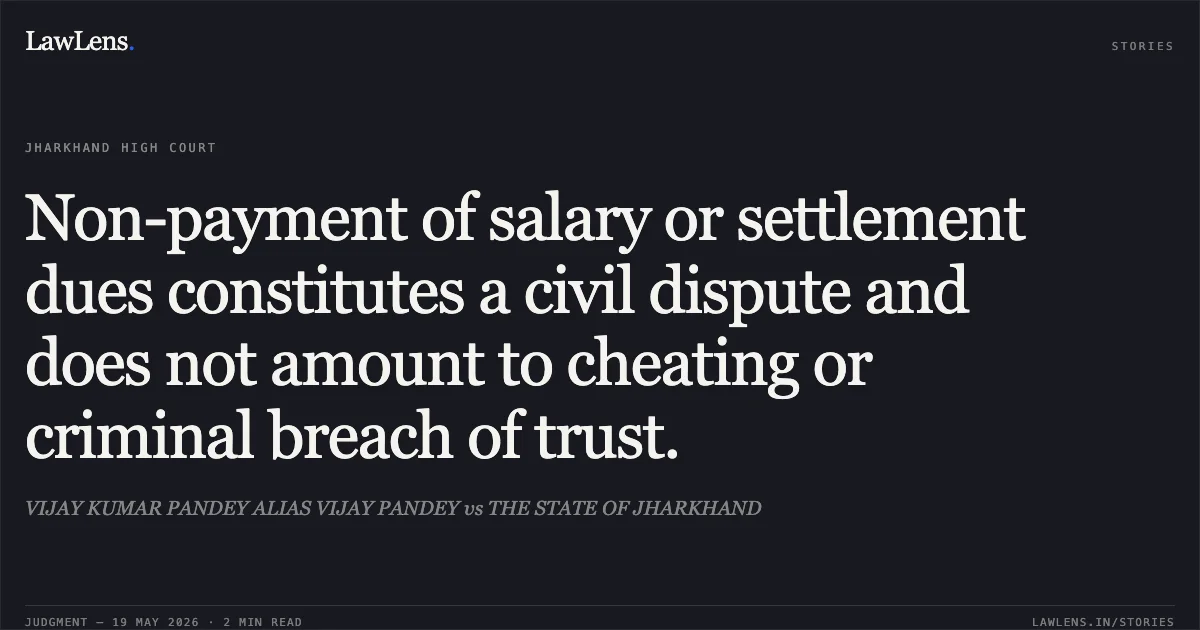
Regarding Section 406, the Court found no evidence of "entrustment" of property by the complainant to the petitioners, nor any dishonest misappropriation, as the dispute concerned unpaid corporate dues.
Source reference: para. 7Regarding Section 417, the Court noted the absence of any allegation that the petitioners intended to deceive the complainant at the time he joined or worked for the company.
Source reference: para. 10The Court reasoned that the dispute was a "purely civil dispute" to which a "cloak of criminal case" had been given.
Source reference: para. 4Since the essential ingredients of the alleged offenses were missing even if the facts were taken at face value, the Court determined that continuing the proceedings would constitute an abuse of the process of law.
Source reference: para. 10Holding
The Court answered both issues in the negative, holding that a mere failure to pay balance settlement dues does not attract criminal liability under Sections 406 or 417 of the IPC.
The Court allowed the petition and quashed the entire criminal proceeding, including the cognizance order dated 16.08.2024 passed by the JMFC, Jamshedpur, in Complaint Case no. 379 of 2024.
Source reference: para. 11-12Acts & Sections Cited
5 provisions across 2 statutes referred to in this judgment. Each provision opens on LawLens.
Bharatiya Nagarik Suraksha Sanhita, 20231
Indian Penal Code, 18604
Original Court PDF
VIJAY KUMAR PANDEY ALIAS VIJAY PANDEYvsTHE STATE OF JHARKHAND
Click to open original judgment
Original judgment, available to read, download and summarize on LawLens.in