Facts
On 8 September 2014, Raj Kumar @amp; Randhir travelled with his brother, Durga Prasad, from Bahadurgarh to New Delhi.
Source reference: p.2The appellants claimed that the deceased had purchased a journey ticket for two persons and fell from a running train while it was approaching Sarai Rohilla Railway Station.
Source reference: p.2He was taken to Hindu Rao Hospital, where he died from his injuries.
Source reference: p.2The Railway Claims Tribunal dismissed the claim, holding that the deceased was neither a bona fide passenger nor the victim of an “untoward incident,” principally because no ticket was recovered and railway records described him variously as a trespasser, a person attempting to board the moving train, or a person who had jumped from it.
Source reference: pp.2–3The appeal was filed under Section 23 of the Railway Claims Tribunal Act, 1987.
Source reference: p.1Issues
Whether the deceased was a bona fide passenger despite the non-recovery of a valid journey ticket
Source reference: p.3, para. 6Whether the deceased’s injuries and subsequent death resulted from an “untoward incident” within the meaning of Sections 123(c) and 124-A of the Railways Act, 1989
Source reference: p.3, para. 7Whether the railway authorities established any statutory exception under Section 124-A so as to avoid liability
Source reference: p.4, para. 10Law Applied
The Court applied Section 23 of the Railway Claims Tribunal Act, 1987, governing appeals to the High Court, and Sections 123(c) and 124-A of the Railways Act, 1989, under which an accidental fall from a train constitutes an “untoward incident,” subject to the statutory exceptions in Section 124-A.
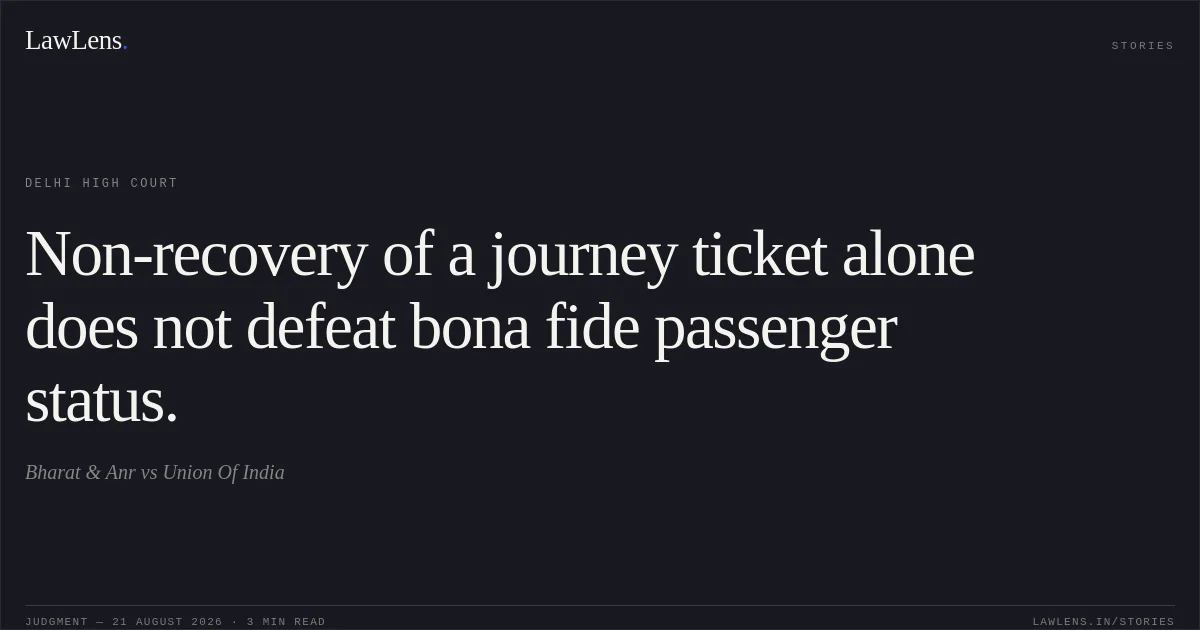
Source reference: p.3, para. 6It held that mere non-recovery of a ticket is not conclusive proof that the deceased was not a bona fide passenger.
Source reference: p.3, para. 6Relying on Union of India v. Rina Devi, (2019) 3 SCC 572, and Lata v. Union of India, 2026 SCC OnLine SC 1350, the Court reiterated that the claimant may discharge the initial burden of proving bona fide passenger status through affidavit or testimony, after which the burden shifts to the Railways to disprove it.
Source reference: p.3, para. 6The Railways must also establish, through cogent evidence, that the occurrence fell within one of the statutory exceptions to Section 124-A.
Source reference: p.4, para. 10Reasoning
The Court found that AW-2, the deceased’s brother and co-passenger, specifically deposed that the deceased had purchased a valid ticket for two persons and kept it in his shirt pocket.
Source reference: p.3, para. 6Although his conduct and relationship with the deceased warranted caution in assessing his testimony, they did not justify rejecting his account altogether; his evidence discharged the initial burden of establishing bona fide passenger status.
Source reference: p.3, para. 6The contemporaneous DD entries, Station Master’s memo, MLC, and death report consistently showed that the deceased suffered injuries in a railway accident and was attended to by the Guard.
Source reference: p.3, para. 8The conflicting descriptions in the Guard’s records—“jumped from the running train,” “trespasser,” and “trying to board the running train”—did not conclusively prove intentional jumping or trespass.
Source reference: pp.3–4, paras. 9–10The Guard was not examined, his initial memo was prepared in haste, and there was no independent eyewitness establishing a statutory exception or deliberate misconduct by the deceased.
Source reference: pp.3–4, paras. 9–10On the cumulative evidence, the Court treated the occurrence as an accidental fall from the train amounting to an “untoward incident” under the Act.
Source reference: p.4, para. 11Holding
The Court answered both principal issues in favour of the appellants.
It held that the deceased was sufficiently shown to be a bona fide passenger and that he sustained injuries in an accidental fall constituting an “untoward incident” under Sections 123(c) and 124-A of the Railways Act, 1989.
Source reference: p.4, para. 11The Tribunal’s judgment dated 20 July 2016 was set aside, and the matter was remanded to the Tribunal to assess the compensation payable in accordance with law and direct its disbursement within two months of receiving the order.
Source reference: p.5, paras. 12–14The matter was directed to be listed before the Tribunal on 11 September 2026.
Source reference: p.5, paras. 12–14Acts & Sections Cited
2 provisions across 2 statutes referred to in this judgment. Each provision opens on LawLens.
Railway Claims Tribunal Act, 19871
Railways Act, 19891
Original Court PDF
Bharat & AnrvsUnion Of India
Click to open original judgment
Original judgment, available to read, download and summarize on LawLens.in