Facts
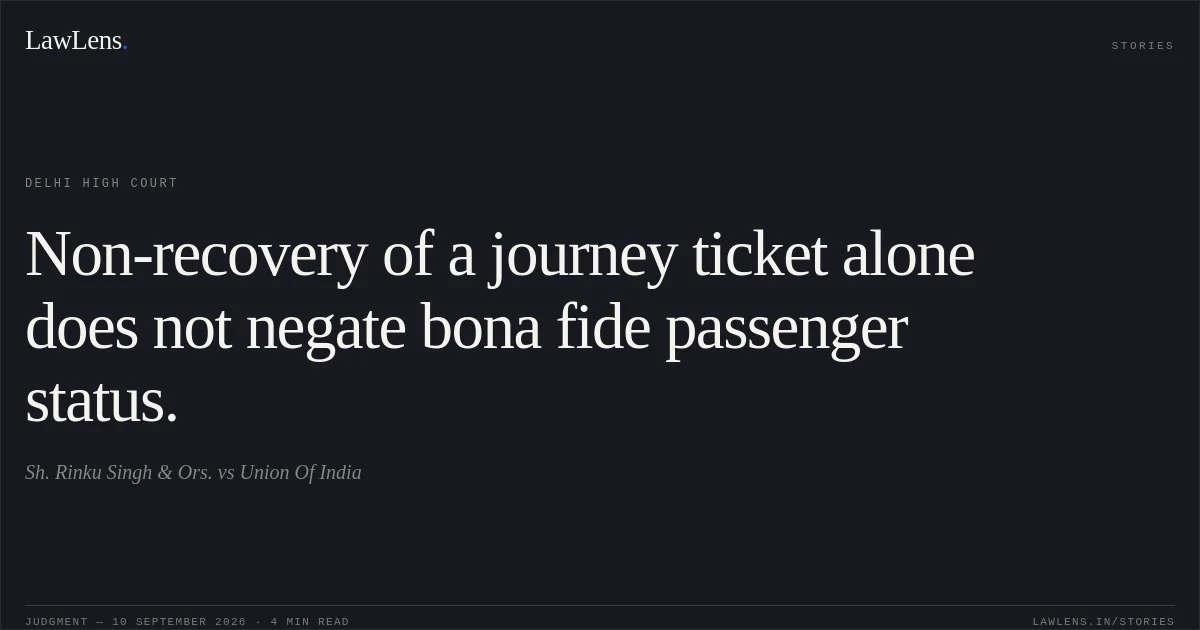
The appellants challenged the judgment dated 18 December 2024 of the Railway Claims Tribunal, Principal Bench, Delhi, in OA/II/DLI/240/2024, under Section 23 of the Railway Claims Tribunal Act, 1987.
Source reference: para. 1The deceased, Vikram Singh Chauhan, allegedly boarded Train No. 14825, Hisar–Jaipur Express, on 29 July 2023 to travel to Harsoli. He was stated to be travelling in an unreserved compartment and standing near the gate because of overcrowding. After the train passed Ajarka Railway Station, he allegedly lost his balance and fell from the moving train near KM 28/14–15, sustaining fatal injuries. His body was initially unidentified and was subsequently identified by his family through his clothes and footwear.
Source reference: para. 2The Tribunal rejected the claim, principally because no journey ticket was recovered and the claimant was not an eyewitness to the deceased’s purchase of the ticket or boarding of the train.
Source reference: paras. 3, 5The Railways relied primarily on the DRM report and did not examine any witness.
Source reference: para. 7Issues
Whether the deceased was a bona fide railway passenger despite the non-recovery of a journey ticket and the claimant’s lack of personal knowledge regarding the deceased’s purchase of the ticket or boarding of the train.
Source reference: paras. 5–7Whether the deceased’s death resulted from an “untoward incident” within the meaning of Section 123(c)(2) of the Railways Act, 1989, namely, an accidental fall from a moving train.
Source reference: paras. 8–11Whether the Tribunal’s rejection of the compensation claim was legally sustainable.
Source reference: paras. 11–13Law Applied
The Court applied Section 23 of the Railway Claims Tribunal Act, 1987, governing appeals from orders of the Tribunal, and Section 123(c)(2) of the Railways Act, 1989, concerning an “untoward incident”.
Source reference: paras. 1, 8Under Union of India v. Rina Devi, (2019) 3 SCC 572, mere non-recovery of a railway ticket does not by itself disprove bona fide passenger status; the claimant must first place relevant facts and circumstances on record, after which the burden shifts to the Railways to rebut that status.
Source reference: para. 5The Court also relied on Lata v. Union of India, 2026 SCC OnLine SC 1350, which reiterated that principle.
Source reference: para. 5Under Prempal Singh v. Union of India, 2018 SCC OnLine Del 9571, the nature or mutilation of injuries alone cannot establish that the deceased was crossing the railway track, since the possibility of a passenger falling from a moving train and being run over cannot be excluded.
Source reference: para. 9Jameela v. Union of India, (2010) 12 SCC 443, establishes that accidentally falling from the open door of a moving train may constitute an untoward incident; negligent or rash conduct of standing near an open door is not, without more, a “criminal act” excluding railway liability under Section 124-A of the Railways Act.
Source reference: para. 10Reasoning
The Court held that the appellants discharged the initial burden regarding bona fide passenger status by placing AW-1’s sworn assertion on record that the deceased had purchased a valid second-class general ticket, boarded Train No. 14825, and fell during the journey.
Source reference: para. 6The fact that AW-1 did not personally witness the ticket purchase or boarding was not decisive, particularly because the deceased was unavailable to testify.
Source reference: para. 6The burden consequently shifted to the Railways, but apart from the missing ticket, it produced no cogent rebuttal evidence and did not examine any supporting witness; reliance on the DRM report alone was insufficient.
Source reference: para. 7On the second issue, the Tribunal’s inference that the deceased was first struck and then run over was based solely on the condition of the body and post-mortem findings.
Source reference: para. 11The Gateman merely reported finding the mutilated body, while the Station Master stated that no driver or guard had reported a run-over incident.
Source reference: para. 11In the absence of direct or cogent evidence disproving the appellants’ version, the possibility that the deceased accidentally fell from the crowded moving train and thereafter suffered fatal injuries could not be ruled out.
Source reference: paras. 9–11Such a fall was capable of constituting an untoward incident under the principles in Jameela.
Source reference: paras. 9–11Holding
The Court answered both principal issues in favour of the appellants.
It held that the deceased’s bona fide passenger status could not be rejected merely because the journey ticket was not recovered, and that the evidence did not exclude the possibility of his accidental fall from the moving train, amounting to an untoward incident.
Source reference: paras. 6–11The Tribunal’s judgment dated 18 December 2024 was set aside.
Source reference: para. 12The matter was remanded to the Tribunal to assess the compensation payable in accordance with law and to direct disbursement within two months of receipt of the High Court’s order.
Source reference: paras. 12–14The parties were directed to appear before the Tribunal on 30 September 2026.
Source reference: paras. 12–14Acts & Sections Cited
2 provisions across 2 statutes referred to in this judgment. Each provision opens on LawLens.
Railway Claims Tribunal Act, 19871
Railways Act, 19891
Original Court PDF
Sh. Rinku Singh & Ors.vsUnion Of India
Click to open original judgment
Original judgment, available to read, download and summarize on LawLens.in