Facts
On 29 April 2016, Rohit was allegedly travelling from Bijwasan to Gurgaon with his uncle, Saheb Singh.
Source reference: p. 3, para. 2Due to heavy rush, they boarded different compartments of the same train, and Rohit allegedly fell from the moving train after a sudden jerk at Bijwasan Railway Station, sustaining fatal injuries.
Source reference: p. 3, para. 2The journey tickets were stated to have been lost in the incident.
Source reference: p. 3, para. 2The Railway Claims Tribunal held that the incident constituted an “untoward incident” under the Railways Act, 1989, but dismissed the claim on the ground that Rohit was not a bona fide passenger.
Source reference: p. 3, para. 3The appellants challenged that finding under Section 23 of the Railway Claims Tribunal Act, 1987.
Source reference: p. 3, para. 1The High Court also condoned a delay of 728 days in filing the appeal, considering the appellants’ financial hardship and the beneficial nature of the legislation.
Source reference: pp. 1–2, paras. 1–7Issues
1. Whether the appellants had shown sufficient cause for condonation of the 728-day delay in filing the appeal.
Source reference: pp. 1–2, paras. 1–72. Whether the deceased was a bona fide passenger for the purposes of claiming statutory compensation, notwithstanding that no journey ticket was recovered or produced.
Source reference: p. 3, paras. 6–7; p. 4, para. 83. Whether the Tribunal’s dismissal of the claim application on the ground of absence of bona fide passenger status was sustainable.
Source reference: p. 3, para. 3; p. 5, paras. 9–11Law Applied
The Court applied Section 23 of the Railway Claims Tribunal Act, 1987, governing appeals against orders of the Tribunal, and the provisions of the Railways Act, 1989 concerning compensation for death arising from an “untoward incident”.
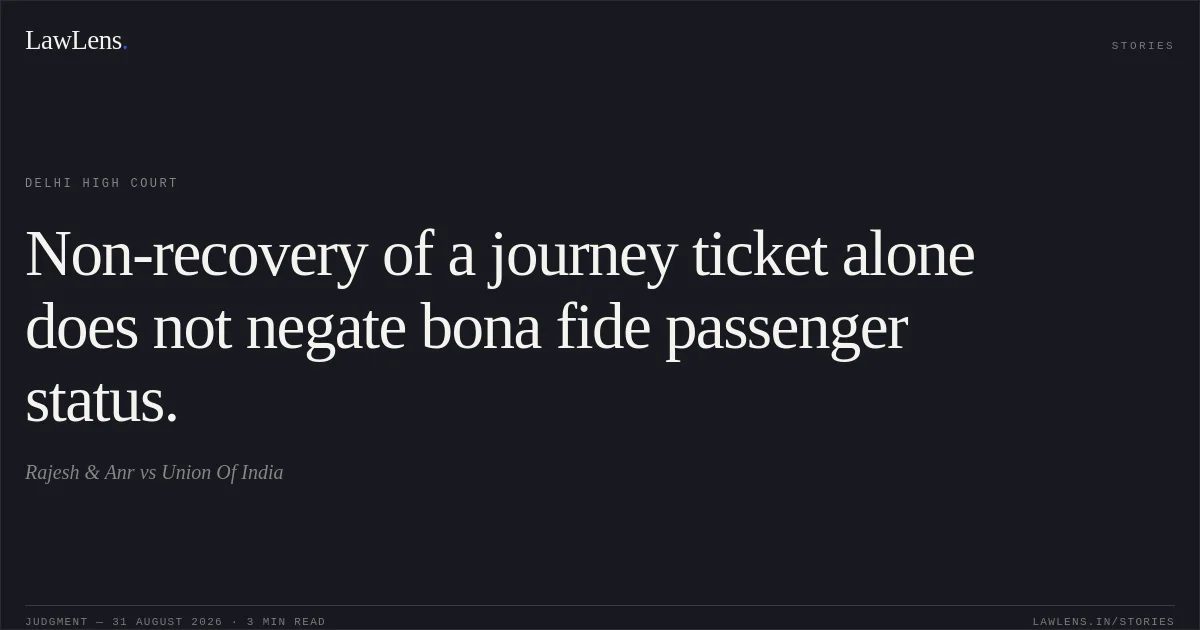
Source reference: p. 3, para. 1It relied on Union of India v. Rina Devi, (2019) 3 SCC 572, for the principle that mere non-recovery of a railway ticket is not conclusive proof that the deceased was not a bona fide passenger.
Source reference: p. 4, para. 8It further relied on Lata v. Union of India, 2026 SCC OnLine SC 1350, which clarified that the claimant’s initial burden may be discharged through affidavit evidence and that the absence of a recovered ticket does not, by itself, defeat bona fide passenger status.
Source reference: p. 4, para. 8The Court also adopted a liberal, justice-oriented approach to condonation of delay in matters arising from beneficial and social-welfare legislation, relying on Mohsina v. Union of India and Brijesh Kumar v. Union of India.
Source reference: p. 2, paras. 3–5Reasoning
The Court first found sufficient cause for the delay because the appellants were poor and illiterate and had been unable to obtain timely legal advice; the beneficial purpose of the railway compensation legislation supported a liberal approach.
Source reference: pp. 1–2, paras. 2–6On the merits, the Tribunal’s finding that the death resulted from an untoward incident had not been challenged by the Railways and had therefore attained finality.
Source reference: p. 4, para. 6The remaining question was whether Rohit was a bona fide passenger.
Source reference: no citationApplying Rina Devi and Lata, the Court held that the absence of a recovered ticket was not decisive.
Source reference: p. 4, para. 8Saheb Singh, who had accompanied Rohit, specifically testified that he had purchased two valid tickets and that they had boarded the train together; his evidence was not materially discredited in cross-examination.
Source reference: p. 5, para. 8The father’s testimony provided corroboration.
Source reference: p. 5, para. 8The Court also held that Saheb Singh’s continuation of the journey after the chain-pulling incident did not, by itself, make his testimony unnatural or unreliable, since he had been separated from Rohit in the crowded train and might not have immediately known what had occurred.
Source reference: p. 5, para. 9Accordingly, the oral evidence sufficiently established Rohit’s bona fide passenger status.
Source reference: p. 6, para. 10Holding
The High Court condoned the 728-day delay in filing the appeal.
It held that the deceased was a bona fide passenger notwithstanding the non-recovery of the journey ticket and consequently found the Tribunal’s dismissal unsustainable.
Source reference: pp. 5–6, paras. 10–11The impugned judgment was set aside, and the matter was remanded to the Railway Claims Tribunal to assess the compensation payable in accordance with law and direct its disbursement within two months of receiving the High Court’s order.
Source reference: p. 6, paras. 11–13The matter was directed to be listed before the Tribunal on 18 September 2026.
Source reference: p. 6, paras. 11–13Acts & Sections Cited
1 provisions across 1 statute referred to in this judgment. Each provision opens on LawLens.
Railway Claims Tribunal Act, 19871
Original Court PDF
Rajesh & AnrvsUnion Of India
Click to open original judgment
Original judgment, available to read, download and summarize on LawLens.in