Facts
On 23 May 2014, Amar Singh allegedly travelled from Palwal Railway Station towards Faridabad after purchasing a journey ticket. Due to heavy rush, he accidentally fell from a running passenger train near KM No. 148/18–20 between Palwal and Asawati Railway Stations and sustained fatal injuries.
Source reference: paras. 1–3; pp. 1–2His parents filed a claim before the Railway Claims Tribunal seeking compensation under the Railways Act, 1989. The Railways contested the claim, asserting that Amar Singh was not a bona fide passenger because no valid journey ticket was recovered and that he died while crossing the railway track. The Tribunal dismissed the claim on 7 February 2018. The claimants thereafter preferred the present appeal.
Source reference: paras. 1–3; pp. 1–2During the deceased’s personal search, a purse containing cash, a mobile phone, a diary and four old railway tickets was recovered, although the particular journey ticket was not found.
Source reference: paras. 1–3, 7; pp. 1–2The Tribunal relied upon a purported statement made during a DRM inquiry and the nature of the injuries to conclude that the deceased had been crossing the railway track rather than falling from a train.
Source reference: paras. 8–11; pp. 3–4Issues
Whether the non-recovery of the particular journey ticket, by itself, established that Amar Singh was not a bona fide passenger.
Source reference: paras. 7, 13–15; pp. 2, 5–6Whether the evidence established that Amar Singh’s death resulted from an “untoward incident”, namely, accidental falling from a passenger train under Section 123(c)(2) of the Railways Act, 1989.
Source reference: paras. 9–13; pp. 3–5Whether the appellants were entitled to statutory compensation under Section 124-A of the Railways Act, 1989, and, if so, what amount and interest were payable.
Source reference: paras. 12, 16–18; pp. 4, 6–7Law Applied
The Court applied Sections 123(c)(2) and 124-A of the Railways Act, 1989: accidental falling of a passenger from a train constitutes an “untoward incident”, attracting strict/no-fault liability, subject to the statutory exceptions such as suicide, attempted suicide, self-inflicted injury, criminal act, intoxication or insanity.
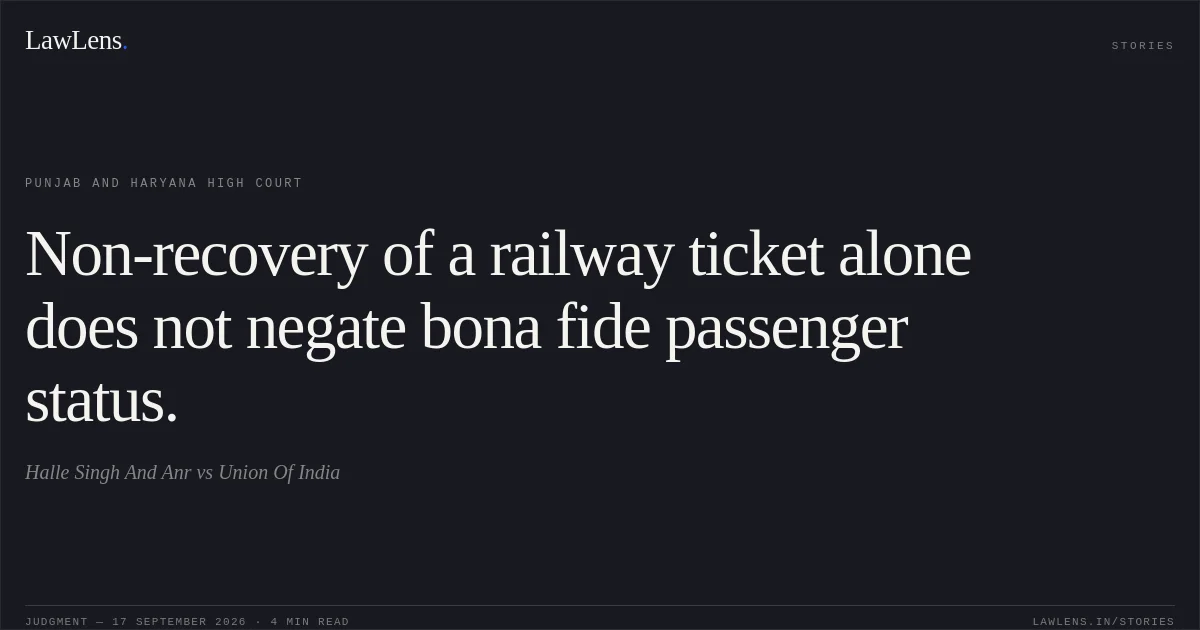
Source reference: para. 12; p. 4Relying on Union of India v. Rina Devi, (2019) 3 SCC 572, the Court held that mere absence or non-recovery of a ticket from the deceased does not negate bona fide passenger status; the claimant must initially furnish prima facie material, after which the burden shifts to the Railways to prove the contrary.
Source reference: para. 7; pp. 2–3The Court also relied on Union of India v. Prabhakaran Vijaya Kumar, (2008) 9 SCC 527, for a broad and beneficial interpretation of accidental falling under the Railways Act, and on Rajni and Another v. Union of India and Another, 2025 INSC 1201, which reiterated that a hyper-technical insistence on production of the ticket cannot defeat a legitimate compensation claim once prima facie evidence of travel is furnished.
Source reference: paras. 7, 12, 14; pp. 2–4, 6Reasoning
The Court held that the Tribunal had adopted an unsustainable and hyper-technical approach by treating the absence of the specific journey ticket as conclusive. The recovery of four old railway tickets from the deceased’s purse was a relevant circumstance supporting the claim that he travelled by train, while the loss of the particular ticket could reasonably have occurred during the accident.
Source reference: para. 7; p. 2The father’s sworn testimony supported the pleaded account, and the alleged contradictory statement recorded during the internal DRM inquiry was not properly proved and could not automatically displace his testimony.
Source reference: para. 8; p. 3Further, the DRM report’s conclusion that the deceased was crossing the railway track was inferential; there was no eyewitness evidence of trespassing or of the identity of a train that allegedly ran over him.
Source reference: para. 9; p. 3Conversely, the railway police records, death report and request for post-mortem recorded the cause of death as a fall from a train, and the injuries were consistent with a railway accident.
Source reference: paras. 10–11, 13; pp. 4–5Since the Railways failed to establish any statutory exception to no-fault liability, the Court concluded that the death fell within Section 123(c)(2) read with Section 124-A.
Source reference: paras. 12–16; pp. 4–6Holding
The appeal was allowed and the Tribunal’s order dated 7 February 2018 was set aside. The Court held that Amar Singh’s death resulted from an untoward incident within the meaning of Section 123(c)(2) of the Railways Act, 1989, and that his parents were entitled to compensation under Section 124-A.
The Railway was directed to pay Rs. 4,00,000 with interest at 9% per annum from the date of filing of the claim petition until the judgment, or Rs. 8,00,000, whichever was higher. The amount was to be deposited with the Railway Claims Tribunal within eight weeks of receiving a certified copy of the judgment. Any delay thereafter would attract further interest at 6% per annum until payment, and the amount was to be disbursed to the appellants after due identification and verification.
Source reference: para. 18; pp. 6–7Acts & Sections Cited
1 provisions across 1 statute referred to in this judgment. Each provision opens on LawLens.
Railways Act, 19891
Original Court PDF
Halle Singh And AnrvsUnion Of India
Click to open original judgment
Original judgment, available to read, download and summarize on LawLens.in