Facts
On 22 July 2011, Shree Krishan, the deceased, allegedly travelled from New Delhi Railway Station to Kanpur Central by Gorakhdham Express after purchasing a journey ticket. Due to overcrowding, he was standing near the compartment entrance and allegedly fell from the moving train near Gangraul Railway Station because of a sudden jerk and jostling of passengers. His body was subsequently found near the railway track.
Source reference: p.2His legal representatives filed a claim before the Railway Claims Tribunal. The Tribunal rejected the claim, principally holding that the deceased’s status as a bona fide passenger and the alleged accidental fall from Gorakhdham Express had not been established.
Source reference: pp.2–3It relied on the non-recovery of the ticket, non-examination of the person accompanying the deceased, the timing discrepancy in the eyewitness’s testimony, and the deceased’s connection with Gangraul Railway Station.
Source reference: pp.2–3The appellants challenged that decision under Section 23 of the Railway Claims Tribunal Act, 1987.
Source reference: p.1Issues
1. Whether the deceased was a bona fide passenger despite the non-recovery of the journey ticket.
Source reference: pp.3–4, para. 62. Whether the deceased’s death resulted from an accidental fall from Gorakhdham Express, constituting an “untoward incident” under the Railways Act, 1989.
Source reference: pp.5–6, paras. 8–13Law Applied
The Court exercised appellate jurisdiction under Section 23 of the Railway Claims Tribunal Act, 1987.
Source reference: p.1Under Sections 123(c) and 124-A of the Railways Act, 1989, an accidental fall from a train may constitute an “untoward incident” giving rise to statutory compensation.
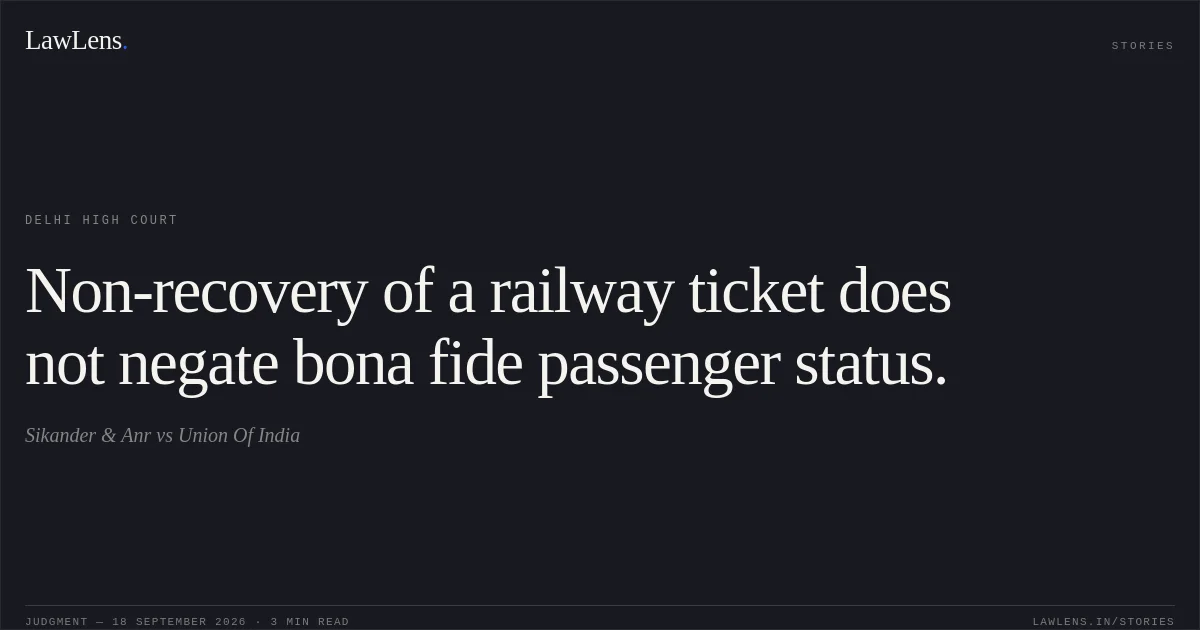
Source reference: p.6Relying on Union of India v. Rina Devi, (2019) 3 SCC 572, and Lata v. Union of India, 2026 SCC OnLine SC 1350, the Court held that mere absence or non-recovery of a ticket does not, by itself, disprove bona fide passenger status; once the claimant establishes the relevant facts and surrounding circumstances, the burden shifts to the Railways to rebut the claim.
Source reference: pp.3–4, paras. 6–7The Court also relied on Sh. Surendra Prasad Verma & Anr. v. Union of India, 2014 SCC OnLine Del 2917, for the principle that delayed discovery of a dead body, by itself, does not disprove an accidental fall from a train.
Source reference: p.7, para. 12Reasoning
The Court found that the appellants’ case regarding the deceased’s journey was consistent from the outset: AW-1 stated that the deceased had left for Kanpur and purchased a ticket, while the loss of the ticket was attributed to the accident.
Source reference: p.4, para. 6Applying Rina Devi and Lata, the Court held that non-recovery of the ticket could not be treated as conclusive, particularly since the Railways produced no evidence rebutting the appellants’ account.
Source reference: p.4, para. 7Regarding the manner of death, the Court considered AW-2’s evidence that he had seen a person fall from an express train travelling from the Delhi side and had informed railway staff.
Source reference: p.5, para. 8The discrepancy between the eyewitness’s reference to “midnight” and the train’s recorded timing of 22:45–22:46 hours was treated as insignificant in the circumstances of a nighttime occurrence.
Source reference: p.5, para. 9The Station Master’s memo, which stated that the death “may be due to fall from some train,” was not treated as conclusive but was considered along with the other evidence.
Source reference: p.5, para. 10The deceased’s bicycle being kept at the railway gate did not establish that he was trespassing on the track or had been run over by another train; there was no evidence identifying another train or showing that the deceased was walking on the track, whereas AW-2 provided affirmative evidence of a fall from a train.
Source reference: p.6, para. 11The delayed discovery of the body likewise did not make the alleged fall impossible.
Source reference: p.6–7, para. 12On cumulative consideration, the evidence established both bona fide passenger status and an accidental fall from the train.
Source reference: p.7, para. 13Holding
The appeal was allowed. The Court held that the deceased was a bona fide passenger and that his death resulted from an accidental fall constituting an “untoward incident” under Sections 123(c) and 124-A of the Railways Act, 1989.
The Tribunal’s judgment dated 30 January 2014 was set aside, and the matter was remanded to the Tribunal to assess the compensation payable in accordance with law and direct its disbursement within two months of receiving the judgment.
Source reference: p.7, para. 14The matter was directed to be listed before the Tribunal on 15 October 2026.
Source reference: p.7, paras. 14–16Acts & Sections Cited
2 provisions across 2 statutes referred to in this judgment. Each provision opens on LawLens.
Railway Claims Tribunal Act, 19871
Railways Act, 19891
Original Court PDF
Sikander & AnrvsUnion Of India
Click to open original judgment
Original judgment, available to read, download and summarize on LawLens.in