Facts
The respondents-plaintiffs instituted a suit for specific performance concerning the property in question, relying, inter alia, on agreements dated 04.03.1976 and 21.06.2001.
Source reference: para. 2–3The defendants disputed the enforceability and admissibility of the agreements on the grounds that they were insufficiently stamped and unregistered; it was also pleaded that certain defendants were minors when the agreements were executed.
Source reference: para. 2–3The trial court framed Issue No. 4 concerning the admissibility of the documents for want of proper stamp duty and registration.
Source reference: para. 4Although arguments on the issue were directed to be heard first in 2011, the issue remained pending for several years owing to repeated adjournments, transfers of the suit, and substitution proceedings following the deaths of parties.
Source reference: para. 5–7By order dated 17.08.2017, the trial court declined to decide Issue No. 4 as a preliminary issue, holding that it involved mixed questions of fact and law.
Source reference: para. 8The petitioner challenged that order under Articles 226 and 227 of the Constitution.
Source reference: para. 9Issues
Whether Issue No. 4, concerning the admissibility of the agreements on account of insufficient stamping and non-registration, could be decided as a preliminary issue under Order XIV Rule 2 CPC.
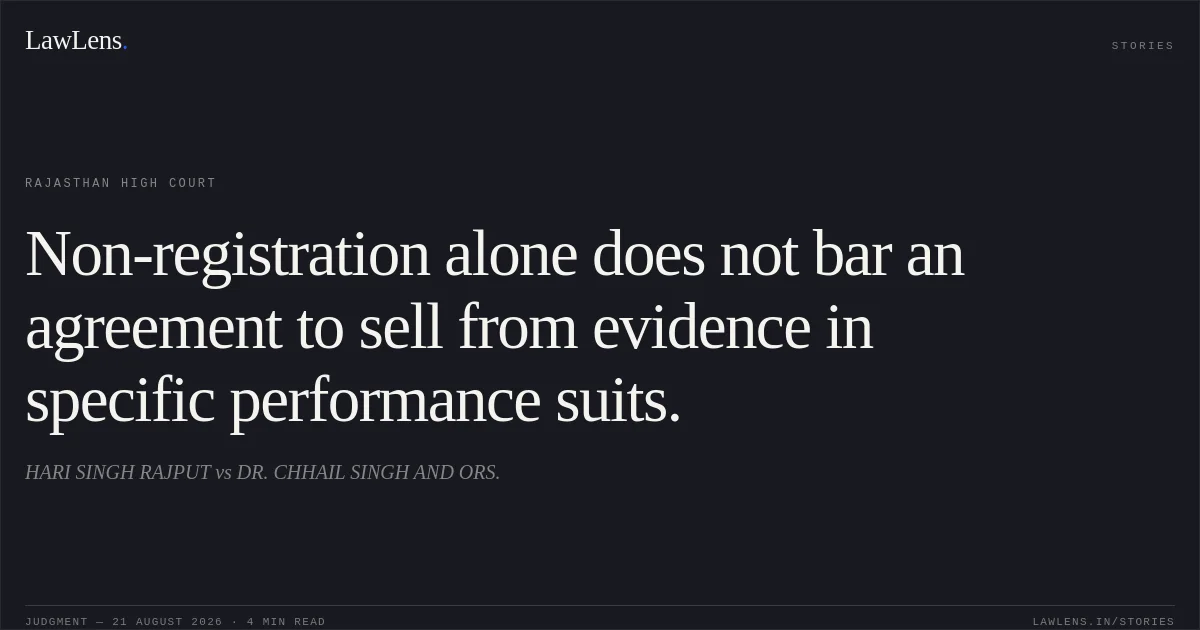
Source reference: para. 13Whether an unregistered agreement to sell is admissible in a suit for specific performance in view of the proviso to Section 49 of the Registration Act, 1908.
Source reference: para. 13, 17–19Whether an insufficiently stamped agreement may be received in evidence before payment of the deficient stamp duty and applicable penalty under Section 39 of the Rajasthan Stamp Act, 1998.
Source reference: para. 13, 20–22Whether the trial court’s refusal to decide Issue No. 4 as a preliminary issue warranted interference under Article 227 of the Constitution.
Source reference: para. 13, 29–32Law Applied
Order XIV Rule 2 CPC permits preliminary determination only of a pure issue of law relating to the court’s jurisdiction or a statutory bar to the suit; issues involving mixed questions of fact and law should ordinarily be tried with the other issues.
Source reference: para. 14–15Section 49 of the Registration Act, 1908 generally bars an unregistered document required to be registered from affecting immovable property or being received in evidence, but its proviso permits such a document to be received as evidence of a contract in a suit for specific performance; this principle was affirmed in R. Hemalatha v. Kashthuri , (2023) 10 SCC 725.
Source reference: para. 17–19Section 17(1A) of the Registration Act remains applicable where relevant.
Source reference: para. 18Section 39 of the Rajasthan Stamp Act, 1998 prohibits admission or reliance upon an insufficiently stamped instrument in its existing form, but permits curing the defect upon payment of the deficient stamp duty and prescribed penalty.
Source reference: para. 20–22The Court also relied on Manoj Kumar v. Nathmal Sharma , S.B. Civil Writ Petition No. 10748/2026, which distinguished the effect of non-registration from insufficiency of stamp duty.
Source reference: para. 21Article 227 confers supervisory, not appellate, jurisdiction, enabling correction of legally improper procedural orders where intervention is warranted.
Source reference: para. 29–30Reasoning
The Court held that the trial court was correct in finding that Issue No. 4 could not, in its entirety, be treated as a preliminary issue because admissibility and evidentiary effect could involve the nature of the documents, the pleadings, and evidence.
Source reference: para. 15, 25However, non-registration alone did not make the agreements inadmissible, since the suit was one for specific performance and the proviso to Section 49 expressly permits an unregistered agreement to sell to be received as evidence of the contract.
Source reference: para. 17–19, 22Insufficient stamping stood on a different footing: the documents could not be admitted in their existing form, but the defect was curable through the statutory process under Section 39 of the Rajasthan Stamp Act.
Source reference: para. 20–22Given that the stamp objection had remained procedurally unresolved for several years, the trial court could not leave it in abeyance merely because the broader issue involved mixed questions of fact and law.
Source reference: para. 23–28The appropriate course was to impound the document and obtain a determination of the deficit duty and penalty, rather than conduct a fragmented preliminary trial.
Source reference: para. 23–28Holding
The writ petition was disposed of and the trial court’s order dated 17.08.2017 was modified.
The trial court was directed to send the document forthwith to the Collector-cum-DIG, Stamps, for impounding and determination of the deficient stamp duty within twenty days of receipt.
Source reference: para. 27The concerned party was required to pay the deficit duty and penalty, if any; thereafter, the trial court was to proceed with the suit, leaving final admissibility and evidentiary effect to be decided in accordance with law and the evidence on record.
Source reference: para. 28The trial court was directed to endeavour to decide the suit within nine months, while avoiding unnecessary adjournments.
Source reference: para. 33–34The Court expressed no opinion on the merits, permitted the legal representatives of deceased respondent No. 4 to seek substitution in accordance with law, and made no order as to costs.
Source reference: para. 35, 37–38Acts & Sections Cited
4 provisions across 2 statutes referred to in this judgment. Each provision opens on LawLens.
Registration Act, 19082
rajasthan stamp act, 19982
Original Court PDF
HARI SINGH RAJPUTvsDR. CHHAIL SINGH AND ORS.
Click to open original judgment
Original judgment, available to read, download and summarize on LawLens.in