Facts
The petitioner challenged the order dated 09.04.2013 passed by the Commissioner, Sagar, which dismissed her second appeal solely on the grounds of delay.
Source reference: para 1-2The petitioner, a woman, contended she was unaware of the underlying order until informed by her husband, after which she obtained a certified copy on 21.03.2012 and filed the appeal on 22.03.2012.
Source reference: para 2The delay amounted to approximately four months.
Source reference: para 2The Appellate Authority dismissed the condonation application via a single-line, non-speaking order, stating the grounds were insufficient.
Source reference: para 3Issues
1. Whether the Appellate Authority's dismissal of an appeal via a non-speaking order on the grounds of delay is legally sustainable.
Source reference: para 3 & 62. Whether the authority failed to apply the established judicial principles governing the condonation of delay and the requirement for reasoned decisions.
Source reference: para 4-6Law Applied
The Court relied on the principle that recording reasons is an indispensable component of the decision-making process and the "heartbeat" of a decision, as established in Kranti Associates (P) Ltd. v. Masood Ahmed Khan (2010).
Source reference: para 4It further applied the guidelines from Esha Bhattacharjee v. Managing Committee of Raghunathpur Nagar Academy (2013), which mandate a liberal, pragmatic, and justice-oriented approach toward the condonation of delay, emphasizing that technicalities should not override substantial justice.
Source reference: para 5Reasoning
The Court observed that the impugned order was a "non-speaking order" passed in a "cursory manner," failing to objectively evaluate the reasons supported by the petitioner’s affidavit.
Source reference: para 3 & 6Referring to Kranti Associates, the Court noted that judicial and quasi-judicial authorities must record reasons to ensure transparency, accountability, and to demonstrate that relevant factors were considered.
Source reference: para 4The Court further reasoned, per Esha Bhattacharjee, that while "sufficient cause" is an elastic concept, authorities must not legalise injustice through a pedantic approach to limitation.
Source reference: para 5Since the Commissioner dismissed the application without dwelling upon the merits of the explanation for the four-month delay, the order was found to be in violation of the principles of natural justice.
Source reference: para 6Holding
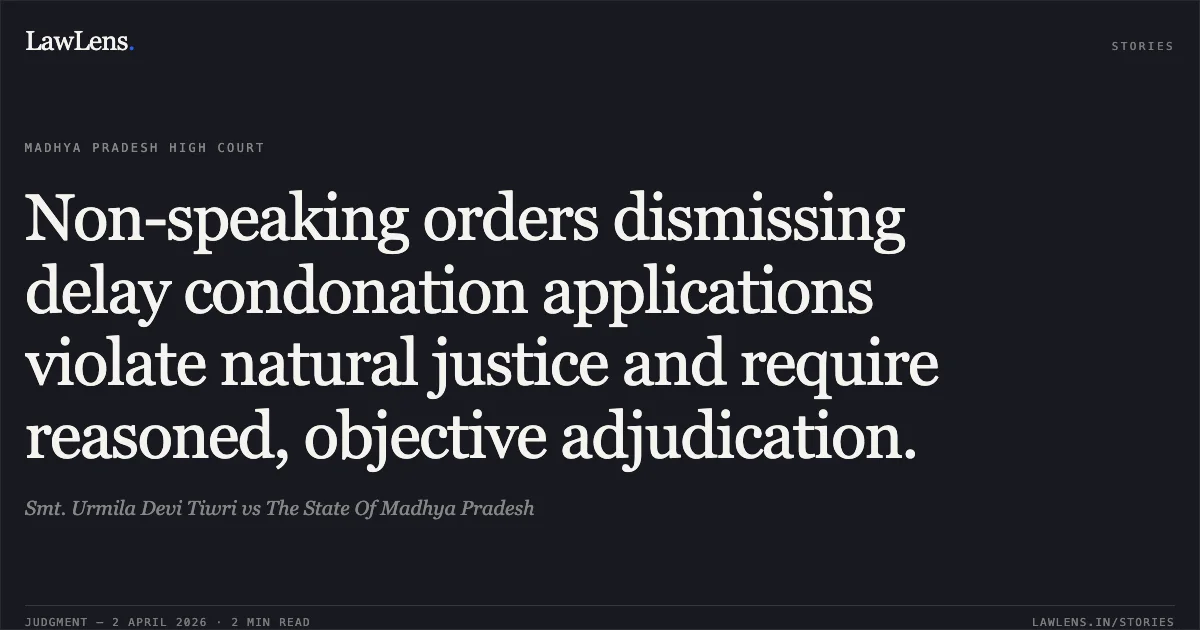
The High Court held that the impugned order dated 09.04.2013 was violative of the principles of natural justice due to its non-speaking nature.
The Court quashed the order and remanded the matter back to the Appellate Authority to decide the application for condonation of delay objectively.
Source reference: para 6The petitioner was directed to file an additional affidavit explaining the day-to-day delay within 15 days, after which the authority must pass a reasoned order after hearing the parties.
Source reference: para 6The petition was disposed of accordingly.
Source reference: para 7Original Court PDF
Smt. Urmila Devi TiwrivsThe State Of Madhya Pradesh
Click to open original judgment
Original judgment, available to read, download and summarize on LawLens.in