Facts
Gagandeep Singh, aged 19 years and studying in the first year of an engineering course, died in a motor-vehicle accident in 1998 due to the rash and negligent driving of respondent No. 2, who was driving Government Gypsy No. HR-01F-121 owned by the State of Haryana.
Source reference: paras. 1, 6, 10The Motor Accident Claims Tribunal, Ambala, awarded the appellants—his parents—lump-sum compensation of ₹2,22,000 with interest at 9% per annum from the date of filing of the claim petition.
Source reference: para. 1The finding that the accident resulted from the negligence of respondent No. 2 was not challenged by the respondents and therefore was not interfered with in appeal.
Source reference: para. 6The parents appealed seeking enhancement of compensation on the ground that the deceased was an engineering student with significant future earning potential.
Source reference: para. 7Issues
Whether the compensation of ₹2,22,000 awarded by the Tribunal was inadequate and required reassessment on the basis of the deceased’s educational qualifications and future earning potential?
Source reference: paras. 6–11Whether the deceased’s notional income, future prospects, personal-expense deduction and multiplier were required to be determined in accordance with the principles in Sarla Verma and Pranay Sethi?
Source reference: paras. 7, 11–14What amount was payable to the parents under the conventional heads of compensation, including consortium, loss of estate and funeral expenses?
Source reference: para. 15Law Applied
The Court applied the principle of “just compensation” under the law governing motor-accident claims, holding that compensation must be reasonable, evidence-based and connected to the loss suffered, and must not be arbitrary, punitive or a source of profit, as explained in Syed Basheer Ahamed v. Mohd. Jameel.
Source reference: para. 9Relying on Sarla Verma v. Delhi Transport Corporation, the Court applied a multiplier of 18 for a deceased aged 19 years and deducted 50% of the income towards the personal and living expenses of a bachelor.
Source reference: paras. 7, 13–14Under National Insurance Co. Ltd. v. Pranay Sethi, 40% was added towards future prospects for a deceased below 40 years of age.
Source reference: para. 12For assessing the notional income of an engineering student, the Court relied on Smt. Meena Pawaia v. Ashraf Ali, Navjot Singh v. Harpreet Singh and Mohinder Kaur v. Brij Lal Arora, recognising that income may be assessed by reference to educational background, social status and future earning potential rather than minimum wages.
Source reference: para. 11The Court further applied Magma General Insurance Co. Ltd. v. Nanu Ram and United India Insurance Co. Ltd. v. Satinder Kaur in awarding parental consortium.
Source reference: para. 15Reasoning
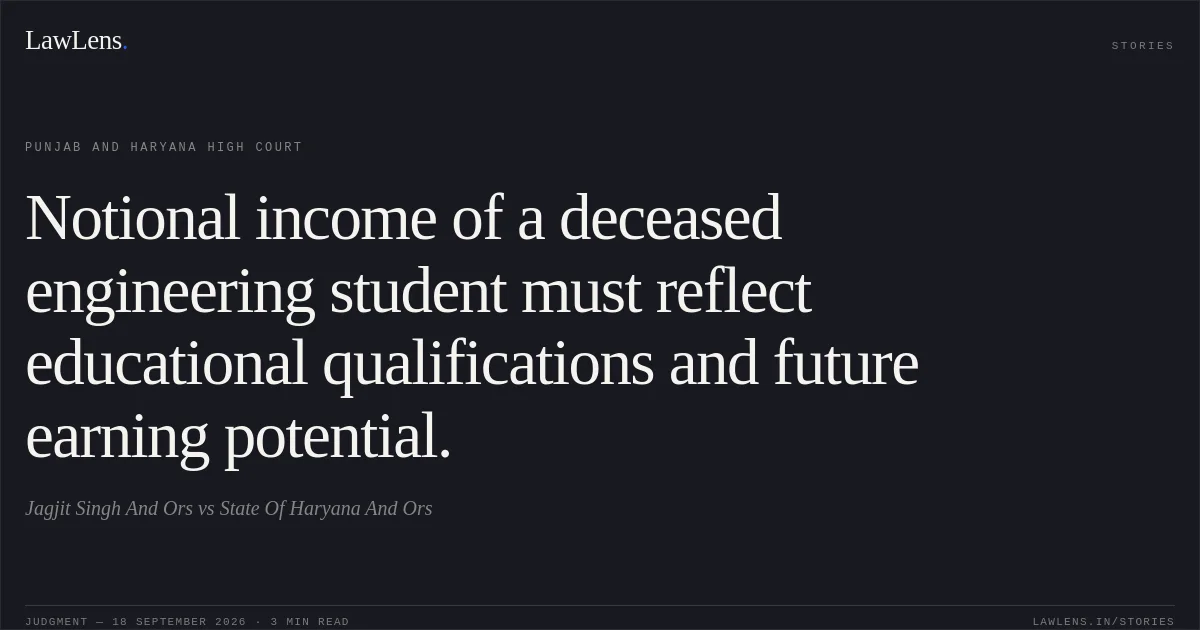
The Court held that the Tribunal erred in awarding a lump-sum amount merely because the deceased was not earning at the time of his death.
Source reference: para. 10Since he was a first-year engineering student, his notional income had to reflect his educational qualifications and probable future earnings.
Source reference: paras. 10–11Considering that the accident occurred in 1998, the Court assessed his monthly income at ₹7,500.
Source reference: para. 11It added 40% for future prospects, resulting in a monthly income of ₹10,500.
Source reference: para. 12As the deceased was unmarried, 50% was deducted for personal expenses, leaving a monthly dependency of ₹5,250 and an annual dependency of ₹63,000.
Source reference: para. 13Applying the multiplier of 18 appropriate to his age of 19 years, the loss of dependency was calculated at ₹11,34,000.
Source reference: para. 14The Court additionally awarded ₹50,000 to the mother under the conventional heads and ₹30,000 to the father towards parental consortium, resulting in total compensation of ₹12,14,000.
Source reference: paras. 15–16Holding
The appeal was partly allowed with costs.
The total compensation was enhanced from ₹2,22,000 to ₹12,14,000.
Source reference: para. 17The enhanced amount of ₹9,92,000, over and above the Tribunal’s award, was directed to carry interest at 9% per annum from 22 October 1998, the date of filing of the claim petition, until realization.
Source reference: para. 17The enhanced compensation was to be shared equally by the appellants and was made payable by respondents Nos. 1 and 2 jointly and severally.
Source reference: para. 17Pending miscellaneous applications, if any, were disposed of.
Source reference: para. 18Original Court PDF
Jagjit Singh And OrsvsState Of Haryana And Ors
Click to open original judgment
Original judgment, available to read, download and summarize on LawLens.in