Facts
The connected writ petitions concerned admission to the MBBS course for the academic session 2026–2027 against seats in the U.T. Chandigarh Pool at Government Medical College and Hospital, Sector 32, Chandigarh. The petitioners had qualified NEET (UG)-2026 and claimed eligibility for admission under the Other Backward Class–Non-Creamy Layer (OBC-NCL) category.
Source reference: para. 3; pp. 3–4The lead petitioner, belonging to the Yadav caste, had completed his education in Chandigarh and possessed an OBC certificate issued by the competent authority of U.T. Chandigarh. However, the certificate described him as a “migrant”.
Source reference: para. 3; pp. 3–4The respondents issued a provisional revised combined merit list dated 20 August 2026, in which the petitioner was treated as ineligible for the OBC category because of his “migrant” status and was instead considered under the General Category.
Source reference: para. 3; p. 4The petitioners challenged their exclusion from the OBC category and sought consideration for admission in accordance with the eligibility conditions contained in the admission prospectus.
Source reference: paras. 2–3; pp. 3–4Issues
Whether the respondents could introduce, during the ongoing admission process, an additional condition excluding OBC candidates described as “migrants” from the reserved OBC seats in the U.T. Chandigarh Pool, when such exclusion was not expressly provided in the prospectus?
Source reference: para. 6; p. 5Whether candidates who fulfilled the U.T. Chandigarh Pool eligibility criteria and submitted an OBC certificate issued by the competent authority of U.T. Chandigarh were entitled to be considered under the OBC-NCL category despite the certificate containing the expression “migrant”?
Source reference: paras. 7–11; pp. 5–10Whether the Government of India instructions relating to the territorial operation of OBC benefits could be read into the prospectus retrospectively for the 2026–2027 admission process?
Source reference: paras. 4, 9–10; pp. 4, 8–9Law Applied
The Court applied the principle that the “rules of the game” or eligibility criteria for selection cannot be altered after the selection or admission process has commenced.
Source reference: para. 6; p. 5The admission prospectus constitutes the governing and declared norm for determining eligibility, scrutiny, merit and admission, and the admitting authority is bound by its terms just as candidates are.
Source reference: para. 6; p. 5Under Clause A-3 of the prospectus, eligibility for the U.T. Chandigarh Pool was based, inter alia, on completion of the prescribed education in Chandigarh or satisfaction of the specified parental-residence requirement.
Source reference: para. 7; pp. 5–6Clause A-7 required OBC-NCL candidates to satisfy the U.T. Pool criteria, claim the OBC category in NEET, and produce an OBC certificate issued by the designated authority of U.T. Chandigarh; it stated that certificates issued by another State or Union Territory would not qualify for reserved OBC seats.
Source reference: para. 7; pp. 6–7The Court relied on the Full Bench principle discussed in Japuji Kaur Bains v. Union Territory of Chandigarh and the Supreme Court’s decision in Adarsh Dinkar Sontakke (Minor) v. Navodaya Vidyalaya Samiti, holding that a new eligibility condition cannot be incorporated after commencement of the selection process.
Source reference: paras. 6, 10; pp. 5, 9Although the respondents relied on the territorial nature of reservation benefits and on Marri Chandra Shekhar Rao and Action Committee, the Court held that those principles could not be retrospectively introduced contrary to the express terms of the prospectus.
Source reference: paras. 4, 10; pp. 4, 8–9Reasoning
The Court examined Clauses A-3 and A-7 and found that the prospectus required an applicant to satisfy the U.T. Pool eligibility conditions and submit the prescribed OBC certificate issued by the competent Chandigarh authority.
Source reference: paras. 7–9; pp. 5–8Neither clause required proof that the candidate’s ancestors had been residing in Chandigarh before 1 November 1966, restricted OBC reservation to persons of “Chandigarh origin” or “bona fide residents,” or declared that a certificate bearing the term “migrant” would be invalid.
Source reference: para. 9; p. 8Reading the Government of India instructions into the prospectus would effectively add a new eligibility condition and render candidates otherwise eligible under the published prospectus ineligible after they had applied and qualified. This would impermissibly alter the rules of the admission process after its commencement.
Source reference: para. 10; p. 9Accordingly, the respondents could not exclude the petitioners merely by labelling them “migrants,” provided they otherwise satisfied the U.T. Pool and OBC-NCL requirements prescribed in the prospectus.
Source reference: para. 11; p. 10Holding
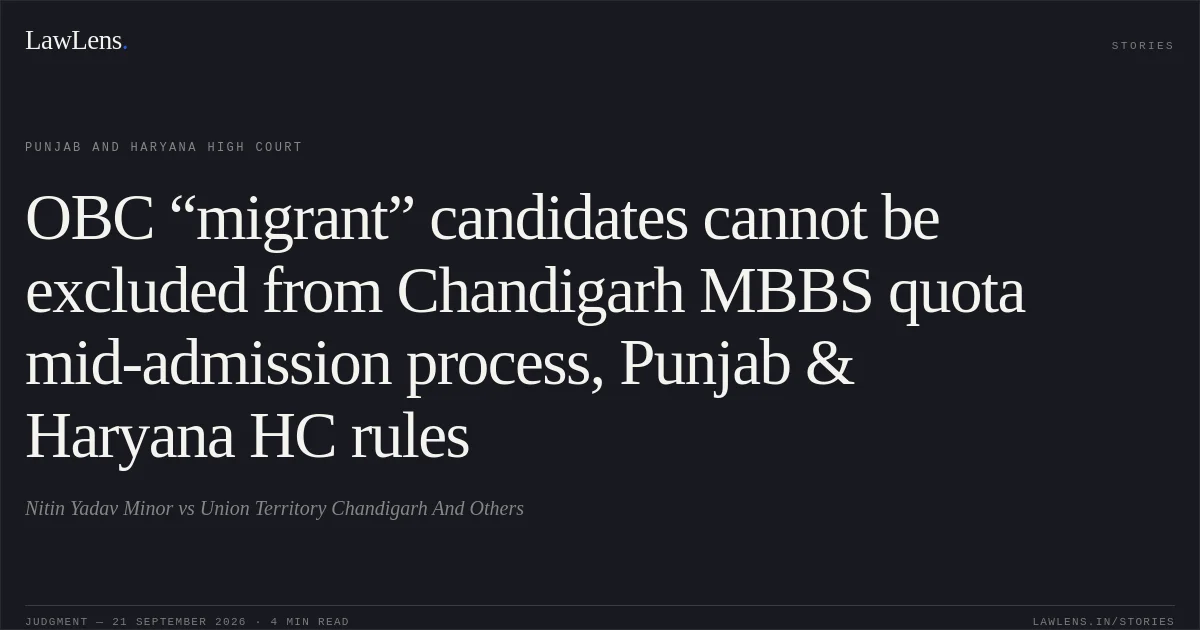
The Court answered the principal issue in the negative and held that, for the 2026–2027 admission process, the respondents could not exclude an otherwise eligible OBC candidate from the U.T. Chandigarh Pool solely because the OBC certificate described the candidate as a “migrant”.
The revised provisional merit list dated 20 August 2026 was quashed to the extent it altered the lead petitioner’s category.
Source reference: para. 12; p. 10The respondents were directed to prepare a fresh merit list of eligible OBC-NCL candidates for the remaining vacant seats strictly in accordance with Clauses A-3 and A-7 of the prospectus, without disturbing admissions of candidates who had already joined the course.
Source reference: para. 12; p. 10All five writ petitions were disposed of.
Source reference: para. 12; p. 10The Court clarified that the respondents could prescribe a legally valid admission criterion based on the Government of India instructions for subsequent academic sessions, but not retrospectively for 2026–2027.
Source reference: paras. 13–14; pp. 10–11Original Court PDF
Nitin Yadav MinorvsUnion Territory Chandigarh And Others
Click to open original judgment
Original judgment, available to read, download and summarize on LawLens.in