Facts
The prosecution case originated from a fardbeyan by Mukund Gope (PW-8) alleging that on January 5, 1991, eleven named accused persons attacked his house due to a title suit animosity.
Source reference: p. 2The appellant, Kishor Gope, allegedly fired a gun hitting Ramavtar Gope, who died en route to the hospital.
Source reference: p. 2Other accused fired at Sunita Kumari (PW-3) and Mahajani Devi (PW-4).
Source reference: p. 3While twelve were chargesheeted, five died during trial.
Source reference: p. 4The trial court convicted the appellant under Section 302 IPC and Section 27 of the Arms Act but acquitted the other six co-accused, citing a lack of corroboration regarding their specific roles and the failure to prove the common object under Section 149 IPC.
Source reference: p. 13, 22Issues
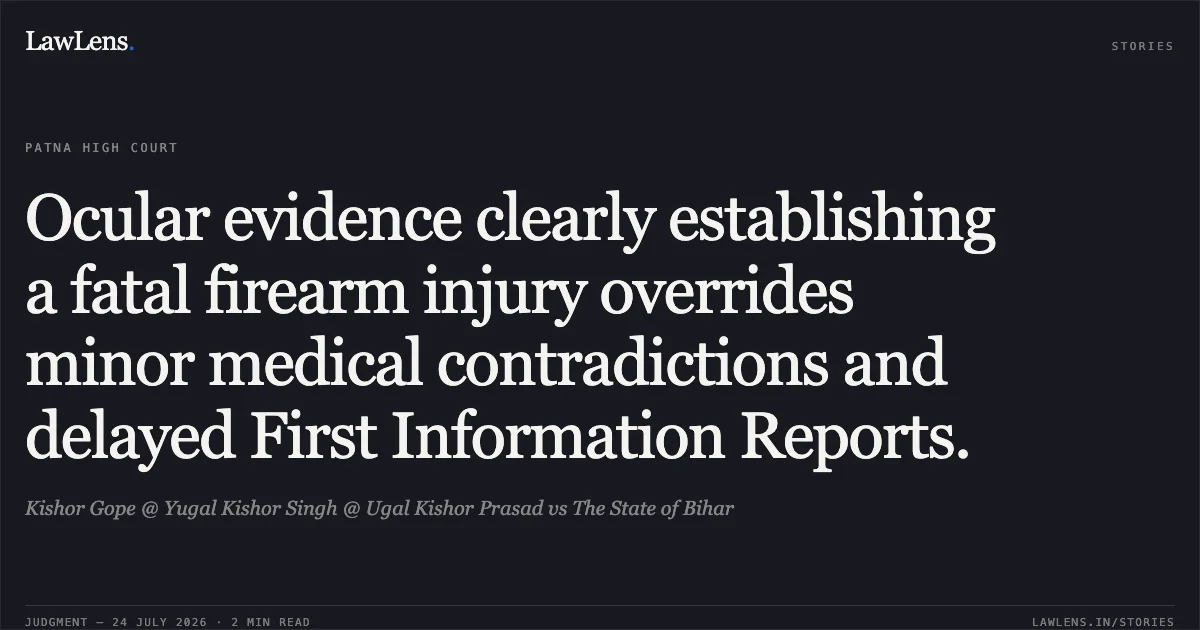
1. Whether the ocular testimony of the prosecution witnesses is reliable despite contradictions with medical evidence and the non-examination of the Investigating Officer.
Source reference: p. 8 / para. 152. Whether the acquittal of co-accused persons on the same set of evidence entitles the appellant to an acquittal.
Source reference: p. 11 / para. 24Law Applied
Section 302 of the Indian Penal Code (IPC) regarding the punishment for murder and Section 27 of the Arms Act for the use of arms.
Source reference: p. 2The court applied the principle that the maxim "falsus in uno, falsus in omnibus" (false in one thing, false in everything) is not applicable in India, requiring the court to separate the "chaff from the grain".
Source reference: p. 15 / para. 30Reliance on Tara Singh v. State of Punjab regarding the effect of delay in lodging an FIR.
Source reference: p. 15Reliance on Gopal Singh v. State of Bihar regarding the application of broad probabilities in criminal adjudication.
Source reference: p. 25Reasoning
The High Court found that the informant (PW-8) and injured witness (PW-3) were credible eye-witnesses whose presence at the scene was established by the defense’s own counter-case (Chandi P.S. Case No. 3/1991), which placed the appellant and witnesses at the same location and time.
Source reference: p. 18-19The court reasoned that the non-examination of the I.O. did not prejudice the defense because the place and time of occurrence were undisputed.
Source reference: p. 19Regarding the medical-ocular conflict, the court noted that while the deceased had additional hard-and-blunt injuries not specifically explained, the primary firearm injury to the thigh and scrotum—attributed to the appellant—was confirmed by the post-mortem report (Ex. 1) as the cause of death.
Source reference: p. 22-23The court separated the specific, consistent allegations against the appellant from the vague or unproven allegations against the acquitted co-accused, justifying the "split" verdict.
Source reference: p. 24Holding
The Court answered the issues in the negative, holding that the prosecution proved the appellant's individual act of murder beyond a reasonable doubt regardless of the acquittal of others under Section 149 IPC.
The conviction and sentence of life imprisonment under Section 302 IPC and five years under Section 27 of the Arms Act were affirmed, and the appeal was dismissed.
Source reference: p. 25-26Acts & Sections Cited
10 provisions across 3 statutes referred to in this judgment. Each provision opens on LawLens.
Indian Penal Code, 18608
Arms Act, 19591
Code of Criminal Procedure, 19731
Original Court PDF
Kishor Gope @ Yugal Kishor Singh @ Ugal Kishor PrasadvsThe State of Bihar
Click to open original judgment
Original judgment, available to read, download and summarize on LawLens.in