Facts
This appeal arose from a judgment dated 17.12.1987, where the appellants were convicted under Sections 147, 148, 323, and 324/149 of the Indian Penal Code (IPC).
Source reference: p. 1-2The case originated from a long-standing land dispute between the de facto complainant, Mahadeb Ghosh (PW-1), and his cousin, Shib Sadhan Ghosh (Appellant 1).
Source reference: p. 2On 19.09.1983, following a verbal altercation, Appellant 1 allegedly exhorted his sons (Appellants 2, 3, and 4) to "finish" Sankar Ghosh (PW-3).
Source reference: p. 4Appellants 2, 3, and 4 arrived armed with a katari, iron khonch (spear), and hansua, inflicting serious bleeding injuries on PW-3’s chest and on the head of Padmabati Ghosh (PW-6).
Source reference: p. 3-4While the Trial Court acquitted the appellants of Section 307 (Attempt to Murder), it convicted them of rioting and voluntarily causing hurt with dangerous weapons.
Source reference: p. 2Appellant 1 and Appellant 5 died during the pendency of this appeal.
Source reference: p. 18-19Issues
1. Whether the investigation was void due to the alleged lack of formal empowerment of the Investigating Officer under the Police Regulations of Bengal.
Source reference: p. 5-62. Whether the conviction under Section 149 IPC (Unlawful Assembly) could be sustained when fewer than five accused remained active in the appeal process.
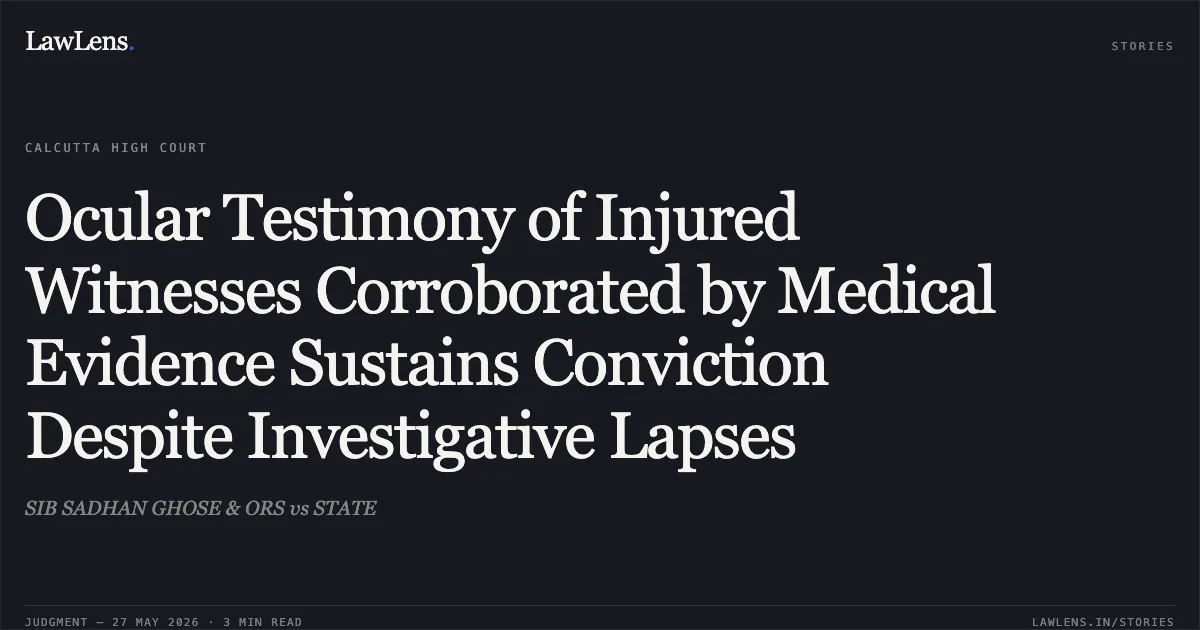
Source reference: p. 6-73. Whether the ocular testimony of injured witnesses was reliable despite contradictions with medical evidence and the non-examination of some independent witnesses.
Source reference: p. 7-84. Whether the substantive sentence should be reduced given the 40-year lapse since the occurrence.
Source reference: p. 17-18Law Applied
Section 149 regarding constructive liability for members of an unlawful assembly.
Source reference: p. 6Section 324 regarding voluntarily causing hurt by dangerous weapons.
Source reference: p. 2Section 148 regarding rioting armed with deadly weapons.
Source reference: p. 2Section 114(g) of the Indian Evidence Act regarding the adverse inference of withholding witnesses.
Source reference: p. 7The established principle that the testimony of an injured witness carries a higher cachet of credibility because their injuries establish their presence at the scene.
Source reference: p. 15-16Reasoning
The Court rejected the technical challenges to the investigation, holding that lapses such as the absence of a sketch map or formal entrustment do not erode the evidentiary value of trustworthy direct testimony from injured witnesses.
Source reference: p. 16Regarding the numerical requirement of Section 149 IPC, the court found that the assembly originally consisted of five or more persons at the time of the offense, satisfying the statute despite subsequent deaths of some appellants.
Source reference: p. 13-14The court emphasized that PW-3 and PW-6, as injured victims, had no reason to falsely implicate the appellants while letting the real assailants go free.
Source reference: p. 15The medical evidence of PW-7 (Dr. Bhar) corroborated the ocular accounts by confirming bleeding injuries caused by sharp/hard weapons on vital areas like the chest.
Source reference: p. 16The court concluded that neither the hostility of some neighbors nor the non-examination of certain FIR-named witnesses (Laxmi and Subal Singh) was fatal given the consistency of the injured witnesses' testimonies.
Source reference: p. 17Holding
The High Court affirmed the conviction of the surviving appellants, finding that the prosecution successfully proved the concerted attack arising from family hostility.
Noting that 43 years had passed since the incident (1983-2026), that the dispute was familial, and that the surviving appellants were now advanced in age, the Court modified the sentence to the period of imprisonment already undergone.
Source reference: p. 18The appeal abated against Appellants 1 and 5 (deceased) and was dismissed against the others with the aforementioned modification of sentence.
Source reference: p. 18-19Acts & Sections Cited
10 provisions across 1 statute referred to in this judgment. Each provision opens on LawLens.
Original Court PDF
SIB SADHAN GHOSE & ORSvsSTATE
Click to open original judgment
Original judgment, available to read, download and summarize on LawLens.in