Facts
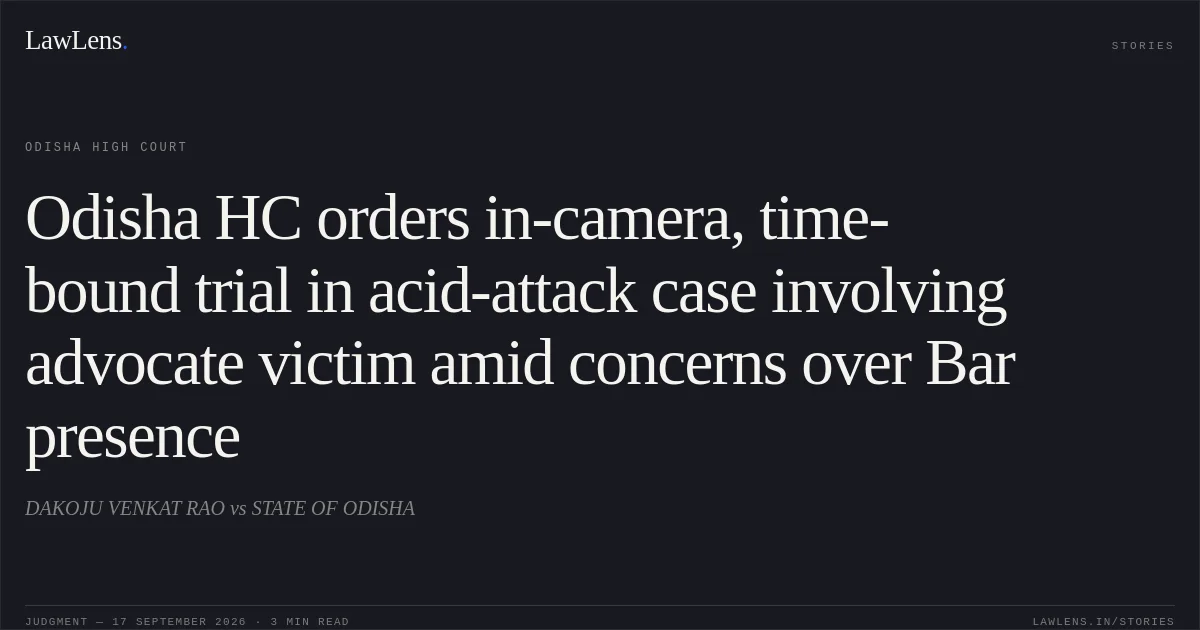
The petitioners, accused in S.T. Case No.41 of 2025 pending before the Sessions Judge, Gajapati at Parlakhemundi, sought transfer of the trial to the Sessions Court at Berhampur, Ganjam.
Source reference: p.2, paras.1–3They alleged obstruction of the proceedings, intimidation, and non-cooperation by members of the local Bar Association, particularly because the victim was an advocate and a member of that Bar Association.
Source reference: p.2, paras.1–3The Registrar, Civil Courts, Gajapati, reported that six of the twenty-five prosecution witnesses had been examined, that the remaining delay was attributable to the non-appearance of prosecution witnesses, and that no obstruction, intimidation, or external influence had been reported to the trial court.
Source reference: pp.2–4, para.3The record also showed that one local advocate continued to represent one petitioner and that another petitioner was represented by counsel from Visakhapatnam.
Source reference: p.3, para.3The informant, formerly Secretary and then President of the local Bar Association, opposed the transfer and submitted that transfer would further delay the trial in an acid-attack case.
Source reference: pp.4–5, para.4During hearing, the petitioners alternatively sought an in-camera trial on the ground that the presence of several Bar members created a threatening atmosphere inside the courtroom.
Source reference: pp.5–6, paras.6–7Issues
Whether the circumstances alleged by the petitioners—obstruction, intimidation, non-cooperation, or possible influence of the local Bar Association—warranted transfer of S.T. Case No.41 of 2025 from Parlakhemundi to Berhampur.
Source reference: pp.2–5, paras.1–5Whether, notwithstanding refusal of transfer, an in-camera trial was necessary to secure a fair and effective trial in view of the sensitivity of the case and the victim’s association with the local Bar.
Source reference: pp.5–6, paras.6–9Whether directions were required to ensure expeditious completion of the acid-attack trial and prevent obstruction or unnecessary adjournments.
Source reference: pp.7–10, paras.10–13Law Applied
The Court applied the principle that transfer of a criminal proceeding must be justified by circumstances demonstrating a real risk to a fair trial or the proper administration of justice, and not by unsupported apprehensions.
Source reference: pp.2–5, paras.1–5It treated an in-camera trial as an appropriate procedural safeguard where the surrounding circumstances may affect the accused’s ability to defend the case fairly.
Source reference: pp.5–6, paras.6–9The Court relied on the Supreme Court’s directions in Shaheen Malik v. Union of India, W.P.(C) No.1112 of 2025, requiring expeditious investigation, trial, and rehabilitation in acid-attack cases, including completion of trial within the prescribed timeline.
Source reference: pp.4–5, para.4; pp.7–8, para.12It also relied on The Central Bureau of Investigation v. Mir Usman alias Ara alias Mur Usman Ali, 2025 SCC OnLine SC 2066, including the principle under Section 309 Cr.P.C. that witness examination should ordinarily proceed day-to-day, adjournments should not be granted for counsel’s convenience except for exceptional reasons, and courts may adopt measures such as appointing an amicus curiae or imposing costs where counsel or accused cause delay.
Source reference: pp.9–10, para.13Reasoning
The Court declined transfer because the material before it did not substantiate the petitioners’ allegations.
Source reference: pp.2–5, paras.1–5The Registrar’s report stated that the proceedings were continuing smoothly, no complaint of intimidation or obstruction had been made before the trial court, and a member of the local Bar was already representing one petitioner.
Source reference: pp.2–4, para.3The informant also denied the existence of any Bar resolution refusing representation and opposed transfer on the ground that it would inconvenience local witnesses and delay an acid-attack trial.
Source reference: pp.4–5, para.4Accordingly, the Court found no sufficient basis to conclude that the Parlakhemundi court was biased or that a fair trial was impossible there.
Source reference: p.5, para.5Nevertheless, considering that the victim was an advocate and Bar member and that the presence of several Bar members could create a threatening courtroom atmosphere, the Court considered an in-camera trial to be a proportionate safeguard short of transfer.
Source reference: pp.5–6, paras.6–9It further directed adherence to the expedited-trial requirements in Shaheen Malik and the day-to-day trial principles stated in Mir Usman.
Source reference: pp.7–10, paras.10–13Holding
The prayer to transfer S.T. Case No.41 of 2025 from the Sessions Court at Gajapati, Parlakhemundi, to the Sessions Court at Berhampur, Ganjam, was rejected.
The learned Sessions Judge, Gajapati, was directed to conduct the trial in-camera and conclude it at the earliest.
Source reference: p.6, paras.8–10The Court directed that the remaining prosecution witnesses, including the victim, be examined expeditiously, and required the concerned Bar Association office-bearers to ensure that no hindrance was caused by Bar members during the trial.
Source reference: pp.7–8, paras.10–11The trial court was further directed to comply with the High Court’s acid-attack-case timelines and the Supreme Court’s directions concerning continuous witness examination, limited adjournments, and prevention of trial delay.
Source reference: pp.7–10, paras.12–13The transfer petition was accordingly disposed of.
Source reference: p.11, para.14Acts & Sections Cited
1 provisions across 1 statute referred to in this judgment. Each provision opens on LawLens.
Code of Criminal Procedure, 19731
Original Court PDF
DAKOJU VENKAT RAOvsSTATE OF ODISHA
Click to open original judgment
Original judgment, available to read, download and summarize on LawLens.in