01Facts
The petitioner operated iron-ore beneficiation and held an Environmental Clearance (EC) initially allowing production of 0.72 MTPA. Following approvals, the mining plan was enhanced to 1.5 MTPA, and an EC for that enhanced capacity was granted. For 2019–20, the authorities alleged that production exceeded the EC limit and issued a demand exceeding Rs. 40 crore under Section 21(5) of the Mines and Minerals (Development and Regulation) Act, 1957 (MMDR Act).
pp. 2–4 · ¶ 3–4The petitioner challenged the demand before the Revisional Authority, which dismissed the revision. The petitioner then brought this writ petition.
pp. 5–6 · ¶ 5–602Issues
i.Whether a permissible production variation could be applied when determining excess extraction beyond the annual production limit in the EC, having regard to Common Cause v. Union of India [(2017) 9 SCC 499].
p. 6 · ¶ 7ii.Whether the authorities should calculate permissible annual production by allowing a ±10% variation over the EC limit, rather than treating production above that limit as unlawful without such allowance.
pp. 14–15 · ¶ 13–1603Law Applied
Sections 4 and 5 of the MMDR Act require mining operations to be conducted under the authority of a valid lease and in accordance with an approved mining plan; Section 18 concerns conservation and environmental protection; and Section 21(5) permits recovery for minerals raised without lawful authority.
pp. 6–8 · ¶ 8–9The applicable mining rules and the EIA framework require mining to conform to both the approved mining plan and the EC; the judgment treats these as complementary and mandatory requirements.
pp. 8–10 · ¶ 9–10In Common Cause v. Union of India, the Supreme Court held that extraction beyond the permissible limits of the mining plan or EC may constitute unlawful mining, while addressing permissible variation in production.
pp. 11–13 · ¶ 11–13The High Court concluded that a ±10% variation should be allowed in calculating annual production against the EC limit and that compensation, if warranted, should be calculated under the Common Cause framework.
pp. 14–15 · ¶ 14–16Provisions in the judgment · 5 · Linked ones open on LawLens
Mines and Minerals (Development and Regulation) Act, 1957 Section 21Section 4Section 3Section 5Section 18
04Reasoning
The Court held that the demand could not be sustained without accounting for the permissible production variation.
pp. 13–15 · ¶ 13–15It read Common Cause as accepting the IBM’s ±10% variation as reasonable in light of practical mining conditions, and distinguished the CEC compensation calculation from the question of whether any variation was permissible.
pp. 13–15 · ¶ 13–15Accordingly, the authorities had to assess production annually against the EC limit, allow a ±10% buffer, and calculate compensation under Common Cause only if extraction exceeded that adjusted limit.
p. 15 · ¶ 1605Holding
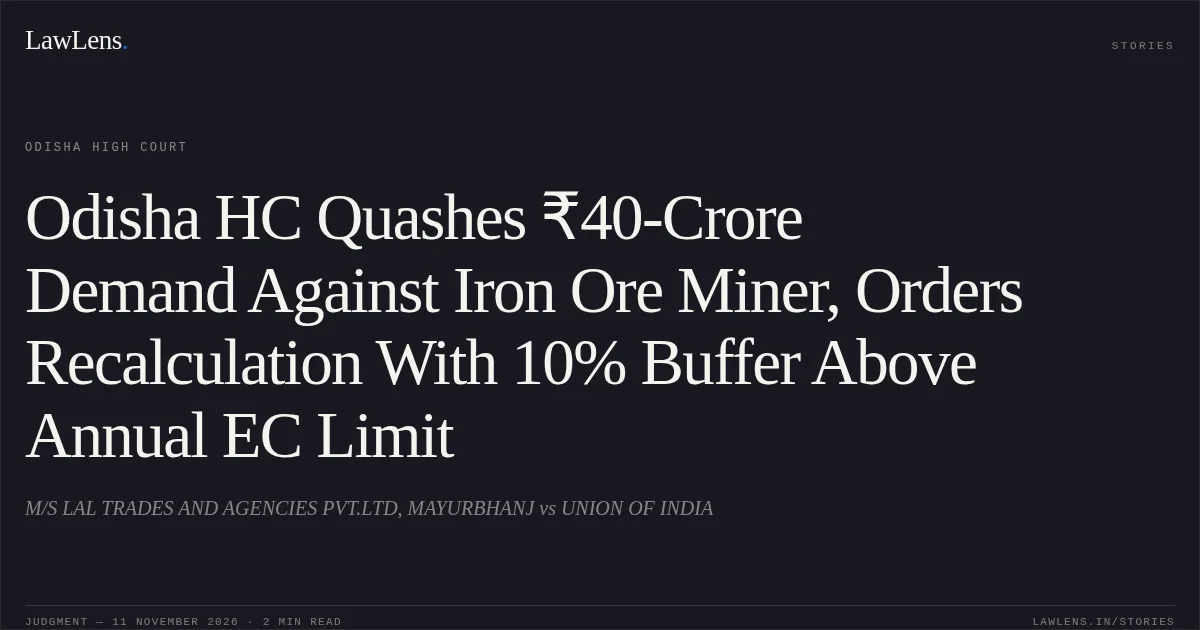
The Court quashed the Revisional Authority’s order and the demand.
p. 15 · ¶ 16It directed the authorities to recalculate production by allowing a ±10% variation over the EC limit, and, if extraction exceeded that limit, to calculate compensation in accordance with Common Cause and provide reasonable time for payment.
p. 15 · ¶ 16The writ petition was disposed of.
p. 16 · ¶ 17Original Court PDF
M/S LAL TRADES AND AGENCIES PVT.LTD, MAYURBHANJvsUNION OF INDIA
Click to open original judgment
Original judgment, available to read, download and summarize on LawLens.in