01Facts
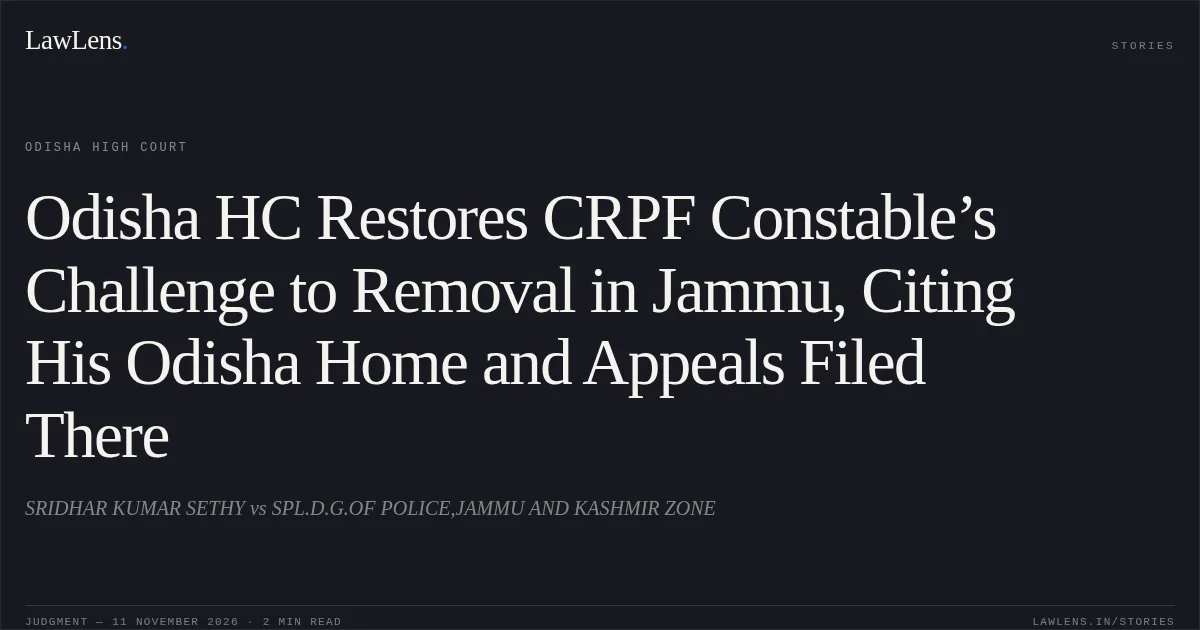
The appellant, a CRPF Constable, was stationed with E/160 Battalion at Barnai, Jammu, when disciplinary proceedings resulted in his removal from service on 8 May 2015. He was then residing at his permanent residence in Keonjhar, Odisha.
pp. 2–4From Odisha, he filed an appeal and revision against the removal order; the decisions rejecting them were communicated to him at his Odisha address.
pp. 2–4, 14He filed a writ petition challenging the removal and the appellate and revisional orders. The Single Judge dismissed it for want of territorial jurisdiction, holding that the cause of action did not arise within Odisha. The appellant appealed.
pp. 1–202Issues
i.1. Whether the Orissa High Court had territorial jurisdiction under Article 226 to entertain the writ petition where the disciplinary proceedings and removal occurred in Jammu, but the appellant filed his appeal and revision from Odisha and received the decisions there.
pp. 4–6, 14ii.2. Whether the appellant’s residence in Odisha, the filing of his appeal and revision there, and communication of the resulting orders to that address constituted a part of the cause of action within Odisha.
pp. 12–1503Law Applied
Article 226(2) of the Constitution permits a High Court to exercise jurisdiction where the cause of action arises wholly or in part within its territory. The cause of action comprises material facts having a nexus to the dispute; the mere presence of an incidental fact or communication in a State does not automatically confer jurisdiction (State of Rajasthan v. Swaika Properties, (1985) 3 SCC 217; Oil and Natural Gas Commission v. Utpal Kumar Basu, (1994) 4 SCC 711; Union of India v. Adani Exports Ltd., (2002) 1 SCC 567; Kusum Ingots & Alloys Ltd. v. Union of India, (2004) 6 SCC 254).
pp. 5–10Even where part of the cause of action arises within the territory, the High Court retains discretion to decline jurisdiction under the doctrine of forum conveniens.
pp. 8–11The Court also relied on Sri Janardan Mohanty v. Union of India, 2000 (II) OLR 126, which considered the circumstances of an individual employee returning to his permanent residence after removal from service.
pp. 11–13Provisions in the judgment · 3 · Linked ones open on LawLens
rajasthan urban improvement act, 1959 Section 52
Code of Civil Procedure, 1908 Section 20Section 141
04Reasoning
Although the disciplinary proceedings and removal took place in Jammu, the Court considered the appellant’s subsequent steps—not merely the communication of orders in isolation. He had returned to his permanent residence in Odisha, filed his appeal and revision from there, and received the decisions there. Given that the CRPF is an all-India organisation with offices in Odisha, the Court held that these facts, considered together and in the circumstances of an individual removed employee, established a part of the cause of action in Odisha.
pp. 12–15It also considered that requiring a jobless employee to litigate elsewhere would cause hardship and would not materially prejudice the respondents. The Court therefore disagreed with the Single Judge’s jurisdictional conclusion.
pp. 12–1505Holding
The Court held that the writ petition was maintainable before the Orissa High Court because part of the cause of action arose in Odisha.
p. 15It set aside the Single Judge’s order, restored the writ petition for determination on its merits by the appropriate Bench, and allowed the writ appeal.
p. 15Original Court PDF
SRIDHAR KUMAR SETHYvsSPL.D.G.OF POLICE,JAMMU AND KASHMIR ZONE
Click to open original judgment
Original judgment, available to read, download and summarize on LawLens.in