01Facts
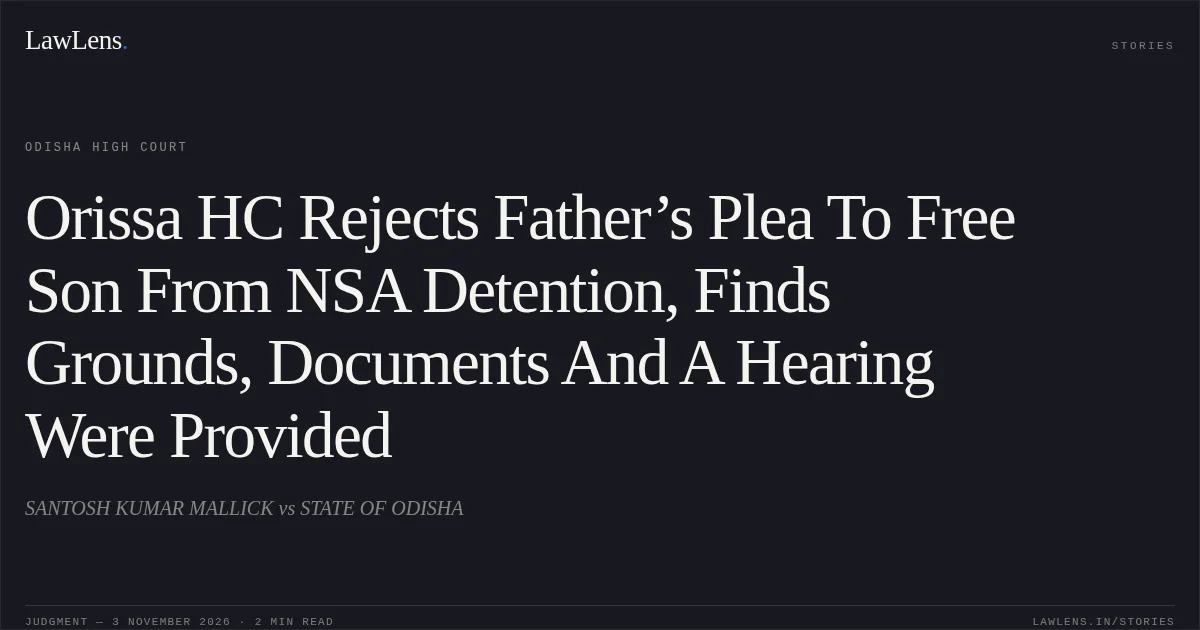
The petitioner, the detenu’s father, challenged the District Magistrate, Puri’s order dated 8 December 2025 detaining his 24-year-old son under Section 3(2) of the National Security Act, 1980 (NSA).
pp. 2–4 · ¶ 2–3The State stated that the detention grounds and supporting documents were served on the detenu on 12 December 2025; the State approved the order on 19 December 2025; and the detenu was given an opportunity to make a representation and appear before the NSA Advisory Board.
pp. 2–4 · ¶ 2–3The petitioner alleged, among other things, that the detenu had not received an effective opportunity to represent against the detention and that the detention was based mechanically on pending criminal cases.
pp. 2–4 · ¶ 2–3The State opposed the petition, asserting compliance with the statutory and constitutional procedures.
pp. 4–6 · ¶ 3–502Issues
i.1. Whether the authorities complied with the NSA and Article 22 safeguards, including communicating the grounds of detention and providing an effective and timely opportunity to make a representation.
pp. 6, 12–14 · ¶ 6, 12–14ii.2. Whether the detention order, made on the basis of the materials concerning the detenu’s criminal cases and the asserted threat to public order, warranted interference by the Court.
pp. 6, 12–14 · ¶ 6, 12–1403Law Applied
Section 3(2) of the NSA authorises preventive detention where the statutory requirements are met; Article 21 protects personal liberty, while Article 22(5) requires that the grounds of detention be communicated and that the detenu be afforded the earliest opportunity to make a representation.
p. 6 · ¶ 7The Court noted that Article 22(3)(b) creates an exception to Article 22(1)’s protections concerning legal representation in preventive-detention cases.
p. 6 · ¶ 7Relying on Rekha v. State of T.N., the Court stated that preventive detention is not barred merely because criminal proceedings are pending, but may be resorted to where ordinary criminal law will not be able to deal with the situation.
pp. 7–8 · ¶ 9Under Ichhu Devi Choraria v. Union of India, relied-upon material must be supplied without undue delay to enable an effective representation.
pp. 8–11 · ¶ 10Sunil Kumar Gupta alias Sunil Chain v. Union of India was cited for the rule that the Government must consider a detenu’s representation at the earliest point of time, and failure to do so may vitiate the detention and its approval.
pp. 11–12 · ¶ 1104Reasoning
The Court found that the detention grounds, spanning 25 pages, and supporting documents were served on the detenu on 12 December 2025 with notice of his right to make a representation.
pp. 12–14 · ¶ 12–14It also found that the detenu sought a personal hearing before the Advisory Board, was informed of the hearing date, appeared, and was heard.
pp. 12–14 · ¶ 12–14The Court further noted that the father’s representation was considered, although he had no right under the NSA to make one.
pp. 12–14 · ¶ 12–14On those facts, it concluded that the detenu had received the grounds and an opportunity to make a representation and defend himself; it found no procedural departure warranting habeas corpus relief.
p. 14 · ¶ 1405Holding
The Court answered the issues against the petitioner, holding that the authorities had followed the procedures under the NSA and Article 22 and that the detention order did not warrant interference.
p. 14 · ¶ 15It dismissed the writ petition without an order as to costs.
p. 14 · ¶ 15Original Court PDF
SANTOSH KUMAR MALLICKvsSTATE OF ODISHA
Click to open original judgment
Original judgment, available to read, download and summarize on LawLens.in