Facts
The appellant was convicted by the Special POCSO Court, Greater Bombay, on March 12, 2020, for raping his minor daughter
Source reference: p. 1-2The victim (PW1), an Urdu school student, reported at a ‘Police Didi’ school program that the appellant had touched her inappropriately since age 10 and had sexually assaulted her at least four times in the three months preceding JULY 2018
Source reference: p. 2-3The prosecution relied on the testimony of nine witnesses, including school principals (PW3, PW7) and a counsellor (PW4), and medical evidence showing old hymenal tears
Source reference: p. 3, 24The appellant contended he was falsely implicated because he intended to discontinue the victim's studies and challenged the victim's minority based on a medical ossification test estimating her age between 17-18 years
Source reference: p. 4-5Issues
1. Whether the prosecution proved beyond reasonable doubt that the victim was a minor at the time of the commission of the offences
Source reference: p. 5/92. Whether the testimony of the victim (prosecutrix) was of "sterling quality" to sustain a conviction without further corroboration
Source reference: p. 6/213. Whether the appellant’s relationship as the victim's father mandates the sentence of life imprisonment for the remainder of his natural life under Section 376(2)(f) of the IPC
Source reference: p. 27Law Applied
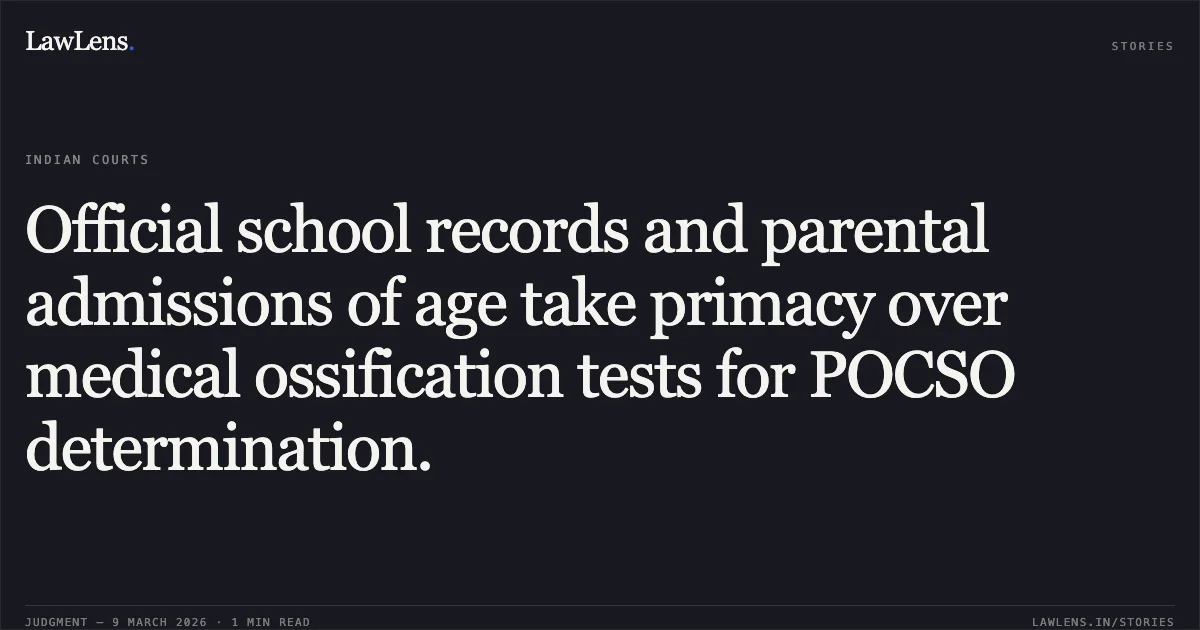
The Court primarily applied Section 94 of the Juvenile Justice (Care and Protection of Children) Act, 2015, which prioritizes school records and statutory certificates over medical ossification tests for age determination
Source reference: p. 15-16It invoked Section 35 of the Indian Evidence Act, 1872, regarding the admissibility of entries in public registers made by public servants in the discharge of official duties
Source reference: p. 6/16Substantively, the Court applied Section 376(2)(f) of the Indian Penal Code (rape by a relative or person in trust)
Source reference: p. 2, 27and Sections 6 and 9(n) of the POCSO Act, 2012
Source reference: p. 2It further relied on the Supreme Court's principles in Rishipal Singh Solanki v. State of U.P. (primacy of school records)
Source reference: p. 14and Bhanei Prasad @ Raju v. State of Himachal Pradesh (judicial response to incestuous violence)
Source reference: p. 26Reasoning
The Court rejected the appellant's challenge to the victim's age, noting that the school admission register (produced by PW7) recorded her birth as 15.02.2002 based on the appellant’s own affidavit
Source reference: p. 17-18Under Section 94 of the JJ Act, such documentary evidence takes precedence over the inconclusive ossification test (17-18 years)
Source reference: p. 19-20Furthermore, the appellant admitted the victim's birth date and minority during his Section 313 CrPC statement
Source reference: p. 17Regarding the merits, the Court found the victim’s testimony (PW1) "steadfast" and graphic, which was not shaken during cross-examination
Source reference: p. 21The Court dismissed the "false implication" theory as far-fetched, ruling that parental discipline (discontinuing studies) would not naturally lead a child to make such scandalous allegations
Source reference: p. 23Medical evidence of old hymenal tears was held to corroborate the victim's account of multiple assaults occurring a week prior to the exam
Source reference: p. 24Finally, the Court held that since the rape was committed by a father (position of trust), Section 376(2)(f) IPC was triggered, leaving no judicial discretion regarding the life sentence
Source reference: p. 27-28Holding
The Court answered all issues in the affirmative, upholding the conviction
It held that the prosecution successfully proved the victim’s minority through credible school records
Source reference: p. 19The Court affirmed that the sole testimony of a victim of sexual assault, if inspiring confidence, is sufficient for conviction
Source reference: p. 21Under the 2013 and 2018 amendments to Section 376(2) of the IPC, a sentence of "imprisonment for life" specifically means imprisonment for the remainder of the person’s natural life when the accused is a relative or person in authority
Source reference: p. 28-29The appeal was dismissed, and the Trial Court’s sentence was maintained
Source reference: p. 29Acts & Sections Cited
7 provisions across 4 statutes referred to in this judgment. Each provision opens on LawLens.
Indian Penal Code, 18601
Code of Criminal Procedure, 19732
Protection of Children from Sexual Offences Act, 20123
Juvenile Justice (Care and Protection of Children) Act, 2015.1
Original Court PDF
Mohammad Shahjad Amir Hasan Shaikh v. The State of Maharashtra and another
Click to open original judgment
Original judgment, available to read, download and summarize on LawLens.in