Facts
The appellant, a candidate under the Persons with Benchmark Disabilities (PwBD) category with locomotor disability, applied for the post of Assistant Professor in Information Technology and Computer Science Engineering following two recruitment notices: Advertisement No. 1 (10.09.2021) and Advertisement No. 2 (27.02.2023)
Source reference: para. 5, 6, 11Prior to these advertisements, the University’s Board of Management had approved a "Recruitment Document" on 20.07.2021, which prescribed a minimum suitability threshold of 50% marks for selection
Source reference: para. 7, 8Under Advertisement No. 1, the appellant scored 37.2% and was not recommended, while a candidate scoring 65.4% was appointed
Source reference: para. 21Under Advertisement No. 2, the appellant scored 38 and 37 marks in the respective disciplines; consequently, the Selection Committee found no candidate suitable as none met the 50% threshold
Source reference: para. 12-15The appellant challenged his non-selection, arguing that the 50% benchmark was introduced after the recruitment process began and was omitted from the advertisements
Source reference: para. 16Issues
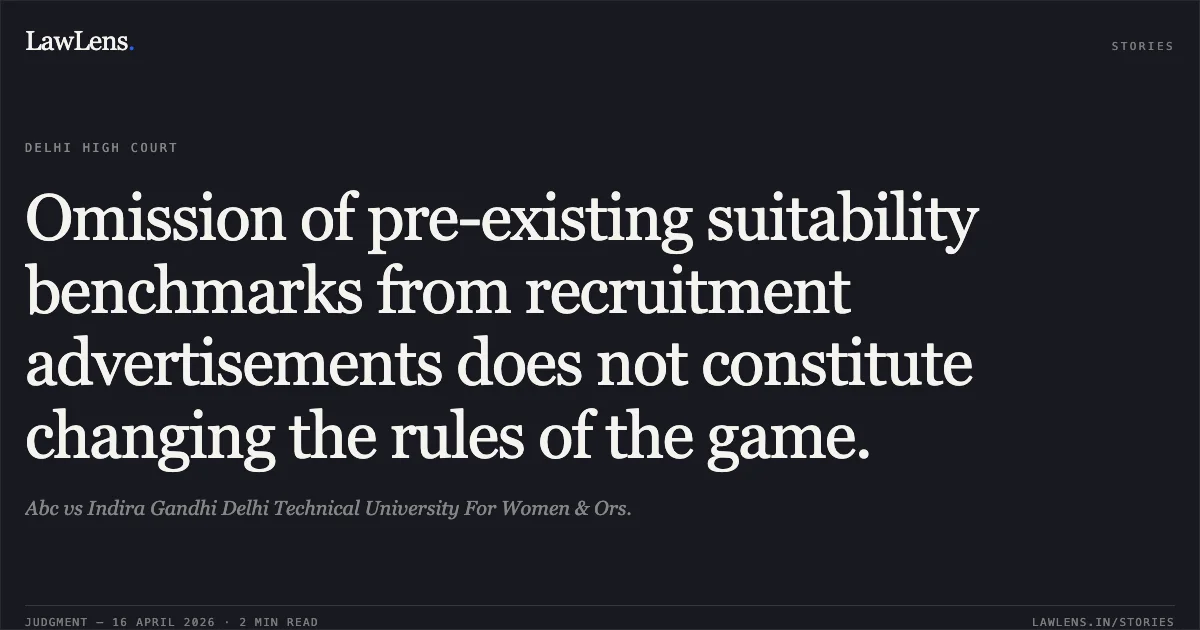
1. Whether the application of a 50% minimum suitability threshold, which was not explicitly mentioned in the recruitment advertisements, constitutes an impermissible "change in the rules of the game" after the commencement of the selection process
Source reference: para. 16, 24A2. Whether the selection process violated the provisions of the Rights of Persons with Disabilities Act, 2016 (RPwD Act)
Source reference: para. 20Law Applied
The court primarily applied the legal principle established in Tej Prakash Pathak v. High Court of Rajasthan (2025), which mandates that the norms, rules, or procedures for recruitment and suitability cannot be altered once the selection process has initiated.
Source reference: para. 17, 24AIt further considered the statutory requirements of the Rights of Persons with Disabilities Act, 2016, regarding the provision of reservations and non-discrimination against PwBD candidates in public employment.
Source reference: para. 20, 24EReasoning
The court found that the 50% suitability benchmark was not a retrospective change but a pre-existing norm approved by the Board of Management on 20.07.2021, nearly two months before Advertisement No. 1 was issued.
Source reference: para. 24BConsequently, the principle in Tej Prakash Pathak was not violated because the "rules" existed before the "game" began.
Source reference: para. 24BThe court reasoned that the absence of the specific 50% threshold in the text of the advertisement does not vitiate the selection process, as advertisements typically provide general eligibility criteria while the Selection Committee follows detailed internal recruitment guidelines.
Source reference: para. 24B, 24DRegarding the RPwD Act, the court observed that the University had complied by providing the mandatory reservations and allowing PwBD candidates to participate.
Source reference: para. 24EThe failure of the appellant to meet the pre-defined merit threshold (scoring 37.2%, 38, and 37 marks against a 50% requirement) did not constitute discrimination or a violation of statutory rights.
Source reference: para. 14, 21, 24EHolding
The court answered both issues in the negative and dismissed the appeals.
It held that there was no illegal change to the selection criteria as the 50% threshold was finalized prior to the advertisements.
Source reference: para. 24BThe court further held that the selection process was transparent and did not infringe upon the RPwD Act, noting that vacancies were being carried forward due to a lack of suitable candidates meeting the merit benchmark.
Source reference: para. 24F, 25No order as to costs was made.
Source reference: para. 26Original Court PDF
AbcvsIndira Gandhi Delhi Technical University For Women & Ors.
Click to open original judgment
Original judgment, available to read, download and summarize on LawLens.in