Facts
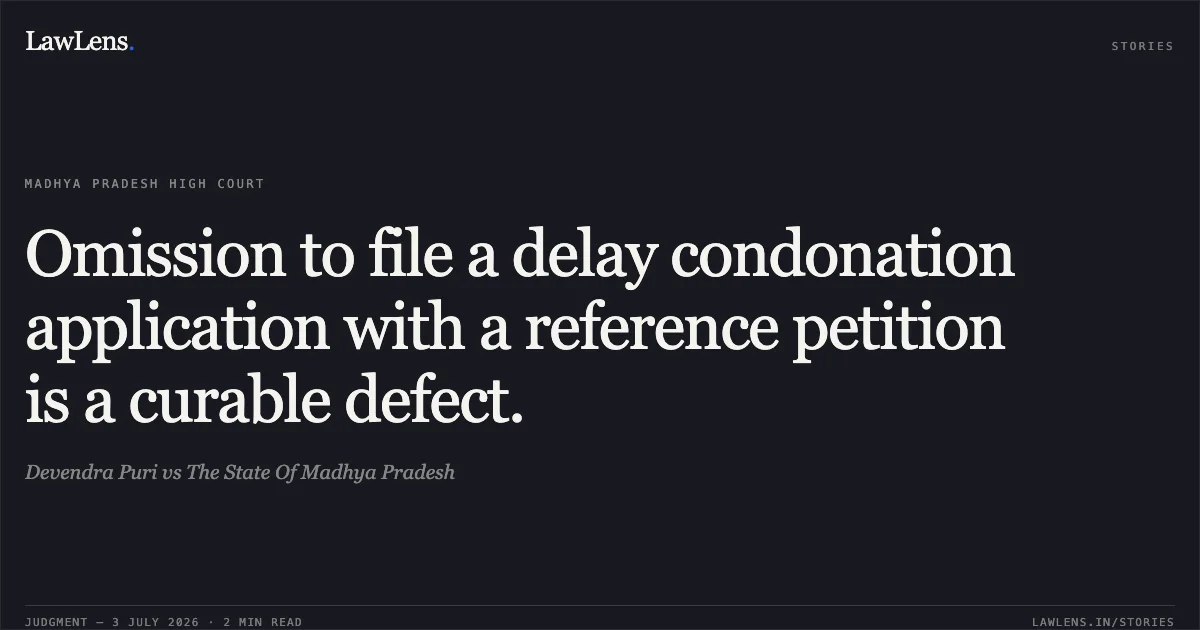
The petitioners’ lands were acquired and an award was subsequently passed. Seeking higher compensation, the petitioners filed applications for reference under Section 64 of the Right to Fair Compensation and Transparency in Land Acquisition, Rehabilitation and Resettlement Act, 2013 (the Act).
Source reference: para. 2-3On 20.01.2025, the Collector, Sagar, dismissed these applications on the grounds that they were barred by limitation.
Source reference: para. 2-3The petitioners challenged these orders before the High Court, admitting that while the applications were delayed, they were not accompanied by a formal application for condonation of delay due to professional oversight by their counsel.
Source reference: para. 5Issues
1. Whether the Collector is justified in dismissing a reference application under Section 64 of the Act solely on the grounds of limitation without providing the applicant an opportunity to file a delay condonation application.
Source reference: para. 9-10Law Applied
Section 64 of the Right to Fair Compensation and Transparency in Land Acquisition, Rehabilitation and Resettlement Act, 2013, noting the second proviso to Section 64(2) which empowers the Collector to entertain applications within a further period of one year beyond the limitation.
Source reference: para. 5The court relied on the Supreme Court precedent in State of M.P. v. Pradeep Kumar (2000) 7 SCC 372, which establishes that procedural defects like the omission of a delay condonation application (under Order 41 Rule 3-A of the CPC or similar provisions) are curable and should not be used to "pull down the shutters of adjudicatory jurisdiction" against a genuine grievance.
Source reference: para. 9It also referenced Khazan Singh (dead) by LRs. v. Union of India (2002) 2 SCC 242 regarding the entitlement to just and fair compensation despite delays.
Source reference: para. 5Reasoning
The court reasoned that the Act of 2013 is a "beneficial legislation" intended to protect the rights of landowners to receive just compensation.
Source reference: para. 4, 9While acknowledging that a Section 5 Limitation Act application should ideally accompany a time-barred reference, the court held that such a deficiency is a "curable defect".
Source reference: para. 9Applying the logic from Pradeep Kumar, the court observed that unintentional human error or a lawyer's fault should not lead to irreparable loss or the permanent closing of judicial doors.
Source reference: para. 5, 9The court found that the Collector, instead of dismissing the applications summarily, ought to have granted the petitioners an opportunity to rectify the mistake by filing an application under the second proviso to Section 64(2) of the Act.
Source reference: para. 9-10Holding
The High Court allowed the writ petitions and set aside the Collector’s orders dated 20.01.2025. The matter was remanded to the Collector for reconsideration.
The court directed the petitioners to appear before the Collector within 15 days and file an application for condonation of delay under Section 5 of the Limitation Act or the second proviso to Section 64(2) of the Act. It was clarified that if the petitioners fail to file said application within the stipulated time, the High Court's order shall lose its effect.
Source reference: para. 10, 11Acts & Sections Cited
2 provisions across 2 statutes referred to in this judgment. Each provision opens on LawLens.
Right to Fair Compensation and Transparency in Land Acquisition, Rehabilitation and Resettlement Act, 20131
Limitation Act, 19631
Original Court PDF
Devendra PurivsThe State Of Madhya Pradesh
Click to open original judgment
Original judgment, available to read, download and summarize on LawLens.in