Facts
The respondent filed a complaint under Section 138 of the Negotiable Instruments Act, 1881 (“NI Act”), alleging that the petitioner had borrowed ₹3,00,000 for “M/s. Fusion Design and Build” and issued a cheque for that amount, which was dishonoured. After service of statutory notice, the respondent initiated proceedings, which were pending as C.C. No. 523/2018.
Source reference: pp. 2–3, paras. 3–5The petitioner applied under Section 141 of the NI Act, arguing that the cheque had been issued on behalf of a partnership firm and that the complaint was not maintainable because the firm had not been impleaded. The Magistrate declined to terminate the proceedings, noting that the petitioner had not produced material establishing that the concern was a partnership firm.
Source reference: p. 4, paras. 6–7The petitioner challenged that order and sought, among other relief, quashing of the complaint.
Source reference: pp. 2, 4, paras. 2, 8Issues
1. Whether a complaint under Section 138 of the NI Act is not maintainable solely because the alleged partnership firm has not been separately arrayed as an accused.
Source reference: pp. 9–10, paras. 16–182. Whether the Supreme Court’s subsequent decision in “Dhanasingh Prabhu v. Chandrasekar & Anr.” applied to the petitioner’s pending proceedings, although the Magistrate’s order preceded that decision.
Source reference: pp. 7–9, paras. 11–15Law Applied
The Court considered Sections 138 and 141 of the NI Act and the Supreme Court’s ruling in “Dhanasingh Prabhu v. Chandrasekar & Anr.”, SLP (Criminal) No. 5706 of 2024, dated 14 July 2025.
Source reference: p. 5, para. 10.1As quoted by the Court, “Dhanasingh Prabhu” held that a complaint may remain maintainable despite the firm not being separately named as an accused where its partners are proceeded against, given the stated joint and several liability of the partners and firm.
Source reference: p. 5, para. 10.1The Court further treated that ruling as a declaration of the law governing the existing statutory scheme, applicable to pending proceedings absent an express prospective limitation.
Source reference: pp. 7–8, paras. 12–14Reasoning
The petitioner relied on the cheque’s indication that it was signed for “M/s. Fusion Design and Build” by a partner, and argued that the firm’s omission was fatal to the complaint.
Source reference: pp. 4–5, para. 9Applying “Dhanasingh Prabhu”, the Court held that non-impleadment of the firm, by itself, did not make the complaint unmaintainable. The petitioner’s objection therefore could not justify termination of the proceedings at that stage.
Source reference: pp. 9–10, paras. 17–19Questions concerning the concern’s status, the petitioner’s capacity in issuing the cheque, and the extent of his liability were left for consideration on the evidence before the Trial Court.
Source reference: pp. 9–10, paras. 17–19The later date of the Supreme Court ruling did not prevent its application to the pending petition, since the ruling declared the governing legal position and did not impose a prospective limitation.
Source reference: pp. 7–9, paras. 11–15Holding
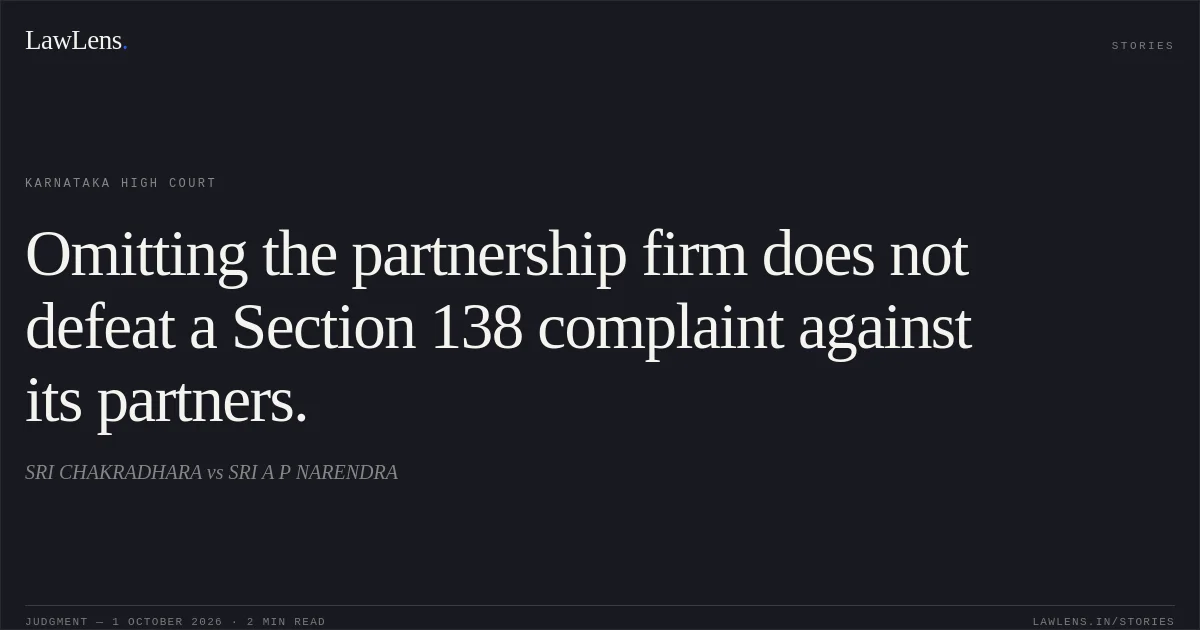
The Court answered the first issue in the negative: the complaint could not be dismissed solely because the alleged partnership firm had not been separately arrayed as an accused. It also held that “Dhanasingh Prabhu” applied to the matter before it.
The petition was dismissed, the Magistrate’s order was left undisturbed, and the petitioner remained at liberty to raise other factual and legal contentions before the Trial Court.
Source reference: pp. 10–11, paras. 20–21Acts & Sections Cited
6 provisions across 3 statutes referred to in this judgment. Each provision opens on LawLens.
Negotiable Instruments Act, 18812
Code of Criminal Procedure, 19732
Bharatiya Nagarik Suraksha Sanhita, 20232
Original Court PDF
SRI CHAKRADHARAvsSRI A P NARENDRA
Click to open original judgment
Original judgment, available to read, download and summarize on LawLens.in