Facts
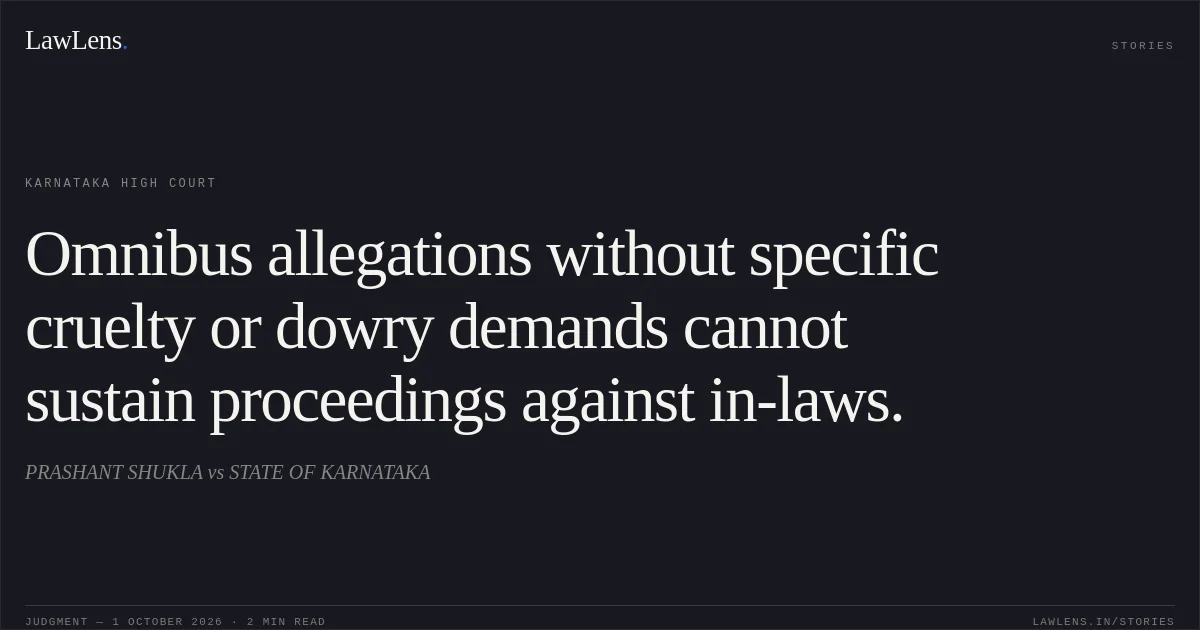
The complainant-wife’s complaint led to proceedings in C.C. No. 1040/2019 before the VI Additional Chief Metropolitan Magistrate, Bengaluru, against her husband (petitioner No. 1) and his parents (petitioners Nos. 2 and 3), alleging offences under Sections 498A, 504 and 506 of the IPC and Sections 3 and 4 of the Dowry Prohibition Act, 1961.
Source reference: p. 3The marriage took place in May 2015; the spouses lived together after marriage and later went abroad, and the complainant returned to India in 2018.
Source reference: p. 6The parents sought to quash the proceedings, alleging that the complaint contained only omnibus allegations against them.
Source reference: p. 3At the hearing, the petition was not pressed on behalf of the husband.
Source reference: p. 3Issues
Whether the complaint contained specific allegations of dowry demand or cruelty sufficient to continue the proceedings against the husband’s parents
Source reference: pp. 6–7Whether continuation of the proceedings against the parents amounted to an abuse of process warranting quashing under Section 482 of the Cr.P.C.
Source reference: p. 7Law Applied
The Court considered its inherent jurisdiction under Section 482 of the Code of Criminal Procedure, 1973, to quash proceedings where their continuation would amount to an abuse of process or cause a miscarriage of justice.
Source reference: p. 7It also considered the allegations under Section 498A of the IPC and Sections 3 and 4 of the Dowry Prohibition Act, 1961; the Court’s reasoning turned on whether the complaint made specific allegations of cruelty or dowry demand against the parents.
Source reference: pp. 5–7The Court referred generally to Supreme Court decisions cautioning against indiscriminately implicating family members in matrimonial disputes, but did not identify particular precedents.
Source reference: p. 8Reasoning
The Court found that the complaint referred to wedding expenses and gifts, including a gold ring and an earring, but did not specify a demand by petitioners Nos. 2 and 3 or identify witnesses to their alleged participation in such a demand.
Source reference: pp. 4, 6The allegation that the parents supported the husband’s “barbaric behaviour” and failed to advise him was, in the Court’s view, insufficiently specific to establish their participation in cruelty or dowry demands.
Source reference: pp. 4, 7It therefore concluded that continuing the criminal proceedings against the parents would amount to harassment and an abuse of process.
Source reference: p. 7Holding
The Court allowed the petition in part and quashed the proceedings only insofar as they concerned petitioners Nos. 2 and 3 (the husband’s parents).
The petition was rejected insofar as it concerned petitioner No. 1, the husband, against whom the challenge was not pressed.
Source reference: pp. 3, 8Acts & Sections Cited
5 provisions across 3 statutes referred to in this judgment. Each provision opens on LawLens.
Code of Criminal Procedure, 19731
Indian Penal Code, 18602
Original Court PDF
PRASHANT SHUKLAvsSTATE OF KARNATAKA
Click to open original judgment
Original judgment, available to read, download and summarize on LawLens.in