Facts
Mamta Devi alleged that, following her marriage to Vishal Kumar Pandey, her husband’s relatives demanded ₹1,00,000 as dowry and subjected her to cruelty and harassment; she further alleged that she was forced from the matrimonial home on 2 May 2009.
Source reference: pp. 2–3, paras. 2–6She filed Complaint Case No. 524(C) of 2009, alleging offences under Sections 498A, 406 and 120B of the Indian Penal Code (IPC) and Sections 3 and 4 of the Dowry Prohibition Act. After inquiry, cognizance was taken under Section 498A IPC and Sections 3 and 4 of the Act.
Source reference: p. 4, paras. 7The petitioners’ application for discharge under Section 245 of the Code of Criminal Procedure (CrPC) was rejected on 21 December 2011, prompting this petition under Section 482 CrPC.
Source reference: pp. 1, 4, paras. 1, 9The petitioners contended that the allegations against them were vague and omnibus and identified no individual acts of cruelty or participation in the alleged dowry demand.
Source reference: pp. 4–5, paras. 10–12The judgment also noted that the marriage was subsequently dissolved by a decree of divorce.
Source reference: pp. 11–12, paras. 32–35Issues
1. Whether the complaint and inquiry materials disclosed the ingredients of the alleged offences against each petitioner, given the absence of specific allegations of individual conduct.
Source reference: pp. 7–10, paras. 19–272. Whether continuation of the criminal proceedings against the petitioners would amount to an abuse of process warranting the High Court’s intervention under Section 482 CrPC.
Source reference: pp. 10–13, paras. 29–40Law Applied
Section 498A IPC criminalises cruelty by a husband or his relative, including wilful conduct likely to cause grave injury or harassment intended to coerce the woman or a person related to her to meet an unlawful demand.
Source reference: pp. 6–7, para. 17Sections 3 and 4 of the Dowry Prohibition Act address giving or taking dowry and demanding dowry; the judgment considered whether the materials disclosed the petitioners’ specific participation in the alleged demand.
Source reference: p. 10, paras. 27–28Under Section 482 CrPC, the High Court may intervene to prevent abuse of court process or secure the ends of justice where allegations, even taken at face value, do not disclose the required ingredients of an offence, while ordinarily avoiding a meticulous assessment of evidence.
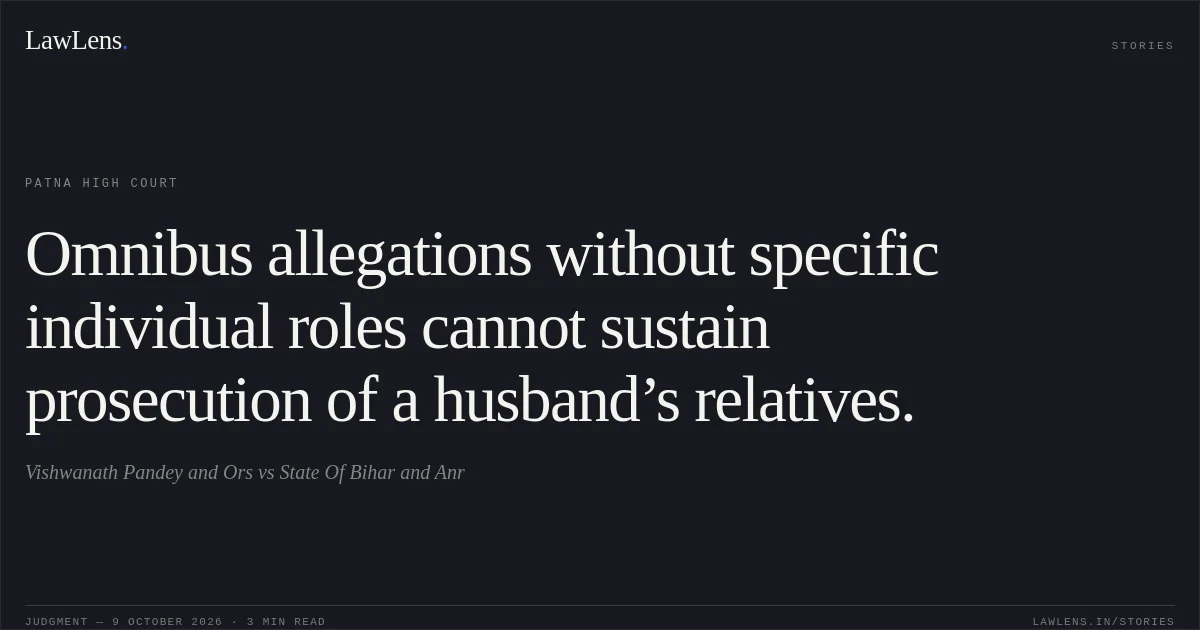
Source reference: pp. 10–11, paras. 30–31Relying on Kahkashan Kausar @ Sonam v. State of Bihar, (2022) 6 SCC 599, the Court stated that relatives should not be prosecuted on omnibus allegations absent specific instances of involvement.
Source reference: p. 8, para. 23It also relied on Arti Mehta v. State of Madhya Pradesh, 2026 SCC OnLine SC 933, for the need to scrutinise whether allegations disclose an offence against each accused.
Source reference: pp. 8–9, para. 24Reasoning
The Court found that the complaint and inquiry statements made general allegations of dowry demand and cruelty but did not identify what any individual petitioner had done to commit those offences.
Source reference: pp. 7–10, paras. 21–27The allegation of a ₹1,00,000 demand, without sufficient particulars of each petitioner’s participation, did not justify continuing the prosecution against them under the Dowry Prohibition Act.
Source reference: p. 10, paras. 27–28Applying the principles in Kahkashan Kausar and Arti Mehta, the Court held that relatives could not be prosecuted merely because of their relationship to the husband.
Source reference: pp. 8–10, paras. 23–26Although the subsequent dissolution of the marriage did not itself extinguish any criminal offence, the Court considered it alongside the lack of specific allegations and concluded that continued proceedings against the petitioners would serve no useful purpose and amount to abuse of process.
Source reference: pp. 12–13, paras. 34–40Holding
The Court allowed the Section 482 CrPC application, quashed the order dated 21 December 2011 rejecting the petitioners’ discharge application, and discharged the petitioners from the case.
It also quashed the criminal proceedings arising from Complaint Case No. 524(C) of 2009 insofar as they concerned the petitioners.
Source reference: p. 14, para. 43Acts & Sections Cited
6 provisions across 4 statutes referred to in this judgment. Each provision opens on LawLens.
Code of Criminal Procedure, 19732
Indian Penal Code, 18601
Hindu Marriage Act, 19551
Original Court PDF
Vishwanath Pandey and OrsvsState Of Bihar and Anr
Click to open original judgment
Original judgment, available to read, download and summarize on LawLens.in