Facts
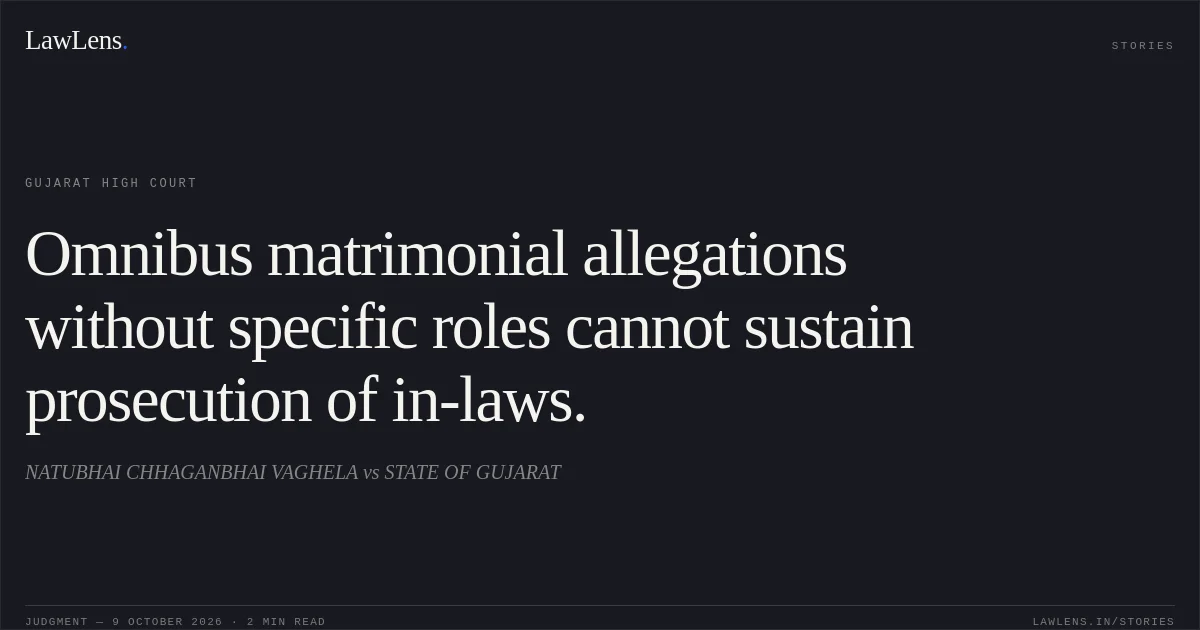
The complainant’s FIR alleged that, after her marriage to accused No. 1, her in-laws (the present applicants, accused Nos. 2–5) made dowry-related remarks and demands, subjected her to verbal mistreatment, and instigated her husband to ill-treat and eventually exclude her from the matrimonial home.
Source reference: p. 2–3She alleged that she was required to bring ₹5 lakh from her parents.
Source reference: p. 2–3The FIR, registered on 16 February 2021, invoked Sections 498A, 323, 504, 294(b) and 114 of the Indian Penal Code, 1860, and Sections 3 and 7 of the Dowry Prohibition Act, 1961.
Source reference: p. 1The applicants sought quashing under Section 482 of the Code of Criminal Procedure, 1973, contending that the allegations against them were vague and that the complainant and accused No. 1 had settled their disputes and obtained a divorce decree on 18 September 2024.
Source reference: p. 3–4, 6The complainant did not appear despite service of notice.
Source reference: p. 4Issues
1. Whether the FIR contained sufficiently specific allegations against applicants Nos. 2–5 to warrant continuation of the criminal proceedings against them
Source reference: p. 4–62. Whether the applicants’ prosecution should be quashed under Section 482 CrPC in light of the parties’ settlement and the subsequent divorce decree
Source reference: p. 6Law Applied
Section 482 CrPC preserves the High Court’s inherent power to quash proceedings to prevent abuse of process or secure the ends of justice.
Source reference: p. 1The Court applied the principle in Dara Lakshmi Narayana v. State of Bihar, (2025) 3 SCC 735, that merely naming family members in a matrimonial-dispute prosecution, without specific allegations showing their active involvement, is insufficient to sustain prosecution; vague and sweeping accusations warrant judicial caution.
Source reference: p. 5–6The FIR also invoked Sections 498A, 323, 504, 294(b) and 114 IPC and Sections 3 and 7 of the Dowry Prohibition Act, 1961.
Source reference: p. 1Reasoning
The Court found that the allegations against applicants Nos. 2 and 3 principally concerned alleged instigation and remarks about dowry, while those against applicants Nos. 4 and 5 were general allegations about clothing, household work, abusive language and instigation.
Source reference: p. 4–6It considered these allegations omnibus and lacking a specific role, time or place; the alleged dowry demand was also not tied to a date or time or to a proximate act by the applicants.
Source reference: p. 4–6Applying Dara Lakshmi Narayana, the Court concluded that the allegations did not disclose a sufficient basis to prosecute these applicants.
Source reference: p. 6It also took account of the parties’ settlement, the withdrawal arrangement recorded in the matrimonial proceedings, and the divorce decree, and held that continuing the investigation against the applicants would amount to abuse of process.
Source reference: p. 6Holding
The Court allowed the application and quashed FIR No. 11196016210213 of 2021, together with all consequential proceedings, qua applicants Nos. 1–4 in the application (accused Nos. 2–5 in the FIR).
The rule was made absolute to that extent; the order did not quash proceedings against accused No. 1.
Source reference: p. 7Acts & Sections Cited
7 provisions across 3 statutes referred to in this judgment. Each provision opens on LawLens.
Code of Criminal Procedure, 19731
Indian Penal Code, 18604
Original Court PDF
NATUBHAI CHHAGANBHAI VAGHELAvsSTATE OF GUJARAT
Click to open original judgment
Original judgment, available to read, download and summarize on LawLens.in