Facts
The Petitioner, a partnership concern engaged in manufacturing and supplying printed materials, was registered under the GST regime.
Source reference: para. 5The Directorate General of GST Intelligence, Delhi Zonal Unit (“DGGI/DZU”) commenced an investigation into the Petitioner’s affairs in December 2020, followed by searches on 21 December 2020.
Source reference: para. 6The DGGI alleged that the Petitioner had fraudulently availed and utilised inadmissible input tax credit (“ITC”) on invoices issued without actual supply of goods, including invoices relating to polycarbonate sheets, metallised paper and coated/uncoated paper.
Source reference: p. 3 / paras. 6–7Separately, the State GST authorities initiated proceedings under Section 73 of the DGST Act for the periods July 2017–March 2018, April 2018–March 2019 and April 2019–March 2020.
Source reference: p. 3 / paras. 8–9Those proceedings allegedly concerned wrongful availment of ITC from cancelled or non-existent suppliers and culminated in demand orders.
Source reference: p. 3 / paras. 8–9Thereafter, the DGGI issued a Show Cause Notice dated 3 August 2024 under Section 74 of the CGST Act, proposing recovery of allegedly wrongful ITC for the period July 2017–March 2024, along with interest and penalty.
Source reference: p. 4 / para. 10The Petitioner challenged the DGGI proceedings under Article 226, principally contending that Section 6(2)(b) of the CGST Act barred initiation of proceedings by the Central authorities because the State authorities had already initiated proceedings concerning the same subject matter.
Source reference: p. 4 / para. 11During the pendency of the writ petition, the adjudicating authority passed Order-in-Original No. 87/CGST WEST/GST/S GARG/ADC/2024-25 dated 31 January 2025, confirming allegedly ineligible ITC of ₹5,71,00,237, together with interest and penalty.
Source reference: p. 5 / para. 13Issues
Whether the writ petition should be entertained after the passing of the Order-in-Original dated 31 January 2025, when the Petitioner had an efficacious statutory remedy of appeal under Section 107 of the CGST Act?
Source reference: p. 2 / para. 3; p. 10 / paras. 17–19Whether the proceedings initiated by the DGGI/DZU and the earlier proceedings initiated by the State GST authorities concerned the “same subject matter” so as to attract the bar under Section 6(2)(b) of the CGST Act?
Source reference: p. 2 / para. 3; p. 11 / paras. 20–23Whether the Petitioner’s jurisdictional objection under Section 6(2)(b), together with its challenge to the demand and evidentiary findings, should be examined in writ jurisdiction or left for consideration by the statutory appellate authority?
Source reference: p. 13 / paras. 31–34Law Applied
Section 6(2)(b) of the CGST Act was relied upon as the statutory provision governing the impermissibility of parallel proceedings by Central and State GST authorities concerning the same subject matter.
Source reference: p. 5 / paras. 14.1–14.4Section 107 of the CGST Act provides a statutory appeal against an adjudication order and formed the principal basis for relegating the Petitioner to the appellate remedy.
Source reference: p. 10 / paras. 19, 24–25The Court applied the general principle that writ jurisdiction under Article 226 may ordinarily be declined where an efficacious alternative statutory remedy exists, particularly when disputed questions concerning the factual basis, scope and overlap of proceedings require examination.
Source reference: p. 11 / paras. 21–24The proceedings involved the contrasting statutory schemes of Section 73 and Section 74 of the CGST Act, but the Court expressly left the significance of that distinction open.
Source reference: no citationThe decisions cited by the parties—including Toyota Kirloskar Motors Pvt. Ltd. v. Union of India, Rajesh Mittal v. Union of India, M/s Aastha Apparels Pvt. Ltd. v. DGGI, M/s PEI Industries v. Union of India and M/s Armour Security (India) Ltd. v. Commissioner, CGST—were not substantively applied and were left for consideration by the appellate authority.
Source reference: p. 12 / paras. 28–30Reasoning
The Court held that the character of the proceedings had materially changed because the challenge was no longer confined to a Show Cause Notice; an Order-in-Original had subsequently determined the Petitioner’s liability.
Source reference: p. 10 / paras. 17–19The Petitioner’s Section 6(2)(b) objection required comparison of the State GST and DGGI proceedings, including their allegations, transactions, ITC claims, evidentiary foundations and the extent of factual overlap.
Source reference: p. 11 / paras. 20–23The parties disputed whether the State proceedings were merely return-based proceedings involving specific instances of ineligible ITC, or whether they overlapped with the DGGI’s investigation into alleged bogus invoices and non-existent supplies.
Source reference: p. 11 / para. 22Since resolving that dispute would involve factual and evidentiary examination, and since the Order-in-Original was appealable under Section 107, the Court declined to undertake that inquiry in extraordinary writ jurisdiction.
Source reference: p. 11 / paras. 23–25The Court further held that the jurisdictional character of the Section 6(2)(b) objection did not justify writ intervention in the circumstances because its determination itself depended upon the nature and scope of the competing proceedings.
Source reference: p. 14 / para. 34Holding
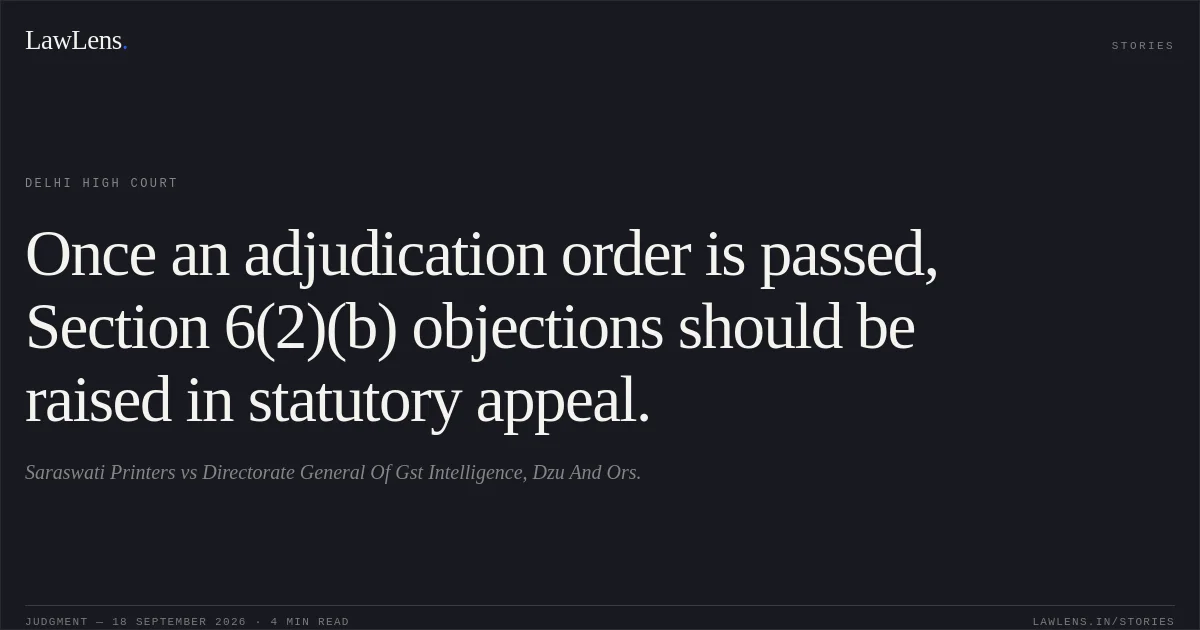
The Court declined to entertain the writ petition on account of the availability of an efficacious statutory appeal under Section 107 of the CGST Act after the passing of the Order-in-Original dated 31 January 2025.
The Petitioner was relegated to the appellate remedy and was permitted to raise all available grounds, including the objection under Section 6(2)(b), the alleged overlap between the State GST and DGGI proceedings, and challenges to the factual, evidentiary and legal basis of the demand.
Source reference: p. 14 / paras. 35–37; p. 15 / para. 39The Court expressly declined to decide whether the proceedings concerned the same subject matter or whether the DGGI proceedings were barred under Section 6(2)(b), leaving those questions open for the appellate authority.
Source reference: p. 15 / para. 40The writ petition and pending application were accordingly dismissed.
Source reference: p. 15 / para. 41Acts & Sections Cited
6 provisions across 2 statutes referred to in this judgment. Each provision opens on LawLens.
Central Goods and Services Tax Act, 20175
Integrated Goods and Services Tax Act, 20171
Original Court PDF
Saraswati PrintersvsDirectorate General Of Gst Intelligence, Dzu And Ors.
Click to open original judgment
Original judgment, available to read, download and summarize on LawLens.in