Facts
The appellant was prosecuted for repeated sexual assault upon a minor girl, then aged about 11 years, during December 2015, allegedly accompanied by threats to kill her younger brother.
Source reference: paras. 4–9The prosecution case was initiated on the victim’s complaint dated 14 March 2016, after the appellant allegedly returned to the family home.
Source reference: paras. 4–9The victim’s age was proved through her birth certificate, recording her date of birth as 2 December 2004.
Source reference: paras. 4–9The Trial Court convicted the appellant under Sections 376(2)(i) and 506(II) IPC and Section 6 of the POCSO Act, sentencing him to 15 years’ rigorous imprisonment under Section 6 POCSO, five years’ rigorous imprisonment under Section 506(II) IPC, and fines, with concurrent sentences.
Source reference: paras. 20, 24–26The appellant challenged the conviction on the grounds that the victim’s versions contained material contradictions, the grandmother’s evidence was inconsistent, the medical and forensic evidence did not corroborate the prosecution, material witnesses were not examined, and the foundational facts for invoking Section 29 of the POCSO Act had not been established.
Source reference: para. 27The medical evidence showed an absent hymen but no fresh genital or perineal injuries; forensic examination detected no semen or sperm on the articles examined.
Source reference: paras. 13, 18, 21–22Issues
Whether the prosecution proved beyond reasonable doubt that the appellant committed aggravated penetrative sexual assault and criminal intimidation against the minor victim.
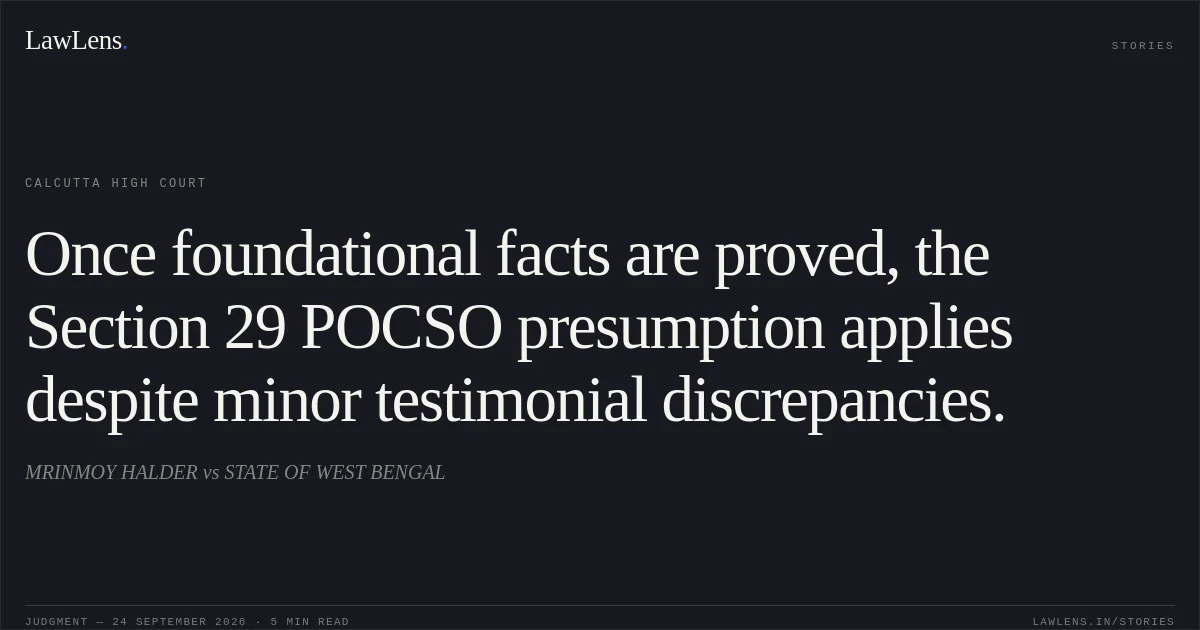
Source reference: paras. 28–30, 70–72Whether the foundational facts necessary to invoke the rebuttable presumption under Section 29 of the POCSO Act were established.
Source reference: paras. 31, 40–45Whether the inconsistencies between the victim’s complaint, Section 164 CrPC statement, trial testimony, and the grandmother’s evidence created a reasonable doubt.
Source reference: paras. 57–69Whether the delay in lodging the FIR, non-examination of the victim’s mother and brother, and absence of positive forensic evidence weakened the prosecution case.
Source reference: paras. 51–56, 64–65Whether the sentence of 15 years’ rigorous imprisonment required modification in light of the appellant’s custody, remission, conduct, and prospects of rehabilitation.
Source reference: paras. 73–77Whether the victim was entitled to enhanced compensation and whether directions were required to protect her identity in the trial-court records.
Source reference: paras. 80–86Law Applied
The Court applied Sections 3, 5, 6, 29 and 33(7) of the POCSO Act, Sections 376(2)(i), 506(II) and 42 IPC, and Sections 428 and 357A CrPC.
Source reference: no citationUnder Section 29 POCSO, the prosecution must first establish foundational facts by cogent, trustworthy and reliable evidence; only thereafter does the rebuttable presumption arise against the accused.
Source reference: paras. 31, 40–45The Court held that the credible testimony of a sexual-assault victim can independently sustain conviction without mandatory corroboration, relying on Vijay @ Chinee v. State of Madhya Pradesh, Ganesan v. State and Sua v. State of Rajasthan.
Source reference: paras. 47–50It further applied the principle that discrepancies which do not affect the identity of the offender, the nature of the sexual act, or the core prosecution case are not fatal, relying on Bharwada Bhoginbhai v. State of Gujarat and State of U.P. v. M.K.
Source reference: paras. 59–63Delay in reporting a sexual offence is to be assessed in context and is not automatically fatal where satisfactorily explained, as recognised in State of Himachal Pradesh v. Prem Singh and Tulshidas Kanolkar v. State of Goa.
Source reference: paras. 51–55The Court also applied the principle that non-examination of a witness does not by itself vitiate the prosecution case where the evidence adduced is otherwise sufficient.
Source reference: para. 65For sentencing, the Court relied on its power to modify sentence while affirming conviction, including the principles recognised in Sachin v. State of Maharashtra and Pradeep Kumar v. State.
Source reference: paras. 74–76The victim’s compensation was governed by Section 357A CrPC and the West Bengal Victim Compensation Scheme, 2017, while confidentiality was mandated by Section 33(7) POCSO.
Source reference: paras. 80–86Reasoning
The Court found the victim’s account consistent on the material particulars: the appellant was identified as the perpetrator, had regular access to the house through his relationship with the victim’s mother, repeatedly removed the victim’s clothes and penetrated her, and used gagging and threats to prevent disclosure.
Source reference: paras. 32–36, 41The victim’s age and the appellant’s access to her were independently established, thereby supplying the necessary foundational facts for Section 29 POCSO.
Source reference: paras. 32–43The Court treated the discrepancies regarding the presence of the younger brother, chronology, precise location, and sequence of disclosure as variations concerning surrounding circumstances rather than contradictions affecting the core offence.
Source reference: paras. 62–67The inconsistency in the grandmother’s claim that she personally witnessed the assault was excluded as unreliable to that extent, but the Court held that it did not undermine the victim’s direct testimony.
Source reference: para. 66The delay was explained by the appellant’s threats, his relationship with the victim’s mother, and the victim’s age and vulnerability.
Source reference: paras. 51–56The absence of fresh injuries and negative forensic results did not negate penetration, particularly since the medical examination occurred substantially after the alleged incidents and ejaculation was not an ingredient of the offence.
Source reference: paras. 37–39The non-examination of the mother and brother was held to deprive the prosecution only of additional corroboration, not to destroy an otherwise reliable case.
Source reference: paras. 64–65Having found the presumption under Section 29 attracted, the Court held that the appellant failed to rebut it.
Source reference: paras. 45, 70–71However, considering the appellant’s prolonged custody, remission, satisfactory conduct and rehabilitative prospects, the Court reduced the sentence under Section 6 POCSO from 15 years to 13 years and 6 months.
Source reference: paras. 74–77Holding
The appeal was dismissed on the merits, and the appellant’s convictions under Sections 376(2)(i) and 506(II) IPC and Section 6 POCSO were affirmed.
The sentence under Section 6 POCSO was modified from 15 years’ rigorous imprisonment to 13 years and 6 months’ rigorous imprisonment; the sentence under Section 506(II) IPC was maintained, with all sentences to run concurrently and the benefit of set-off under Section 428 CrPC preserved.
Source reference: para. 77The compensation payable to the victim was enhanced from ₹3,00,000 to ₹4,50,000 under the West Bengal Victim Compensation Scheme, 2017, with directions for payment of the balance within 30 days.
Source reference: paras. 80–83The Trial Court was directed to redact the victim’s name, address and identifying particulars from the records and copies supplied or inspected, in compliance with Section 33(7) POCSO.
Source reference: paras. 84–86Acts & Sections Cited
17 provisions across 3 statutes referred to in this judgment. Each provision opens on LawLens.
Indian Penal Code, 18602
Protection of Children from Sexual Offences Act, 20128
Code of Criminal Procedure, 19737
Original Court PDF
MRINMOY HALDERvsSTATE OF WEST BENGAL
Click to open original judgment
Original judgment, available to read, download and summarize on LawLens.in