Facts
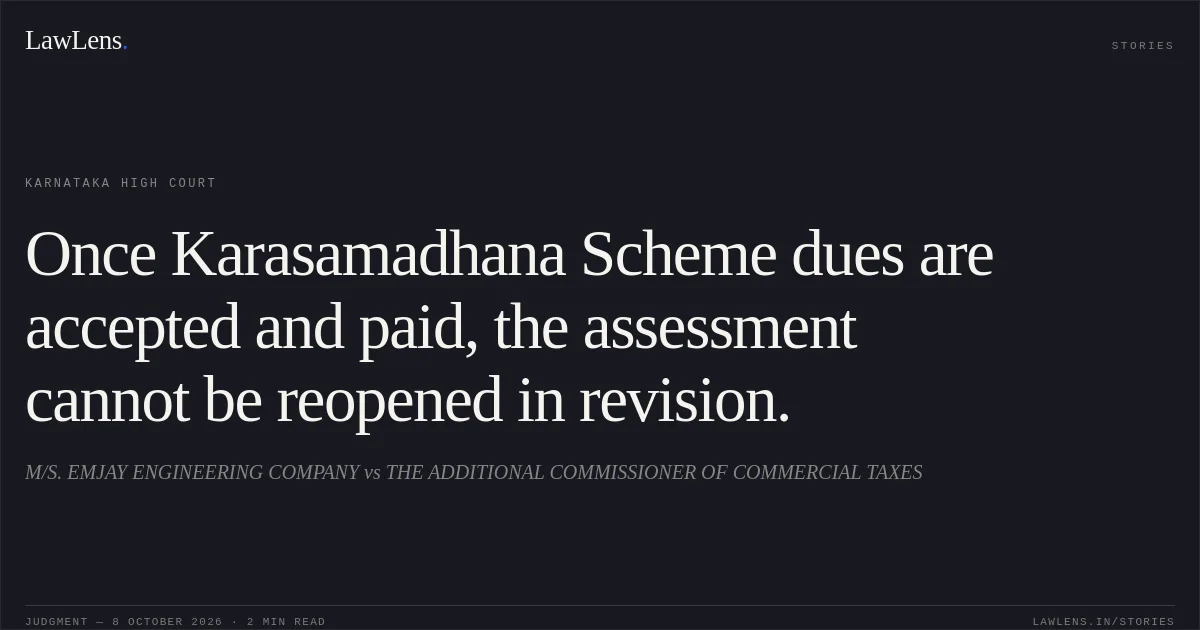
For the 2016–17 assessment year, the appellant’s application under the Karasamadhana Scheme, 2021 was accepted, and the appellant paid ₹46,002 towards tax, penalty and interest pursuant to the order dated 13 July 2021.
Source reference: p. 5; p. 8More than four years later, the Revisional Authority issued a notice under Section 64(1) of the Karnataka Value Added Tax Act, 2003 (KVAT Act), seeking to set aside the First Appellate Authority’s order dated 22 January 2021.
Source reference: p. 4–5, 8The appellant objected that acceptance under the Scheme precluded reopening the assessment.
Source reference: p. 4–5, 8The Revisional Authority nevertheless set aside the appellate order and directed recomputation of turnover and tax liability.
Source reference: p. 4–5, 8The appellant appealed to the High Court against the revisional order dated 30 March 2025.
Source reference: p. 2–3Issues
1. Whether the Revisional Authority was justified in invoking Section 64(1) of the KVAT Act to set aside the First Appellate Authority’s order after the assessment had been settled under the Karasamadhana Scheme, 2021
Source reference: p. 32. Whether the Revisional Authority could reopen or revise the matter after the appellant’s application under the Scheme had been accepted and payment made, without addressing the appellant’s objection based on the Scheme
Source reference: p. 4–5, 83. Whether the revisional order was sustainable insofar as it modified the appellate order and restricted input tax credit
Source reference: p. 3Law Applied
Section 64(1) of the KVAT Act confers revisional power on the authority; however, its exercise in this case had to be considered in light of the Karasamadhana Scheme, 2021.
Source reference: p. 6–8Clause 6.2 requires the concerned authority to scrutinize the application, determine the arrears payable, and inform the applicant of any discrepancy within 15 days.
Source reference: p. 6–8Clauses 6.3 and 6.4 set out the consequences and requirements concerning payment and withdrawal of appeals or other applications.
Source reference: p. 6–8The Court identified no precedent as the basis for its decision.
Source reference: no citationReasoning
The Court found that the appellant’s application under the Scheme had been accepted and the required amount paid, and that no discrepancy had been identified or communicated within the 15-day period prescribed by Clause 6.2.
Source reference: p. 5, 8The Revisional Authority did not address the appellant’s contention that acceptance under the Scheme precluded reopening, yet proceeded to set aside the appellate order.
Source reference: p. 5–6, 8–9In those circumstances, the Court held that issuing the revisional notice and passing the impugned order were contrary to the Scheme and unjustified.
Source reference: p. 5–6, 8–9Holding
The High Court allowed the appeal and set aside the Revisional Authority’s order dated 30 March 2025.
It held that, in the circumstances of this case, the authority was not justified in invoking Section 64(1) of the KVAT Act to set aside the First Appellate Authority’s order after the appellant’s application under the Karasamadhana Scheme had been accepted and payment made.
Source reference: p. 8–9Acts & Sections Cited
3 provisions across 1 statute referred to in this judgment. Linked provisions open on LawLens.
Karnataka Value Added Tax Act, 20033
Original Court PDF
M/S. EMJAY ENGINEERING COMPANYvsTHE ADDITIONAL COMMISSIONER OF COMMERCIAL TAXES
Click to open original judgment
Original judgment, available to read, download and summarize on LawLens.in