Facts
Green Ivy Ventures Pvt. Ltd., formerly known as Narayana Learning Pvt. Ltd., conducted coaching classes for competitive examinations through several branches. The Department alleged that the appellant had short-paid service tax by excluding amounts collected under various heads—including study material, hostel fee, mess fee, “other fee,” examination and application fees, reservation charges and miscellaneous income—from the taxable value of Commercial Training or Coaching Service (“CTCS”) and, after 1 July 2012, taxable services under the negative-list regime.
Source reference: paras. 3; p. 5The Department also alleged short-payment on tuition-fee income recorded as receivable in the appellant’s books and sought service tax on rental income and additional income disclosed before the income-tax authorities.
Source reference: paras. 6, 18–20; pp. 7–15Seven adjudication orders covering periods from 2003–04 to June 2017 confirmed, wholly or partly, service-tax demands and penalties. The appellant challenged the demands, while the Department filed appeals against the dropping of demands relating principally to mess charges and study material.
Source reference: paras. 1–2; pp. 3–5The appellant contended that the sale of books and study material constituted a distinct sale of goods, and that hostel and mess facilities were independent, non-taxable activities lacking nexus with coaching services.
Source reference: paras. 4–7; pp. 6–8Issues
Whether the value of books and study material supplied to students was includible in the taxable value of CTCS or taxable services under the post-1 July 2012 regime.
Source reference: paras. 11–15; pp. 9–12Whether hostel fees, mess fees and amounts recorded as “other fee” were consideration for CTCS and liable to service tax.
Source reference: paras. 11, 16–17; pp. 9, 12–13Whether amounts collected towards applications, examination fees, reservation of seats, admission fees, ID cards, deposits, dhobi charges, pocket money and other miscellaneous items were connected with CTCS and taxable.
Source reference: paras. 11, 19–20; pp. 9, 14–15Whether the alleged differential service tax on tuition-fee income recorded as receivable was sustainable under the Point of Taxation Rules, 2011.
Source reference: paras. 6, 9, 18; pp. 7–8, 13–14Whether additional income of ₹10 crore disclosed before the income-tax authorities could be presumed to arise from taxable coaching services.
Source reference: paras. 19–23; pp. 14–17Whether rental income received from premises leased to an educational institution was liable to service tax.
Source reference: para. 27; p. 18Whether the extended period of limitation and penalties under Sections 76, 77 and 78 of the Finance Act, 1994 were invocable.
Source reference: paras. 21–26; pp. 15–18Whether the appellant was entitled to the benefit of Notification No. 12/2003-ST, as amended by Notification No. 12/2004-ST, in respect of study material supplied before 1 July 2012.
Source reference: paras. 11–15; pp. 9–12Law Applied
The Tribunal applied the Finance Act, 1994, including the provisions governing CTCS, the definition and exclusion of “service” under Section 65B(44), the negative list under Section 66D, valuation under Section 67 and the cum-tax principle under Section 67(2).
Source reference: paras. 12–15; pp. 9–12It held that goods sold in a distinct transaction, including books and study material, could not be subjected to service tax merely because they were supplied by a coaching provider; for the pre-negative-list period, their value could be excluded under Notification No. 12/2003-ST, subject to satisfaction of its conditions.
Source reference: paras. 12–15; pp. 9–12The Tribunal relied on Cerebral Learning Solutions Pvt. Ltd. v. CCE, Indore, affirmed by the Supreme Court, and related decisions holding that independently sold study material is not part of the value of coaching services.
Source reference: para. 14; p. 11It further applied the nexus principle—that the consideration must arise from the taxable service—to exclude hostel and mess charges, relying on Aditya College of Competitive Exam v. CCE and Vikas Coaching Centre v. CC & ST.
Source reference: paras. 16–17; pp. 12–13On limitation and penalties, the Tribunal relied on Nizam Sugar Factory v. Collector, Chemphar Drugs & Liniments, Cosmic Dye Chemical and related authorities, holding that mere non-payment or a debatable interpretation of taxability does not establish suppression or wilful misstatement.
Source reference: paras. 21–25; pp. 15–18Section 80 was applied to waive penalties where the appellant had reasonable cause for the failure.
Source reference: para. 26; p. 18Reasoning
The Tribunal found that the appellant’s invoices and books separately identified study material and that the material constituted goods leviable to VAT, even though exempt from VAT; consequently, it was not transformed into a taxable service merely because it supported the coaching activity.
Source reference: paras. 12–14; pp. 9–11The Department had not alleged in the show-cause notices that the material formed an integral or bundled service, and the adjudicating authority therefore could not sustain the demand on that additional basis.
Source reference: para. 13; p. 10Hostel and mess facilities were optional and independently provided, and earlier departmental adjudication had already accepted that they lacked nexus with CTCS; amounts described as “other fee” were excluded to the extent supported by evidence showing that they represented hostel, mess or study-material charges.
Source reference: paras. 16–17; pp. 12–13Likewise, the Department failed to prove that miscellaneous receipts, application fees, deposits, examination fees or similar collections represented consideration for coaching services.
Source reference: para. 20; p. 15The tuition-fee differential was attributable to accounting entries passed as receivables and was paid in the succeeding month; since there was no evasion of tax, the demand based solely on the accounting method was unsustainable.
Source reference: para. 18; p. 14The ₹10 crore income-tax disclosure could not, without proof of its connection with a taxable service, be treated as taxable service consideration.
Source reference: paras. 20, 23; pp. 15–17The Tribunal also held that the continuing dispute over the taxability of non-tuition receipts, the appellant’s regular filing of returns and the absence of deliberate concealment defeated invocation of the extended limitation period and penalties.
Source reference: paras. 23–26; pp. 17–18Holding
The appeals filed by Green Ivy Ventures were partly allowed, and the Department’s appeals were dismissed.
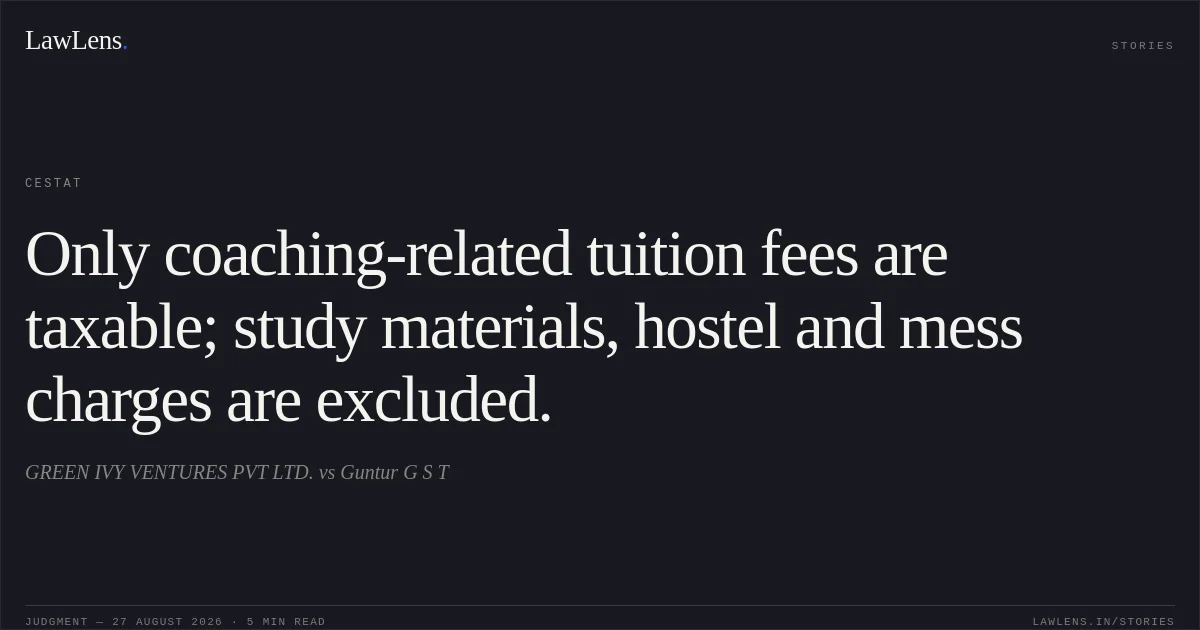
The Tribunal held that service tax was sustainable on tuition-fee receipts attributable to CTCS, but demands relating to books and study material, hostel fee, mess fee, unsupported “other fee,” miscellaneous collections, rental income and the ₹10 crore additional income were set aside or remanded for re-determination where necessary.
Source reference: para. 28; pp. 18–19The appellant was granted the benefit of Notification No. 12/2003-ST up to 30 June 2012, subject to the Tribunal’s findings and supporting certification.
Source reference: paras. 15, 28(h); pp. 11–12, 19The extended period was held unavailable; penalties under Sections 76 and 77 were waived under Section 80, and penalty under Section 78 was set aside.
Source reference: paras. 24–26, 28(i)–(k); pp. 17–19Cum-tax benefit was directed to be granted wherever not already extended, and interest was held payable only on any service tax surviving after re-determination.
Source reference: para. 28(l)–(m); p. 19Acts & Sections Cited
9 provisions across 2 statutes referred to in this judgment. Linked provisions open on LawLens.
Finance Act, 19947
Point of Taxation Rules, 20112
Original Court PDF
GREEN IVY VENTURES PVT LTD.vsGuntur G S T
Click to open original judgment
Original judgment, available to read, download and summarize on LawLens.in
![Courts will not interfere with transfers absent mala fides or violation of statutory rules.. M Ramya vs EMPLOYEES STATE INSURANCE CORPORATION (ESIC). CAT - ['Chennai']. LawLens](/stories/thumbnails/courts-will-not-interfere-with-transfers-absent-mala-fides-or-violation-of-statutory-rules-a6845e9ca6f548fca284c51c8351957f.webp)
![Courts cannot direct one-time recruitment age relaxation absent authority in the governing rules or advertisement.. UT OF PUDUCHERRY vs M ANDAL. CAT - ['Chennai']. LawLens](/stories/thumbnails/courts-cannot-direct-one-time-recruitment-age-relaxation-absent-authority-in-the-governing-895d78fde47143e2a8ed0207c4b6a44f.webp)
![A review cannot correct an allegedly erroneous decision absent an error apparent on the record.. Ajit Kumar Jha vs RAILWAY BOARD. CAT - ['Delhi']. LawLens](/stories/thumbnails/a-review-cannot-correct-an-allegedly-erroneous-decision-absent-an-error-apparent-on-the-re-8ac952fd4eba470c92f7da20af72a220.webp)