Facts
The petitioner was appointed as Senior Deputy Director General (Non-Communicable Diseases) in the Indian Council of Medical Research (ICMR) by office order dated 31 December 1998, at a pay scale of ₹18,400 per month, with the approval of the ICMR Executive Committee (EC).
Source reference: p.2, para. 1In 2015, she was served with a charge-sheet under Rule 14 of the Central Civil Services (Classification, Control and Appeal) Rules, 1965, concerning her alleged approval and non-objection to the transfer of an ICMR plot to a private cooperative housing society.
Source reference: pp.2–3, para. 2The charge-sheet was signed by the Senior Deputy Director General and Chief Vigilance Officer, but stated that the Director General (DG) had approved institution of disciplinary proceedings.
Source reference: pp.3, 11, paras. 3, 21The petitioner challenged the charge-sheet before the Central Administrative Tribunal, contending that the EC, and not the DG or Senior DDG, was her competent disciplinary authority and that the alleged acts did not constitute misconduct.
Source reference: pp.3–4, paras. 3–4The Tribunal dismissed the challenge, holding that the DG possessed the relevant appointment and termination powers and was therefore competent to issue the charge-sheet.
Source reference: pp.4–8, paras. 7–9The petitioner thereafter filed the present writ petition.
Source reference: p.4, para. 5Issues
Whether the charge-sheet was issued by an authority competent to institute disciplinary proceedings against the petitioner under Rules 13(2), 14 and 2(a) of the CCS (CCA) Rules, 1965?
Source reference: pp.13–16, paras. 24–32Whether the DG could validly act as the petitioner’s disciplinary authority merely because the DG was the appointing authority for the post at the time when the charge-sheet was issued, despite the EC having approved the petitioner’s appointment in 1998?
Source reference: pp.8–12, paras. 11–16; pp.15–20, paras. 28–39Whether the charge-sheet could be challenged at the threshold, without the petitioner participating in the disciplinary inquiry, on the ground of want of competence or because the alleged acts did not constitute misconduct?
Source reference: pp.4–5, paras. 6–7; p.12, paras. 18–20Law Applied
The Court applied Rule 13(2) of the CCS (CCA) Rules, which authorises a disciplinary authority competent to impose minor penalties to institute proceedings even where major penalties are proposed.
Source reference: p.14, para. 25Rules 14(3) and 14(4) require the disciplinary authority to draw up, or cause to be drawn up, and serve the articles of charge.
Source reference: pp.2–3, fn. 5; p.16, paras. 31–32Under Rule 12(2)(b), where no specific disciplinary authority is prescribed, the appointing authority is competent to impose penalties.
Source reference: p.15, para. 27Rule 2(a) defines “appointing authority” by reference to the higher of the authority that appointed the employee and the authority competent to appoint persons holding the post at the relevant time.
Source reference: p.15, para. 28Relying on Om Prakash Gupta Swadheen v. Union of India, (1976) 1 SCC 594, the Court held that, where the appointing authorities at the date of appointment and at the date of disciplinary action differ, the higher authority is the competent appointing authority.
Source reference: pp.16, 18–19, paras. 29, 36, 39State of Jharkhand v. Rukma Kesh Mishra, 2025 SCC OnLine SC 676, establishes that a disciplinary authority may cause the charge-sheet to be prepared by another person or authority, but it does not dispense with the requirement that the proceedings originate from the competent disciplinary authority or a valid delegatee.
Source reference: pp.19–20, paras. 37–39The Court further held that an incompetent charge-sheet may be quashed at the threshold, although judicial review of the merits of charges at that stage remains limited.
Source reference: p.12, paras. 18–20Reasoning
The Court found that the charge-sheet was, in substance, issued pursuant to the DG’s decision, notwithstanding that it bore the signatures of the Senior DDG and CVO.
Source reference: p.13, para. 21The central question was therefore whether the DG was the competent disciplinary authority.
Source reference: no citationApplying Rule 2(a) alongside Rules 12(2)(b) and 13(2), the Court held that the relevant appointing authority was the higher authority between the authority that had appointed the petitioner and the authority competent to appoint a person to the post when the charge-sheet was issued.
Source reference: pp.15–19, paras. 28–36The petitioner’s 1998 appointment had been made with the EC’s approval, and the respondents did not establish that the EC had delegated its disciplinary power to the DG.
Source reference: p.8, para. 11; p.20, para. 39Consequently, the DG could not validly institute proceedings merely because the DG had later acquired appointment-related powers.
Source reference: no citationRukma Kesh Mishra did not cure the defect because the DG was neither the competent disciplinary authority nor shown to be a delegatee of the EC.
Source reference: p.20, para. 39Since the proceedings were initiated by an incompetent authority, the defect was jurisdictional and vitiated the proceedings ab initio; it was unnecessary to examine whether the charges, on their merits, disclosed misconduct.
Source reference: pp.12, 20–21, paras. 18–19, 41–43Holding
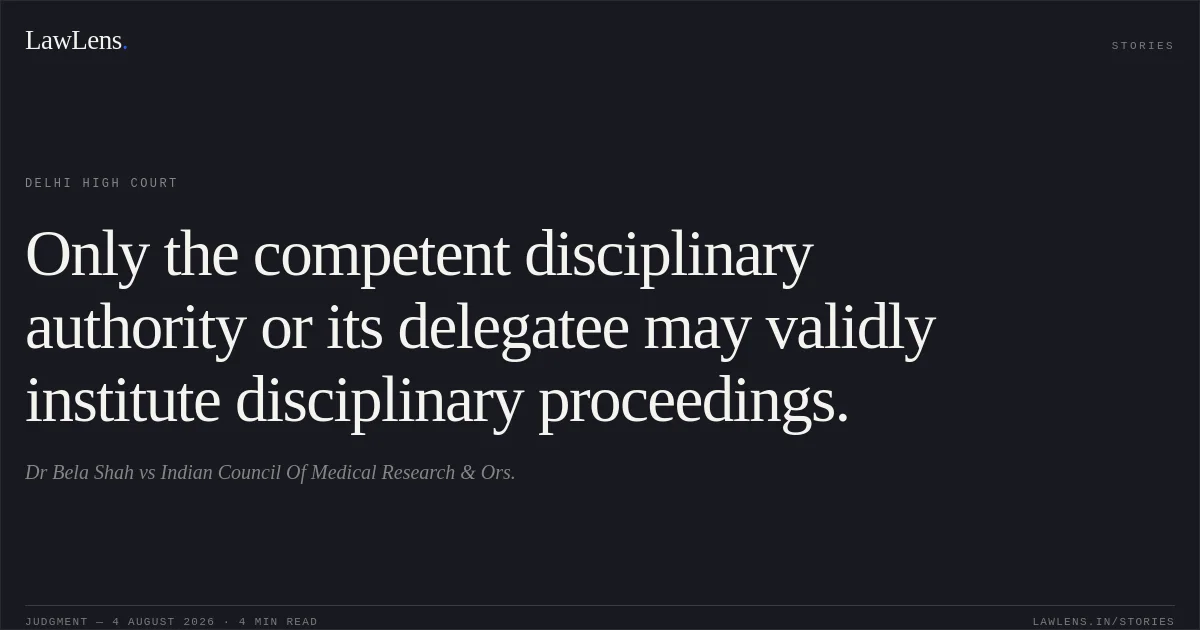
The Court answered the principal issue in favour of the petitioner and held that the DG was not competent to institute disciplinary proceedings against her.
The charge-sheet dated 27/30 April 2015, having been issued without authority under Rules 13(2), 14 and 2(a) of the CCS (CCA) Rules, was invalid, and the disciplinary proceedings stood vitiated from their inception.
Source reference: pp.20–21, paras. 41–43The writ petition and OA No. 3428/2015 were allowed; the charge-sheet was quashed and set aside.
Source reference: p.21, paras. 44–46No order as to costs was made.
Source reference: p.21, paras. 44–46Original Court PDF
Dr Bela ShahvsIndian Council Of Medical Research & Ors.
Click to open original judgment
Original judgment, available to read, download and summarize on LawLens.in