Facts
The petitioner approached the Madhya Pradesh High Court under Article 226 of the Constitution seeking removal of the hold/freeze placed on his bank account and release of the amount therein.
Source reference: paras. 1–5The account had been restricted pursuant to information or directions received from cyber-crime/police authorities in connection with an alleged cyber fraud.
Source reference: paras. 1–5The petitioner relied upon the High Court’s earlier decision in Malcolm Murayis & Ors. v. State Bank of India & Others, W.P. No. 1100 of 2024, decided on 26 April 2024, concerning similar bank-account freezes.
Source reference: paras. 1–5In the present case, the amount identified as disputed was Rs. 3,000.
Source reference: paras. 1–5Issues
1. Whether the petitioner’s bank account, frozen pursuant to communication from cyber-crime/police authorities, should be permitted to operate subject to safeguarding the disputed amount.
Source reference: paras. 1–52. Whether the disputed amount of Rs. 3,000 should be retained in a fixed deposit pending an order by the competent Judicial Magistrate under the applicable criminal procedure law.
Source reference: para. 53. Whether the remaining balance in the petitioner’s account, not connected with the alleged cyber fraud, should be released from the freeze.
Source reference: para. 6Law Applied
The Court exercised its jurisdiction under Article 226 of the Constitution to issue appropriate directions concerning the freezing of the petitioner’s bank account.
Source reference: paras. 3–5It applied the principle laid down in Malcolm Murayis & Ors. v. State Bank of India & Others, W.P. No. 1100 of 2024, decided on 26 April 2024, that where an account is frozen on the basis of cyber-crime allegations, the disputed amount may be secured in a fixed deposit and may be liquidated only pursuant to an order of the competent Judicial Magistrate within the prescribed period.
Source reference: paras. 3–5The Court also relied on the statutory requirement that the investigating agency proceed in accordance with Section 102 of the CrPC, or the corresponding applicable provisions of the BNSS, and obtain appropriate judicial oversight over the seized or restrained amount.
Source reference: paras. 3–5Reasoning
The Court found that the petitioner’s case was squarely covered by Malcolm Murayis and applied that decision mutatis mutandis.
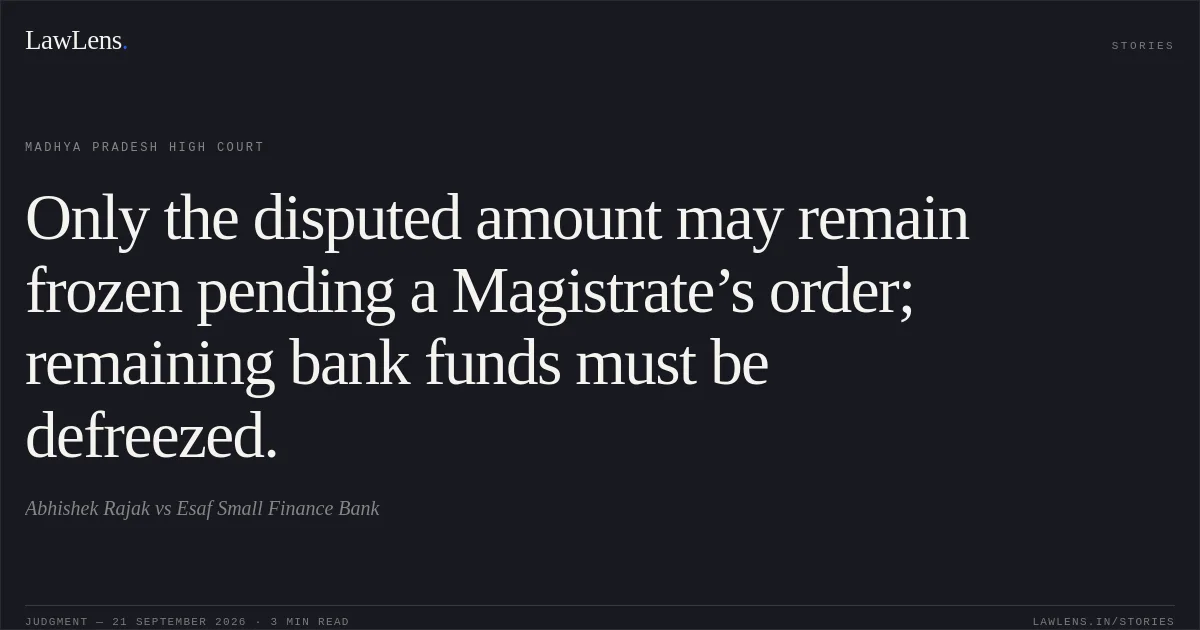
Source reference: para. 4Balancing the need to preserve any amount potentially connected with cyber fraud against the petitioner’s right to access his lawful funds, the Court directed that only the identified disputed amount of Rs. 3,000 be kept in a fixed deposit.
Source reference: paras. 4–6Its liquidation was made conditional upon an order of the competent Judicial Magistrate within three months, thereby requiring the police agency to proceed in accordance with law.
Source reference: paras. 4–6Since the remaining funds were not shown to be connected with the alleged cyber offence, there was no justification for continuing the freeze over the entire account.
Source reference: paras. 4–6Holding
The petition was disposed of.
The respondent bank was directed to keep Rs. 3,000 in a fixed deposit, which could be liquidated only pursuant to an order of the competent Judicial Magistrate within three months.
Source reference: paras. 5–7If the police agency failed to obtain such an order within that period, the amount could be released to the petitioner under intimation to the police agency.
Source reference: paras. 5–7The petitioner’s bank account was otherwise directed to be unfrozen, and any remaining amount was ordered to be released from the freeze.
Source reference: paras. 5–7Acts & Sections Cited
1 provisions across 1 statute referred to in this judgment. Each provision opens on LawLens.
Code of Criminal Procedure, 19731
Original Court PDF
Abhishek RajakvsEsaf Small Finance Bank
Click to open original judgment
Original judgment, available to read, download and summarize on LawLens.in