Facts
Respondent No. 3, Subhash Chandra Lalwani, filed a complaint under Section 200 CrPC alleging that the appellant and other accused had forged a General Power of Attorney purportedly executed by Respondent No. 2, Pradeep Singh Mehta, and thereafter created the partnership firm “M/s Paradise Farms” and obtained mutation of 54.48 acres of land in the firm’s name, allegedly including 7.50 acres said to have been given to the complainant.
Source reference: paras. 3–10Respondent No. 2 initially stated before the Magistrate that his signature on the Power of Attorney was forged. Cognizance was taken for offences under Sections 466, 467, 468, 471, 420, 406 and 120-B IPC, and charges were ultimately framed under Sections 467, 468 and 471 IPC.
Source reference: para. 11; para. 12; para. 16During proceedings under Section 482 CrPC, Respondent No. 2 filed an affidavit stating that he had contributed the land to the partnership, that the formalities had been carried out by the appellant with his authority, that he had no grievance against the accused, and that he did not wish the prosecution to continue.
Source reference: para. 17The High Court nevertheless refused to quash the proceedings, holding that the settlement was only between the appellant and a witness, and not between the appellant and the complainant. The appellant challenged that order before the Supreme Court.
Source reference: paras. 20–21Issues
1. Whether criminal proceedings involving non-compoundable offences could be quashed in exercise of the High Court’s inherent jurisdiction under Section 482 CrPC on the basis of a settlement between the accused and the alleged owner and principal victim of the property.
Source reference: para. 272. Whether Respondent No. 2, Pradeep Singh Mehta, was the “victim” for purposes of settlement, and whether the complainant’s non-participation in the settlement barred quashing of the proceedings.
Source reference: paras. 32, 39–40, 443. Whether, in view of Respondent No. 2’s affidavit and the surrounding circumstances, continuation of the prosecution would amount to an abuse of the process of law.
Source reference: paras. 41–43, 47Law Applied
The Court distinguished compounding under Section 320 CrPC, now reflected in Section 359 BNSS, from quashing under the High Court’s inherent jurisdiction under Section 482 CrPC; while compounding is restricted by statute, quashing may be ordered where the settlement makes conviction unlikely and continuation of proceedings would defeat the ends of justice.
Source reference: para. 28; Gian Singh v. State of Punjab, (2012) 10 SCC 303, para. 37Under Gian Singh, proceedings involving offences with an overwhelmingly civil, commercial, partnership or family character may be quashed upon settlement, but heinous offences or offences having serious societal impact ordinarily cannot be quashed merely on that basis.
Source reference: paras. 30, 37–38Relying on Jagjeet Singh v. Ashish Mishra, (2022) 9 SCC 321, the Court held that an informant and a victim are distinct, and that the person who suffered the loss or injury is the person competent to authorise a settlement.
Source reference: paras. 31–36The Court also relied on Naushey Ali v. State of Uttar Pradesh, (2025) 4 SCC 78, reaffirming the distinction between statutory compounding and quashing based on settlement.
Source reference: para. 29Reasoning
Respondent No. 2 was the alleged owner of the land, and the complaint itself identified the alleged forgery of his signature and the consequent creation of the partnership and mutation as the central acts of wrongdoing; he therefore suffered the alleged loss or injury and was the real victim.
Source reference: para. 40His subsequent affidavit expressly accepted the partnership arrangement and mutation, stated that the appellant had acted on his instructions, withdrew his grievance against the accused, and made clear that he would not support continuation of the prosecution.
Source reference: paras. 17, 41The dispute had a predominantly civil and commercial character arising from a partnership and land transaction, with no wider societal repercussions; consequently, it fell within the category recognised in Gian Singh as amenable to quashing.
Source reference: paras. 42–43Although Respondent No. 3 claimed that 7.50 acres had been transferred to him, the earlier High Court had found no documentary evidence establishing that interest.
Source reference: para. 14Further, the complaint did not allege that the appellant knew of any independent transfer of that land to Respondent No. 3; its principal allegation was that the accused intended to usurp Respondent No. 2’s land.
Source reference: paras. 44–47Once Respondent No. 2, the alleged owner and principal victim, disclaimed the alleged forgery and refused to support the prosecution, the likelihood of conviction became bleak. Continuing the proceedings would therefore constitute an abuse of process and an unnecessary expenditure of judicial time.
Source reference: paras. 41, 43, 47Holding
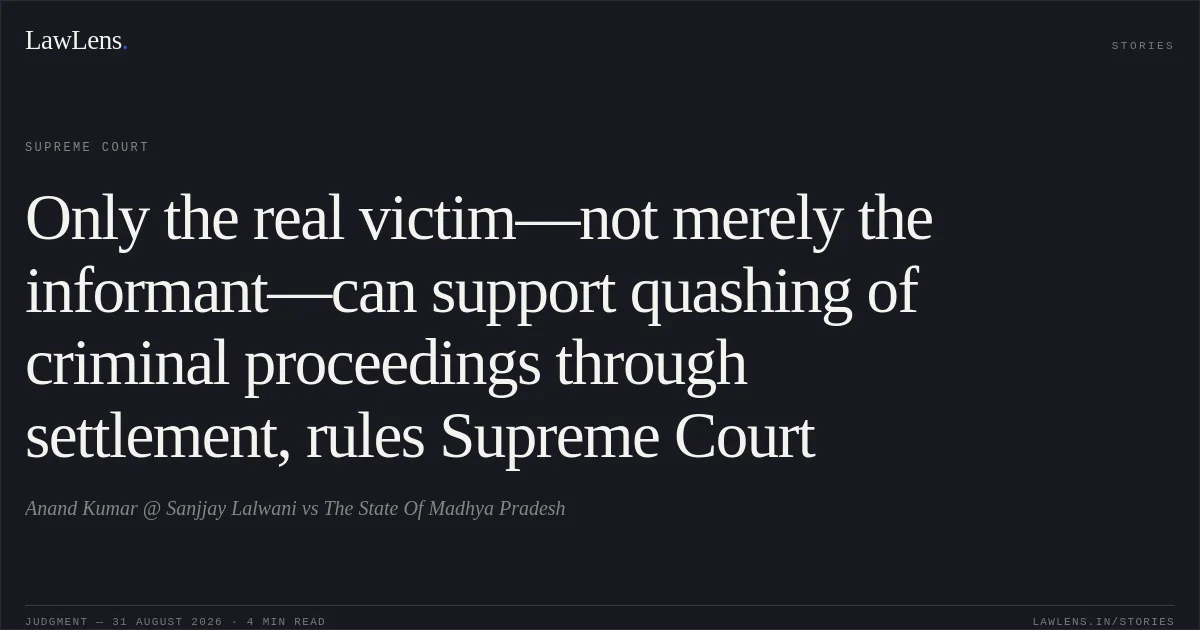
The Supreme Court allowed the appeal and set aside the High Court’s order dated 19 September 2024.
It held that the proceedings could be quashed because Respondent No. 2 was the real victim who had settled the dispute with the accused, the offences had a predominantly civil and commercial character, and conviction was highly unlikely.
Source reference: no citationIndependently, the Court held that Respondent No. 3 had not established a sustainable basis to prosecute the accused in light of Respondent No. 2’s affidavit and the allegations in the complaint.
Source reference: para. 48The criminal proceedings in ST No. 459 of 2018 were quashed against all arrayed accused, and Criminal Revision No. 2747 of 2019 pending before the High Court was dismissed as infructuous.
Source reference: para. 49Acts & Sections Cited
17 provisions across 3 statutes referred to in this judgment. Each provision opens on LawLens.
Code of Criminal Procedure, 19736
Indian Penal Code, 18608
Bharatiya Nagarik Suraksha Sanhita, 20233
Original Court PDF
Anand Kumar @ Sanjjay LalwanivsThe State Of Madhya Pradesh
Click to open original judgment
Original judgment, available to read, download and summarize on LawLens.in