Facts
The appellant-wife challenged the judgment and decree dated 22 August 2024 by which the Principal Judge, Family Court, Jehanabad dismissed Matrimonial Case No. 27 of 2022, instituted by her seeking divorce on the ground of cruelty and non-consummation of marriage.
Source reference: para. 1, p. 1; para. 7, p. 3The parties were married on 11 December 2020 according to Hindu rites. The appellant alleged that she stayed in the matrimonial home for approximately 18 days, during which the respondent and his family members assaulted and harassed her, the respondent consumed liquor, and no marital relationship was established by cohabitation.
Source reference: para. 2, p. 1She further alleged that she was driven out of the matrimonial home and thereafter received medical treatment at her parental home, but no medical documents were produced before the Trial Court.
Source reference: paras. 2, 5, pp. 1, 3The respondent denied the allegations and contended that the appellant had voluntarily left the matrimonial home shortly after marriage and refused to return despite his efforts to bring her back.
Source reference: para. 3, p. 2The Family Court held that the appellant had failed to prove cruelty and dismissed the matrimonial case.
Source reference: para. 4, p. 2During the appeal, it was undisputed that the parties had lived separately from shortly after the marriage and that no cohabitation had taken place.
Source reference: paras. 7, 10, pp. 3–4Issues
Whether the appellant proved that the respondent’s conduct constituted cruelty under Section 13(1)(i-a) of the Hindu Marriage Act, 1955?
Source reference: paras. 4–6, pp. 2–3Whether the absence of cohabitation and the parties’ prolonged separation immediately after marriage demonstrated a complete breakdown of the marital relationship and amounted to reciprocal cruelty justifying dissolution of the marriage?
Source reference: paras. 7–10, pp. 3–5Whether the judgment and decree dismissing Matrimonial Case No. 27 of 2022 required interference in appeal?
Source reference: paras. 1, 4, 11–12, pp. 1–2, 5Law Applied
The Court applied Section 13(1)(i-a) of the Hindu Marriage Act, 1955, under which a marriage may be dissolved where one spouse has treated the other with cruelty.
Source reference: para. 10, p. 5The Court treated the absence of marital cohabitation from the commencement of the marriage, coupled with prolonged separation and the parties’ failure to resume their relationship, as conduct evidencing reciprocal cruelty and the practical collapse of the marital relationship.
Source reference: paras. 7, 10, pp. 3–5The Court also referred to Rakesh Raman v. Kavita, (2023) 17 SCC 433, and Nayan Bhowmick v. Aparna Chakraborty, Civil Appeal No. 5167 of 2012, in which the Supreme Court granted divorce in circumstances involving irretrievable breakdown of marriage.
Source reference: para. 9, p. 4Reasoning
Although the appellant’s allegations of physical and mental cruelty were not supported by medical records, and the Trial Court consequently found the proof insufficient, the High Court relied on the undisputed absence of cohabitation and the parties’ continued separation from shortly after the marriage.
Source reference: paras. 5–7, 10, pp. 3–5The respondent’s assertion that he attempted to bring the appellant back did not alter the fact that no effort by either party had resulted in restoration of the marital relationship throughout the period of separation.
Source reference: para. 7, p. 3The Court reasoned that where the marital tie had never been substantively established through cohabitation and the relationship had effectively ceased from its inception, the conduct of both parties constituted reciprocal cruelty within the meaning of Section 13(1)(i-a) of the Hindu Marriage Act.
Source reference: para. 10, p. 5Accordingly, the Court concluded that the marriage had irretrievably broken down and that continuation of the marital tie was legally unjustified.
Source reference: para. 10, p. 5Holding
The High Court allowed the appeal and set aside the judgment and decree dated 22 August 2024 dismissing Matrimonial Case No. 27 of 2022.
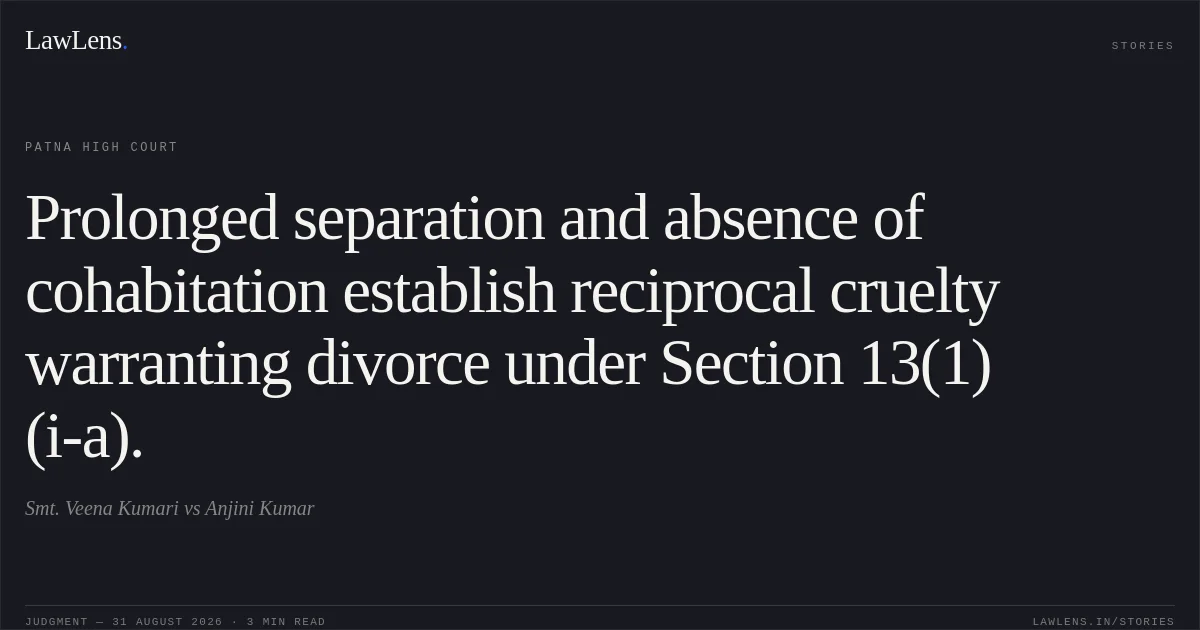
It held that the absence of cohabitation, immediate and continuing separation, and the parties’ failure to resume marital life established reciprocal cruelty under Section 13(1)(i-a) of the Hindu Marriage Act.
Source reference: para. 10, p. 5The marital tie between the appellant and respondent was accordingly dissolved by a decree of divorce, and the office was directed to prepare the decree forthwith.
Source reference: paras. 12–13, p. 5Acts & Sections Cited
1 provisions across 1 statute referred to in this judgment. Each provision opens on LawLens.
Hindu Marriage Act, 19551
Original Court PDF
Smt. Veena KumarivsAnjini Kumar
Click to open original judgment
Original judgment, available to read, download and summarize on LawLens.in