Facts
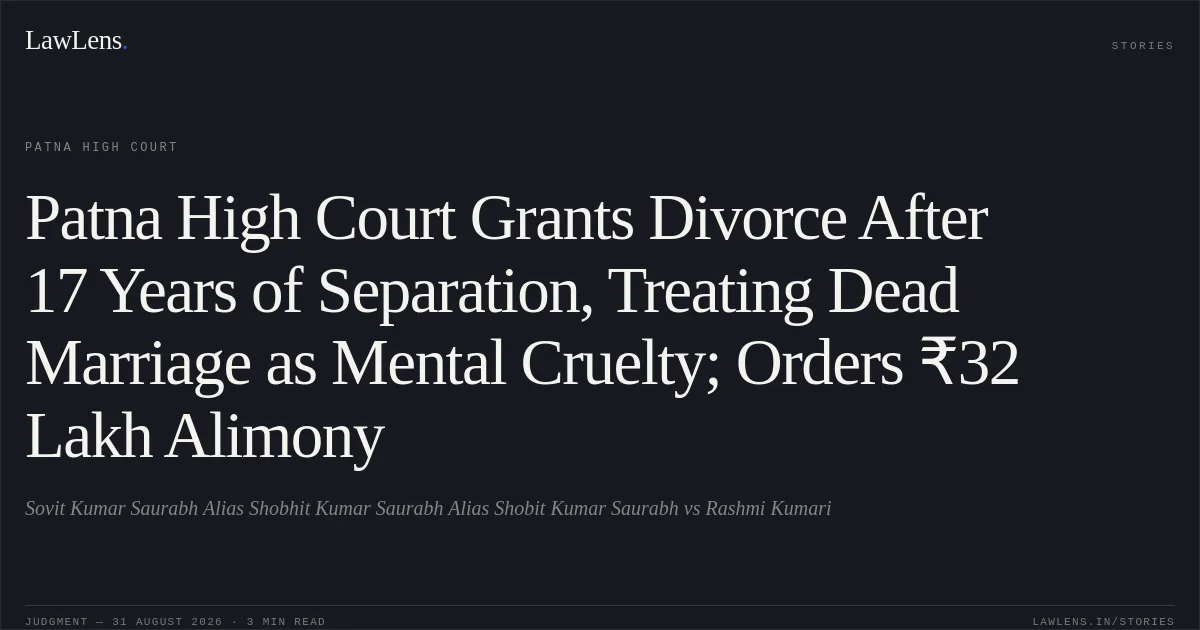
The appellant-husband and respondent-wife were married on 29 January 2007.
Source reference: no citationThe parties had admittedly lived separately since 29 September 2009, with no subsequent conjugal relationship.
Source reference: paras. 4–5The appellant’s matrimonial case seeking divorce was dismissed by the Additional Principal Judge, Family Court, Patna, on 8 August 2024, principally on the ground that the issue of cruelty could not be determined until disposal of the pending criminal case under Section 498A IPC.
Source reference: para. 2; para. 5Issues
Whether the pendency of a criminal prosecution alleging cruelty under Section 498A IPC prevented the Family Court from independently determining cruelty under Section 13(1)(i-a) of the Hindu Marriage Act, 1955?
Source reference: paras. 5–6Whether the parties’ prolonged separation since 2009 and the complete breakdown of their matrimonial relationship constituted mental cruelty warranting dissolution of the marriage under Section 13(1)(i-a) of the Hindu Marriage Act?
Source reference: paras. 7–9Whether the marriage could be dissolved subject to payment of permanent alimony of ₹32,00,000 to the respondent-wife?
Source reference: paras. 10–12Law Applied
The Court applied Section 13(1)(i-a) of the Hindu Marriage Act, 1955, under which a marriage may be dissolved where one spouse has treated the other with cruelty.
Source reference: no citationIt held that cruelty in matrimonial proceedings is determined on the preponderance of probabilities, independently of the outcome of a criminal prosecution; a criminal judgment concerning cruelty does not, by itself, establish or disprove cruelty for purposes of the Hindu Marriage Act.
Source reference: para. 6The Court relied on Rakesh Raman v. Kavita, reported in (2023) 17 SCC 433, and Nayan Bhowmick v. Aparna Chakraborty, Civil Appeal No. 5167 of 2012, for dissolution of marriage on the ground of irretrievable breakdown, and on Nishi Kant Singh @ Amit Kumar Singh v. Sunita, Misc. Appeal No. 147 of 2017, decided on 24 July 2025, for the principle that prolonged separation, where the matrimonial bond is beyond repair and has become a mere legal fiction, may constitute mental cruelty under Section 13(1)(i-a).
Source reference: paras. 8–9Reasoning
The Court found the Family Court’s approach legally erroneous because the civil matrimonial proceedings had to be decided on the basis of evidence and the preponderance-of-probabilities standard, irrespective of the pending criminal case.
Source reference: para. 6On the admitted circumstances, the parties had lived apart since September 2009 and had not resumed conjugal relations for approximately seventeen years.
Source reference: para. 7The Court treated the prolonged separation and the absence of any surviving matrimonial relationship as demonstrating that the marriage had effectively broken down and had become a legal fiction.
Source reference: para. 7Applying the principles concerning irretrievable breakdown and mental cruelty, the Court concluded that continuing the marital tie would perpetuate misery and justified dissolution under Section 13(1)(i-a).
Source reference: paras. 8–9Holding
The appeal was allowed, and the judgment and decree dismissing Matrimonial Case No. 4974 of 2014 were set aside.
The matrimonial tie between the parties was dissolved by a decree of divorce on the basis of cruelty arising from the prolonged separation and irretrievable breakdown of the marriage.
Source reference: paras. 6–9, 13The appellant was directed to pay the respondent-wife ₹32,00,000 as permanent alimony in two equal monthly instalments, subject to her submission of bank-account details; the Court directed that the previously paid ₹22,00,000 be adjusted against the permanent alimony.
Source reference: paras. 10–12The Registry was directed to prepare the decree forthwith.
Source reference: para. 14Acts & Sections Cited
5 provisions across 3 statutes referred to in this judgment. Each provision opens on LawLens.
Indian Penal Code, 18602
Hindu Marriage Act, 19551
Original Court PDF
Sovit Kumar Saurabh Alias Shobhit Kumar Saurabh Alias Shobit Kumar SaurabhvsRashmi Kumari
Click to open original judgment
Original judgment, available to read, download and summarize on LawLens.in