Facts
The parties married on 17 October 2003, each having been married previously and having a child from the earlier marriage.
Source reference: p. 1The husband alleged cruelty, desertion and adultery, including that the wife mistreated his daughter, refused cohabitation and was found with another man.
Source reference: p. 5–15The wife denied the allegations and alleged that the husband assaulted her and her daughter.
Source reference: p. 5–15The Family Court dismissed the husband’s divorce petition; he appealed under Section 19(1) of the Family Courts Act, 1984 read with Section 28 of the Hindu Marriage Act, 1955, arguing that the evidence was wrongly assessed and that the marriage had irretrievably broken down.
Source reference: p. 1, 5–15At trial, the husband and his daughter testified for him; the wife and her aunt testified for her.
Source reference: p. 15–18Issues
1. Whether the husband proved cruelty, desertion or adultery by the wife so as to establish a ground for divorce
Source reference: p. 25–27, 312. Whether the High Court could grant divorce on the ground of irretrievable breakdown of marriage
Source reference: p. 25–26, 31–34Law Applied
The Court considered the statutory grounds of cruelty, desertion and adultery under the Hindu Marriage Act, 1955, and applied Section 23(1)(a), which prevents a petitioner from obtaining relief by taking advantage of their own wrong.
Source reference: p. 26–27Cruelty is assessed from the parties’ complete matrimonial relationship and circumstances; it may be physical or mental, intentional or unintentional, but must be evaluated in its factual context.
Source reference: p. 19–22, 27–30The Court relied on Rakesh Raman v. Kavita, which treated irretrievable breakdown as potentially evidencing cruelty on the facts of that case, and on Shilpa Sailesh v. Varun Sreenivasan and Sonal Talpada v. Veerbhan Singh concerning the Supreme Court’s power under Article 142 to dissolve a marriage irretrievably broken down.
Source reference: p. 19–24, 31–34It held that the High Court cannot exercise that Article 142 power.
Source reference: p. 31–34Reasoning
The Court found insufficient evidence to establish that the wife had subjected the husband or his daughter to cruelty.
Source reference: p. 25–27, 31The husband’s adultery allegation was not proved; he did not identify the alleged person, and the material concerning online photographs did not establish adultery.
Source reference: p. 25–27, 31Nor was there evidence corroborating that the wife voluntarily deserted the matrimonial home; the parties’ separation alone did not prove desertion.
Source reference: p. 25–27, 31The parties’ disputes and differences, including those arising in a blended family, did not by themselves satisfy the legal test for cruelty.
Source reference: p. 26–31Although the relationship had broken down, that circumstance did not empower the High Court to grant divorce solely on that ground.
Source reference: p. 31–34Holding
The Court answered the first issue in the negative: the husband failed to prove cruelty, desertion or adultery.
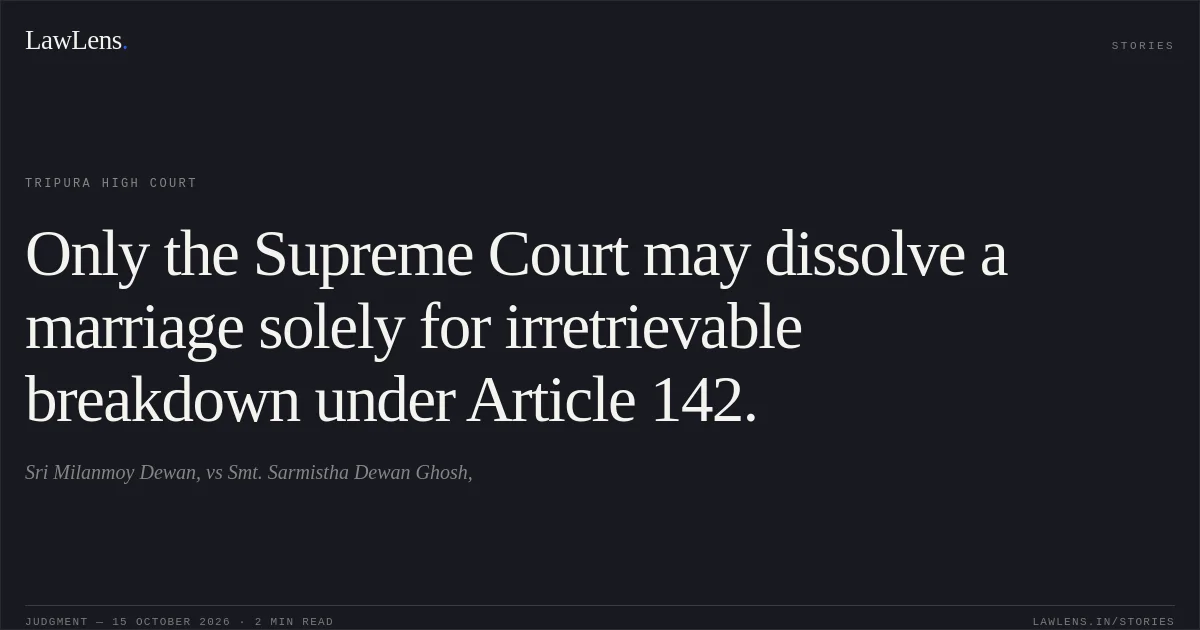
It also held that it lacked power to dissolve the marriage solely for irretrievable breakdown, a power exercisable by the Supreme Court under Article 142.
Source reference: p. 31–34Finding no perversity or infirmity in the Family Court’s decision, it dismissed the appeal without costs and directed that the trial-court record be returned; pending applications were closed.
Source reference: p. 34Acts & Sections Cited
7 provisions across 4 statutes referred to in this judgment. Each provision opens on LawLens.
Family Courts Act, 19841
Hindu Marriage Act, 19554
Special Marriage Act, 19541
Code of Civil Procedure, 19081
Original Court PDF
Sri Milanmoy Dewan,vsSmt. Sarmistha Dewan Ghosh,
Click to open original judgment
Original judgment, available to read, download and summarize on LawLens.in