Facts
The respondent-landlord filed a release application under Section 21(1)(a) of the U.P. Act No. XIII of 1972 for a commercial shop to establish a clinic for her son.
Source reference: para. 3-5During pendency, the original tenant died, and the petitioners (legal heirs) were substituted. Despite registered notices and a further opportunity granted by the Prescribed Authority on 20.07.2023, the petitioners failed to lead evidence.
Source reference: para. 6-7An ex parte release order was passed on 22.12.2023.
Source reference: para. 8The petitioners’ subsequent recall application was rejected on 07.02.2025.
Source reference: para. 9Their appeal against this rejection was dismissed by the District Judge, Agra, as not maintainable on 03.02.2026; the petitioners then challenged these orders under Article 227.
Source reference: para. 2, 9Issues
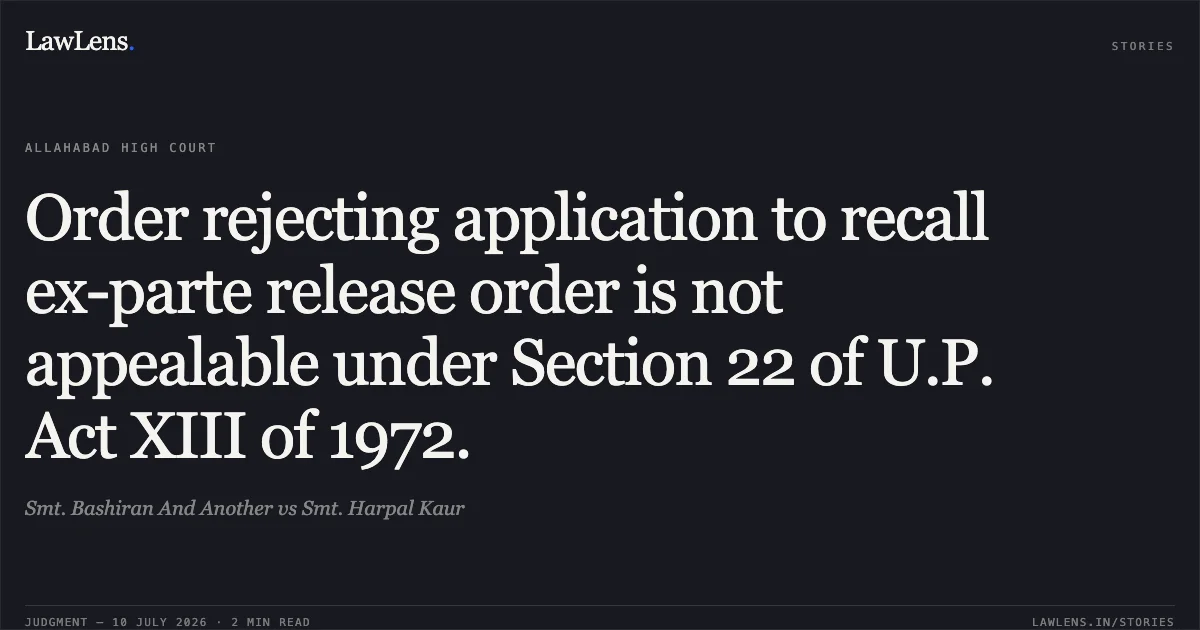
1. Whether an appeal under Section 22 of U.P. Act No. XIII of 1972 is maintainable against an order rejecting an application for recall of an ex parte release order.
Source reference: para. 20.12. Whether the petitioners established "sufficient cause" or absence of due service to warrant the recall of the ex parte release order dated 22.12.2023.
Source reference: para. 20.2Law Applied
The Court applied Section 21 of U.P. Act No. XIII of 1972 regarding the substantive release of buildings and Section 22, which provides a right of appeal strictly against orders passed under Sections 21 or 24.
Source reference: para. 21, 24It relied on Section 34(1)(g) and Rule 22(b), which vest procedural powers in the Prescribed Authority to set aside ex parte orders.
Source reference: para. 21, 27Regarding "sufficient cause," the Court followed the principles in Parimal v. Veena (2011) and G.P. Srivastava v. R.K. Raizada (2000), holding that the right of appeal is a creature of statute and procedural law—as the "handmaid of justice"—cannot reopen concluded proceedings due to a party's negligence.
Source reference: para. 37, 40Reasoning
The Court reasoned that while Section 21 determines substantive civil rights, Section 34 is purely procedural.
Source reference: para. 27-28Since Section 22 explicitly limits appeals to orders under Sections 21/24, a procedural order rejecting a recall application (referable only to Section 34/Rule 22) is not appealable.
Source reference: para. 29-32Expanding Section 22 to include ancillary procedural orders would defeat the legislative intent and the goal of expeditious adjudication.
Source reference: para. 33On the merits of the recall, the Court found that the judicial record proved the petitioners had been served via registered post and were granted additional time to contest, which they failed to utilize.
Source reference: para. 45-50The petitioners failed to produce independent material to rebut the presumption of correctness of the judicial record regarding service; the Court invoked the maxim vigilantibus non dormientibus jura subveniunt, noting the petitioners failed to exercise due diligence over inherited tenancy rights.
Source reference: para. 52, 53, 55Holding
The Court held that: (i) an appeal under Section 22 is not maintainable against an order rejecting a recall application; and (ii) the petitioners failed to establish "sufficient cause" as their absence was attributable to negligence rather than lack of notice.
The petition was dismissed, and all impugned orders—the release order (22.12.2023), the rejection of recall (07.02.2025), and the dismissal of appeal (03.02.2026)—were upheld.
Source reference: para. 64-65Acts & Sections Cited
5 provisions across 1 statute referred to in this judgment. Linked provisions open on LawLens.
U.P. Urban Buildings (Regulation of Letting, Rent and Eviction) Act, 19725
Original Court PDF
Smt. Bashiran And AnothervsSmt. Harpal Kaur
Click to open original judgment
Original judgment, available to read, download and summarize on LawLens.in