Facts
The petitioner/plaintiff instituted a suit for permanent injunction, recovery of possession, use and occupation charges, and mesne profits concerning the first floor of property No. B-82, Ganesh Nagar, New Delhi. She claimed that the property had been purchased and constructed by her deceased father, who died intestate, and that the first floor devolved upon her pursuant to a family arrangement. The respondents, comprising the wife, husband, and mother-in-law of the matrimonial occupant, were allegedly permitted to reside in the property as licensees, but continued to remain there after revocation of the licence
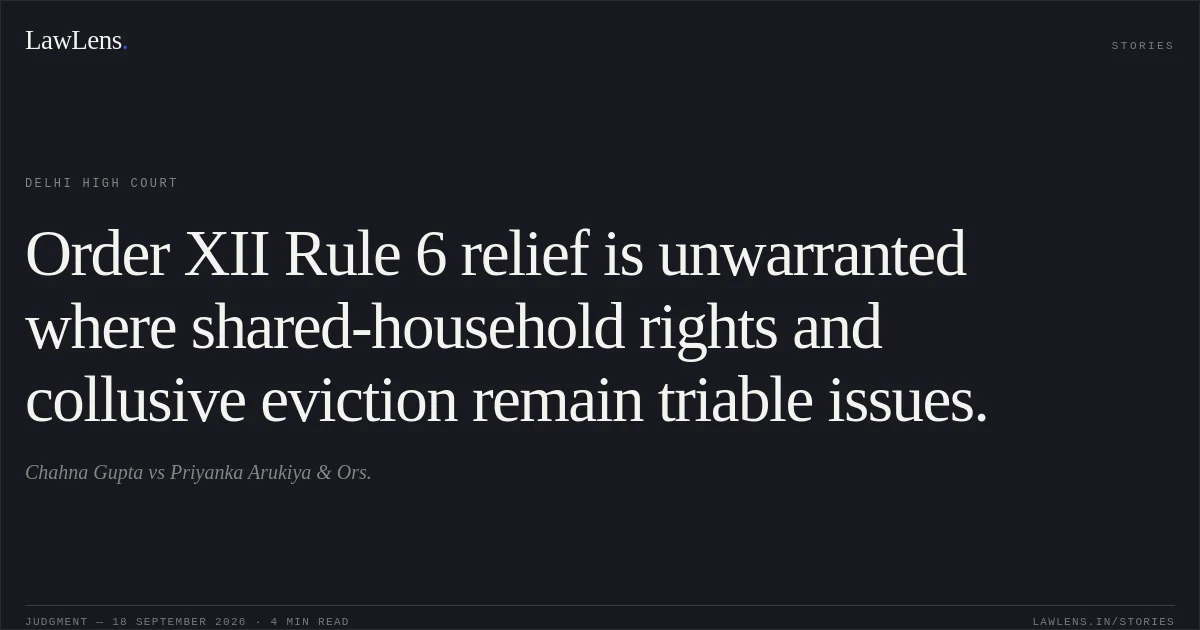
Source reference: paras. 2–4; pp. 2–3After the written statements were filed, the petitioner sought a decree on admissions under Order XII Rule 6 CPC, contending that the respondents had admitted their status as licensees and had no ownership rights. Respondent No. 1 resisted the application, asserting that the property was her matrimonial home and “shared household” under the Protection of Women from Domestic Violence Act, 2005 (“DV Act”), and alleging collusion between the petitioner and Respondent Nos. 2 and 3 to dispossess her. The Trial Court dismissed the application, holding that whether the property constituted the respondent’s matrimonial home was a triable issue. The petitioner challenged that order in revision.
Source reference: paras. 5–8; pp. 3–6Issues
Whether the pleadings disclosed clear, unequivocal, and unconditional admissions sufficient to justify a decree under Order XII Rule 6 CPC
Source reference: paras. 25, 28–29, 35; pp. 14–20Whether the respondent’s claim that the suit property was her matrimonial home and shared household under the DV Act raised triable issues relevant to her alleged right of residence
Source reference: paras. 11–14, 20–22, 30–35; pp. 6–20Whether the alleged collusion between the petitioner/licensor and Respondent Nos. 2 and 3/licensees required adjudication on evidence before the respondent could be evicted
Source reference: paras. 32–35; pp. 19–20Law Applied
Order XII Rule 6 CPC empowers, but does not compel, a court to pronounce judgment on admissions; the power is discretionary and should be exercised only where the admission is clear, categorical, unequivocal, unconditional, and makes the claimant’s entitlement unmistakable
Source reference: paras. 25, 28–29; pp. 14–18Under Sections 2(s), 17 and 19 of the DV Act, a woman in a domestic relationship may claim residence in a “shared household,” including a household belonging to or occupied by a relative of the husband with whom she has lived in a domestic relationship, as explained in Satish Chander Ahuja v. Sneha Ahuja, (2021) 1 SCC 414
Source reference: paras. 20–22; pp. 13–14However, under Satish Chander Ahuja, the DV Act does not prevent a landlord, lessor, or licensor from pursuing eviction proceedings against a tenant, allottee, or licensee; where collusion is alleged, the woman residing in the shared household may resist the proceedings on grounds available to the tenant, allottee, or licensee
Source reference: para. 22; pp. 13–14The Court also relied on Rajiv Ghosh v. Satya Narayan Jaiswal, 2025 SCC OnLine SC 751, which holds that Order XII Rule 6 is enabling and discretionary and may be refused where the case involves issues unsuitable for determination solely on admissions
Source reference: para. 29; pp. 16–18The contrary interpretation in S.R. Batra v. Taruna Batra, (2007) 3 SCC 169, was noted as having been overruled on the interpretation of “shared household” by the three-Judge Bench in Satish Chander Ahuja
Source reference: paras. 16–22; pp. 10–14Reasoning
The Court held that Respondent No. 1 had not made any admission entitling the petitioner to an immediate decree. Although Respondent Nos. 2 and 3 described themselves as licensees, Respondent No. 1 disputed the petitioner’s assertion that the property was exclusively self-acquired by her father and specifically pleaded that the property was jointly owned by the two brothers and had been represented to her as such before and after her marriage
Source reference: paras. 30–32; pp. 18–19She also asserted that the property was her matrimonial home and shared household and alleged that the suit was collusive. In light of paragraph 125 of Satish Chander Ahuja, the alleged status of the respondents as licensees did not automatically defeat the respondent’s right to contest eviction where collusion was pleaded
Source reference: para. 33; p. 19The questions concerning the nature of the property, the rights of Respondent Nos. 2 and 3, the existence of a shared household, and alleged collusion could not be conclusively resolved from the pleadings and required evidence. Consequently, it was not safe or appropriate to exercise the discretionary power under Order XII Rule 6 CPC
Source reference: para. 35; p. 20Holding
The High Court dismissed the revision petition and declined to grant judgment on admissions under Order XII Rule 6 CPC. It held that no clear, unequivocal, or unconditional admission had been made by Respondent No. 1 and that the pleaded issues required trial.
The Court expressly clarified that it had not determined whether the suit property was in fact a shared household and had confined its decision to the maintainability of a decree on admissions. The Trial Court was directed to proceed with the suit in accordance with law; pending applications were rendered infructuous
Source reference: paras. 35, 36, 38; pp. 20–21Acts & Sections Cited
11 provisions across 2 statutes referred to in this judgment. Each provision opens on LawLens.
Protection of Women from Domestic Violence Act, 2005
Indian Penal Code, 18602
Original Court PDF
Chahna GuptavsPriyanka Arukiya & Ors.
Click to open original judgment
Original judgment, available to read, download and summarize on LawLens.in