Facts
The plaintiffs sued for declaration of title, injunction and correction of revenue records, claiming rights in ancestral property as the wife and sons of the deceased Hulgonda Mehtre.
Source reference: para. 3–4The defendants denied the plaintiffs’ relationship to Hulgonda and disputed their rights in the property.
Source reference: para. 3–4The trial court dismissed the suit. On appeal, the first appellate court set aside that decree and declared plaintiff Nos. 2 and 3 and defendant No. 2 entitled to equal shares, also directing mutation of their names in the record of rights.
Source reference: para. 7–8The defendants brought this second appeal. The High Court admitted it on a substantial question concerning whether admissions by plaintiff No. 3 about possession of certain lands established severance in the family.
Source reference: para. 14Issues
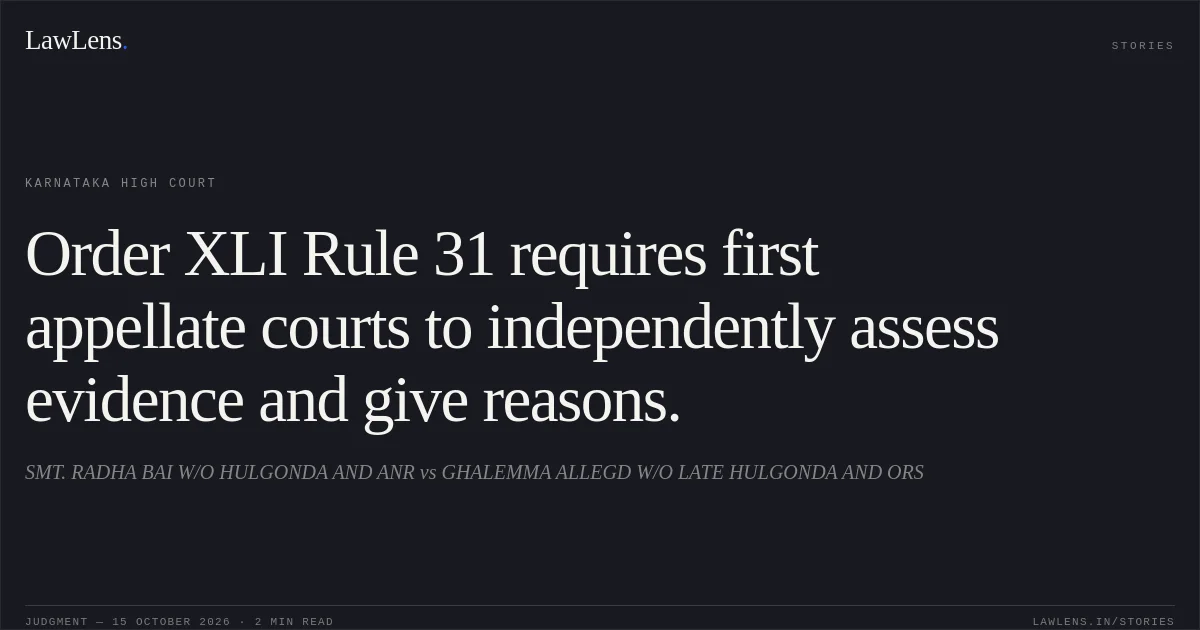
1. Whether the first appellate court’s judgment complied with Order XLI Rule 31 CPC by framing appropriate points for determination, independently assessing the evidence and giving reasons for reversing the trial court’s decree?
Source reference: para. 19–24, 272. Whether the plaintiffs’ asserted entitlement to shares, including the effect of the alleged admissions concerning possession and severance, could be determined in the second appeal without reconsideration by the first appellate court?
Source reference: para. 14, 28Law Applied
Order XLI Rule 31 CPC requires an appellate judgment to state the points for determination, the decision on each point, reasons for the decision, and the relief where the decree is reversed or varied.
Source reference: para. 22A first appellate court, as the final court of fact, must independently assess the evidence, address the material points arising for decision and give reasons; general expressions of concurrence or reversal are insufficient.
Source reference: para. 20–25The court relied on Bangarappa v. Rudrappa and Another, ILR 2012 KAR 1020, and H. Siddiqui (Dead) by LRs v. A. Ramalingam, AIR 2011 SC 1492, for these requirements.
Source reference: para. 20–25It also referred to Lakshmi v. Gopi and Others, 2026 SCC OnLine SC 1338, concerning the first appellate court’s jurisdiction to consider questions of both fact and law under Section 96 CPC.
Source reference: para. 26Reasoning
The first appellate court framed general points about whether the plaintiffs were entitled to a declaration and whether the trial court’s judgment required interference, but did not properly address the issues arising from the trial court’s decision or provide reasons for reversing it.
Source reference: para. 18–19, 27Applying Order XLI Rule 31 CPC and the cited authorities, the High Court held that the appellate judgment did not demonstrate the required independent appraisal of the evidence and was therefore procedurally deficient.
Source reference: para. 23–27Because the matter required reconsideration by the first appellate court, the High Court left the substantial question concerning the alleged admissions and family severance undecided.
Source reference: para. 28Holding
The High Court allowed the second appeal, set aside the first appellate court’s judgment and decree, and restored R.A. No. 28/2011 to that court for reconsideration.
It made no determination on the merits and kept all parties’ contentions open.
Source reference: para. 29The parties were directed to appear before the first appellate court on 11 November 2026, and the records were to be transmitted to that court.
Source reference: para. 29Acts & Sections Cited
2 provisions across 1 statute referred to in this judgment. Each provision opens on LawLens.
Code of Civil Procedure, 19082
Original Court PDF
SMT. RADHA BAI W/O HULGONDA AND ANRvsGHALEMMA ALLEGD W/O LATE HULGONDA AND ORS
Click to open original judgment
Original judgment, available to read, download and summarize on LawLens.in