Facts
The respondents/plaintiffs filed O.S. No. 25870 of 2017, a partition suit.
Source reference: para. 1They sought, by I.A. No. 13 under Order I Rule 10(2) CPC, to implead proposed defendants as defendant Nos. 8 and 9.
Source reference: para. 1The Trial Court allowed the application on 17 August 2024, referring to a sale of part of item No. 1 of the suit property to defendant No. 8, but gave no reasons for its conclusion that the proposed parties were necessary parties.
Source reference: paras. 1, 6Defendant No. 8 challenged that order under Article 227, contending that he was neither a necessary nor a proper party and that a prior compromise affected the plaintiffs’ rights in the property.
Source reference: paras. 2, 4The plaintiffs disputed those submissions and maintained that they were entitled to item No. 1.
Source reference: para. 5Issues
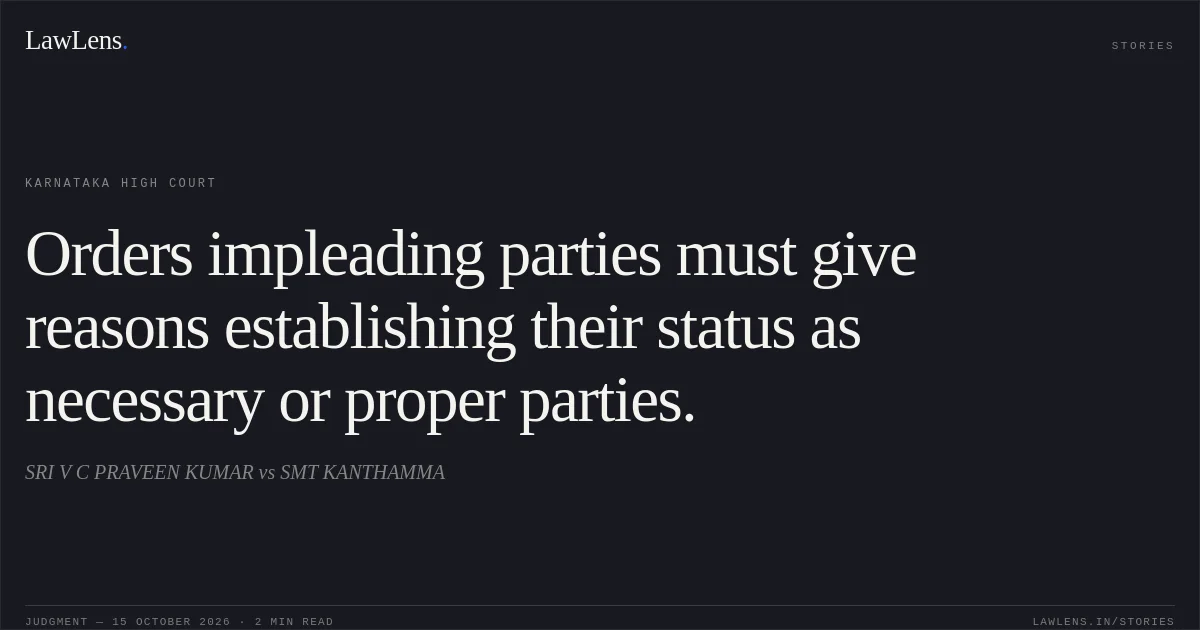
Whether the Trial Court’s order allowing impleadment under Order I Rule 10(2) CPC could stand when it did not give reasons addressing the parties’ contentions and the basis for finding the proposed parties necessary.
Source reference: paras. 6, 9Whether the High Court should itself determine the proposed parties’ status as necessary or proper parties, or remit the application for a reasoned decision by the Trial Court.
Source reference: paras. 9–10Law Applied
Order I Rule 10(2) CPC governs the addition of parties to a suit.
Source reference: para. 1A judicial order must state reasons sufficient to demonstrate application of mind to the relevant issues; reasoned decisions promote fairness, constrain arbitrariness, and enable effective judicial review.
Source reference: paras. 7–8The Court relied on Uttar Pradesh State Road Transport Corporation v. Jagdish Prasad Gupta, (2009) 12 SCC 609, on the duty to give reasons in judicial orders, and Kranti Associates (P) Ltd. v. Masood Ahmed Khan, (2010) 9 SCC 496, on the importance of clear, cogent reasons in judicial and quasi-judicial decision-making.
Source reference: paras. 7–8Reasoning
The Trial Court referred to the sale of a portion of the suit property to defendant No. 8 and concluded that the proposed parties were necessary, but did not explain why that conclusion followed or address the contentions raised, including the alleged prior compromise.
Source reference: paras. 6, 9Applying the requirement that judicial orders disclose the reasoning behind their conclusions, the High Court held that the impleadment application required consideration of the application, objections, and supporting documents.
Source reference: paras. 9–10It left the necessary-or-proper-party determination to the Trial Court rather than deciding the merits itself.
Source reference: paras. 9–10Holding
The High Court set aside the order dated 17 August 2024 and directed the Trial Court to reconsider I.A. No. 13, the objections, and the documents relied upon, and to pass a reasoned, speaking order.
The parties’ rights and contentions were left open, and the High Court expressly stated that it had not examined the merits.
Source reference: para. 11The petition was disposed of accordingly; counsel undertook to avoid unnecessary adjournments before the Trial Court.
Source reference: paras. 11–11.1Original Court PDF
SRI V C PRAVEEN KUMARvsSMT KANTHAMMA
Click to open original judgment
Original judgment, available to read, download and summarize on LawLens.in