Facts
The dispute involves the control and management of Vidhi Research and Development LLP ("LLP") between partners Mayank Shah ("Petitioner") and Raju Shah ("Respondent No. 1")
Source reference: para. 4In 2019, Raju recorded that he had created a Trust, making his son the beneficiary of his 20% share in the LLP
Source reference: para. 5In 2022, Mayank contended that this assignment terminated Raju’s partnership
Source reference: para. 5Raju subsequently filed an application before the Arbitral Tribunal under Section 17 of the Arbitration and Conciliation Act ("the Act"), seeking to implead the trustees of the Trust as co-claimants "out of abundant caution"
Source reference: para. 6The Tribunal allowed the impleadment via an order dated April 29, 2024
Source reference: para. 3Mayank challenged this order before the Bombay High Court under Section 37(2)(b) of the Act, arguing that the Tribunal lacked jurisdiction to implead third parties
Source reference: para. 1, 3Issues
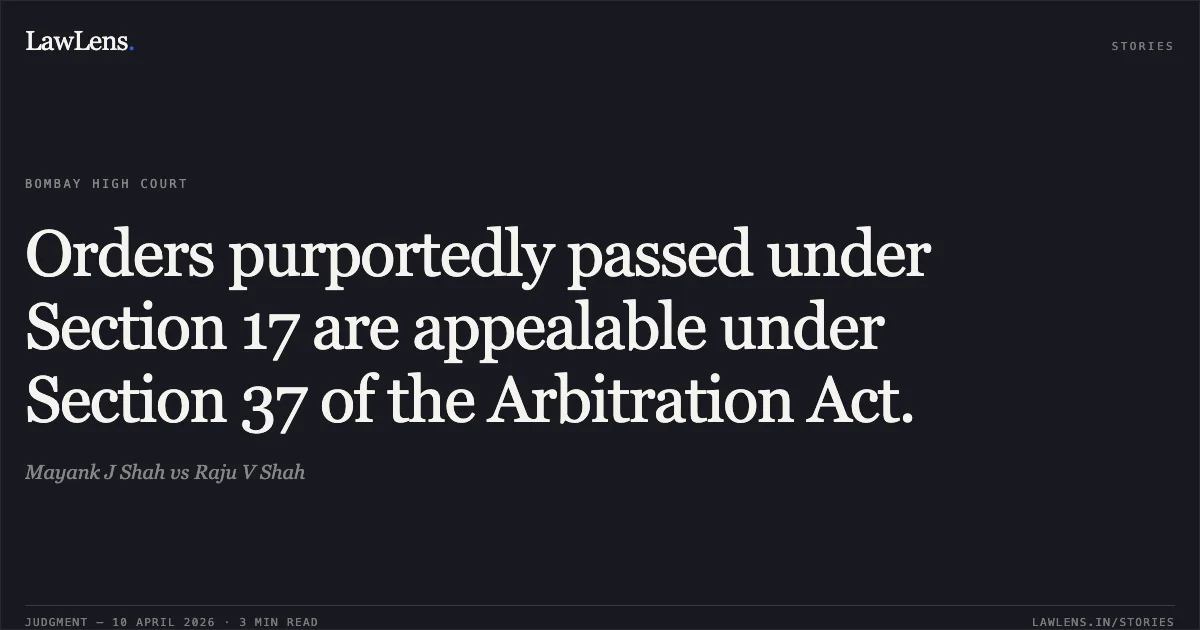
1. Whether an appeal under Section 37(2)(b) of the Act is maintainable against an order of impleadment that purports to be passed under Section 17
Source reference: para. 82. Whether the Arbitral Tribunal has the power to implead trustees of a trust created by an existing partner to the arbitration proceedings
Source reference: para. 21Law Applied
The court primarily considered Section 37(2)(b) of the Act, which provides an exhaustive list of appealable orders, and Section 17, regarding interim measures by an arbitral tribunal
Source reference: para. 2It applied the principle from Antikeros Shipping Corporation v. Adani Enterprises Ltd., which holds that the right to appeal is determined by what the trial court "purported to do" rather than what it "ought to have done"
Source reference: para. 8, 10Regarding the LLP structure, the court referenced Section 5 of the Limited Liability Partnership Act, 2008, which restricts partnership to individuals or bodies corporate
Source reference: para. 12Furthermore, it examined the "Group of Companies" and non-signatory joinder principles established in Cox & Kings Ltd. v. SAP India (P) Ltd.
Source reference: para. 21Reasoning
The court first addressed maintainability, noting that while impleadment is generally a procedural direction not appealable under Section 37, since the Respondent invoked Section 17 and the Tribunal "purported" to exercise power under that section, the appeal was maintainable for review
Source reference: para. 8-11On the merits, the court observed that Raju, a signatory and partner, remained the legal owner of the partnership interest; creating a trust merely split the legal estate from the beneficial estate
Source reference: para. 14The court found that impleading the trustees was not a joinder of a "third party" in the conventional sense, but rather a protective measure to ensure the person already party to the agreement could participate in his capacity as a trustee
Source reference: para. 16, 24The court held that the Tribunal’s decision to allow joinder while reserving the final determination of the partnership's status (Point No. 5) for the final award was a valid exercise of discretion to preserve the parties' positions
Source reference: para. 25, 29Holding
The High Court dismissed the petition, holding that the Arbitral Tribunal's order did not suffer from perversity or error of law
The court concluded that impleading the same partner in his capacity as a "trustee" was a cautious and fair approach to ensure a comprehensive adjudication of rights
Source reference: para. 29The court declined to interfere under Section 37, noting the Petitioner’s delay in serving the petition [para. 27] and left the final adjudication of costs for this round of litigation to the Arbitral Tribunal
Source reference: para. 30Acts & Sections Cited
8 provisions across 3 statutes referred to in this judgment. Each provision opens on LawLens.
Arbitration and Conciliation Act, 19965
Code of Civil Procedure, 19081
Original Court PDF
Mayank J ShahvsRaju V Shah
Click to open original judgment
Original judgment, available to read, download and summarize on LawLens.in