Facts
The appellant-defendant and the respondents-plaintiffs were siblings, being the children of Sundarathachi and Murugaiah Pillai.
Source reference: paras. 1–2The plaintiffs instituted a suit for partition claiming one-third shares each in the properties allegedly left by their mother, who died in 1991, and their father, who died intestate on 18 September 2009.
Source reference: paras. 1–2The defendant resisted the suit, relying on a 1953 Will executed by the maternal grandmother, Subbammal, and a 2005 Will executed by the father, Murugaiah Pillai, while also contending that several scheduled properties had been sold or belonged to other persons.
Source reference: para. 3The Trial Court excluded certain properties and passed a preliminary decree granting the plaintiffs one-third shares; the First Appellate Court affirmed that decision.
Source reference: paras. 6–10In the second appeal, the High Court examined the pleas of ouster, the interpretation and proof of the two Wills, and the non-impleadment of alleged beneficiaries and interested parties.
Source reference: para. 12Issues
1. Whether the defendant established ouster of the plaintiffs from the properties inherited from their mother, having regard to the plaintiffs’ alleged absence from possession and non-participation in the income for several decades?
Source reference: para. 12(i); paras. 18–242. Whether the 1953 Will executed by Subbammal was correctly interpreted under Section 63(c) of the Indian Succession Act, 1925, and whether the 2005 Will executed by Murugaiah Pillai was duly proved under Section 68 of the Indian Evidence Act, 1872?
Source reference: para. 12(ii); paras. 13–17, 26–293. Whether the suit was defective for non-impleadment of necessary and proper parties, particularly the grandchildren and other beneficiaries claiming interests under the sale deed and the 2005 Will?
Source reference: para. 12(iii); paras. 23, 29–30Law Applied
The Court applied Section 63(c) of the Indian Succession Act, 1925, requiring an unprivileged Will to be attested by at least two witnesses in the prescribed manner, and Section 68 of the Indian Evidence Act, 1872, requiring examination of at least one attesting witness to prove execution of a Will.
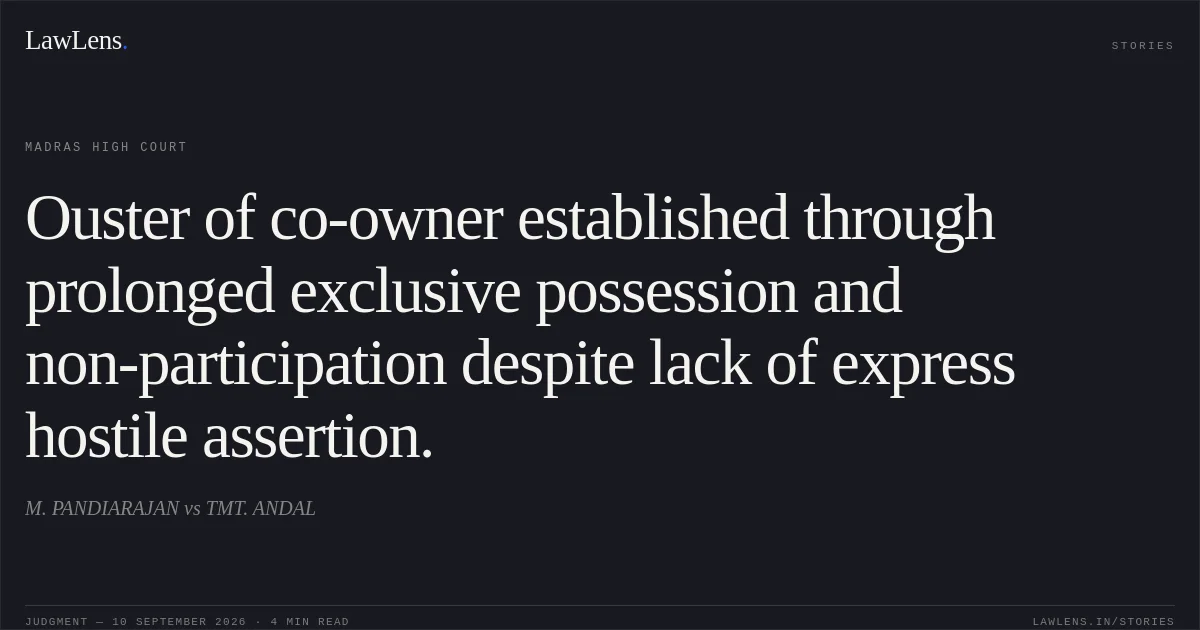
Source reference: para. 14It applied the principle that a co-owner’s possession, however long, does not become adverse unless ouster is established by clear pleadings and proof; however, exclusive possession, receipt of income, and prolonged non-participation by another co-owner may, in appropriate circumstances, support an inference of ouster.
Source reference: paras. 20–22The Court relied on Maharajadhiraj of Burdwan, Udaychand Mahatab Chand v. Subodh Gopal, AIR 1971 SC 376, Mohaideen Abdul Kadir v. Mohammad Mohaideen Umma, I.L.R. (1970) 2 Mad. 636, and N. Vartha Pillai v. Jeevarathnammal, AIR 1919 PC 44.
Source reference: paras. 20–22It also applied the principle that persons whose proprietary or testamentary interests may be directly affected by a partition decree are necessary or proper parties.
Source reference: para. 29Reasoning
The Court held that Subbammal’s 1953 Will, read as a whole and applying the “armchair rule,” demonstrated an intention that the property should ultimately devolve upon all the children of Sundarathachi, whether male or female; consequently, the plaintiffs possessed an underlying co-ownership claim in the ‘A’ schedule properties.
Source reference: paras. 13–17Nevertheless, the plaintiffs’ claim failed because the first plaintiff admitted that after her marriage in 1971 she had lived separately, had not enjoyed the properties, had received no income from them, and had no documents showing joint possession.
Source reference: para. 19This prolonged inaction, coupled with the incorrect inclusion of properties already sold or belonging to others, supported the defendant’s plea of ouster despite the general rule protecting co-owners.
Source reference: paras. 20–24As to the 2005 Will, the attesting witnesses merely stated that Murugaiah Pillai brought the document to them and obtained their signatures; they did not testify that they saw him sign or acknowledge his signature.
Source reference: paras. 26–27Accordingly, the statutory requirement for proving execution under Section 68 was not satisfied.
Source reference: paras. 26–27However, the plaintiffs had failed to implead the grandchildren and other beneficiaries whose rights were affected by the properties included in the suit and by the challenge to the Will.
Source reference: para. 29The omission was fatal, particularly because the plaintiffs had notice of those interests through the defendant’s reply notice.
Source reference: para. 29Holding
The High Court answered the substantial questions of law in favour of the defendant.
It held that the plaintiffs were ousted from claiming shares in the ‘A’ schedule properties, notwithstanding the testamentary intention under the 1953 Will in favour of Sundarathachi’s children.
Source reference: para. 30It further held that the suit concerning the ‘B’ schedule properties was defective for non-impleadment of necessary and proper parties, although the 2005 Will itself had not been duly proved under Section 68.
Source reference: paras. 27, 29–30The second appeal was therefore allowed; the judgments and decrees of the Trial Court and First Appellate Court were set aside, with no order as to costs, and the connected miscellaneous petition was closed.
Source reference: para. 31Acts & Sections Cited
2 provisions across 2 statutes referred to in this judgment. Each provision opens on LawLens.
Code of Civil Procedure, 19081
Indian Succession Act, 19251
Original Court PDF
M. PANDIARAJANvsTMT. ANDAL
Click to open original judgment
Original judgment, available to read, download and summarize on LawLens.in