Facts
The petitioner was accused No. 1 in a private complaint filed by an SBI official alleging offences under Sections 406, 408, 417, 418, 419, 420, 423, 465, 467, 468, 471, 504 and 506 IPC.
Source reference: para. 2The Magistrate referred the complaint for investigation under Section 156(3) CrPC, following which the police registered an FIR.
Source reference: para. 3The petitioner had obtained a ₹39,92,000 loan to purchase an apartment under a tripartite agreement with the Bank and the developer.
Source reference: paras. 7–10The agreement required the developer to repay specified amounts to the Bank if the project was shelved or not completed, and restricted transfer of the apartment without the Bank’s consent.
Source reference: paras. 7–10The project was not completed, no sale deed was executed in the petitioner’s favour, and the developer later sold the apartment to a third party.
Source reference: paras. 11–13The loan remained unpaid.
Source reference: paras. 11–13The petitioner sought quashing of the complaint proceedings and FIR insofar as they concerned him.
Source reference: paras. 1, 25Issues
1. Whether the complaint’s allegations, taken at face value, disclosed the commission of any alleged criminal offence by the petitioner.
Source reference: paras. 14–152. Whether continuation of the criminal proceedings against the petitioner would amount to an abuse of process where the project was incomplete and the developer had sold the apartment to a third party.
Source reference: paras. 20–23Law Applied
The petition invoked the High Court’s inherent jurisdiction under Section 482 CrPC (identified in the petition heading as filed under Section 528 BNSS) to seek quashing of the proceedings.
Source reference: para. 1The complaint alleged offences under Sections 406, 408, 417, 418, 419, 420, 423, 465, 467, 468, 471, 504 and 506 IPC.
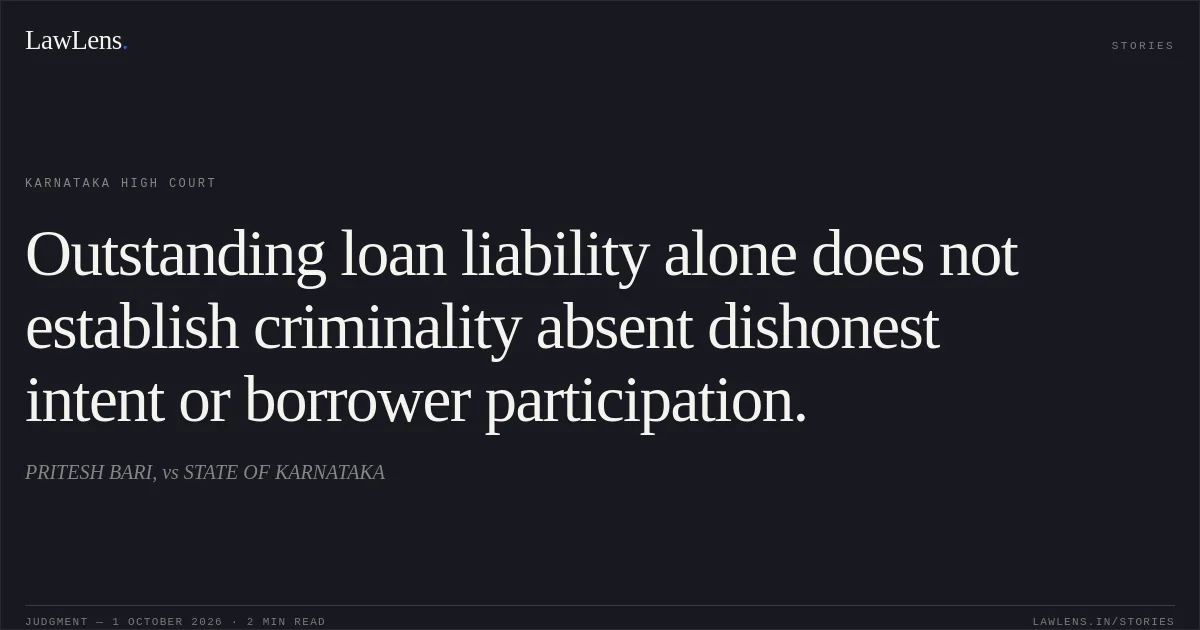
Source reference: paras. 1–2The Court applied the principle that an outstanding contractual or financial liability, without material disclosing the ingredients of a criminal offence, does not by itself justify criminal prosecution; criminal proceedings cannot be used as a substitute for recovery remedies.
Source reference: paras. 18, 20–21No judicial precedents were cited.
Source reference: no citationReasoning
The Court considered the tripartite agreement, which placed on the developer the obligation to repay the Bank in the specified circumstances, and found no corresponding obligation on the petitioner to repay amounts that the developer was required to return under that agreement.
Source reference: paras. 8–10The petitioner never acquired title to the apartment, did not participate in its subsequent sale, and was not shown to have benefited from it or acted in concert with the developer.
Source reference: paras. 12–15In the absence of material showing dishonest intention, deception, misappropriation, or other criminal conduct by the petitioner, the unpaid loan and failed property transaction did not establish criminal liability against him.
Source reference: paras. 18–23Holding
The Court held that the complaint and material on record did not disclose the alleged offences against the petitioner and that continuing the proceedings against him would constitute an abuse of process.
It allowed the petition and quashed the proceedings in PCR No. 8789/2024 and the consequential FIR in Crime No. 55/2024 insofar as the petitioner/accused No. 1 was concerned, without expressing an opinion on the allegations against accused Nos. 2 to 5.
Source reference: paras. 24–26Acts & Sections Cited
16 provisions across 3 statutes referred to in this judgment. Each provision opens on LawLens.
Code of Criminal Procedure, 19732
Bharatiya Nagarik Suraksha Sanhita, 20231
Original Court PDF
PRITESH BARI,vsSTATE OF KARNATAKA
Click to open original judgment
Original judgment, available to read, download and summarize on LawLens.in