Facts
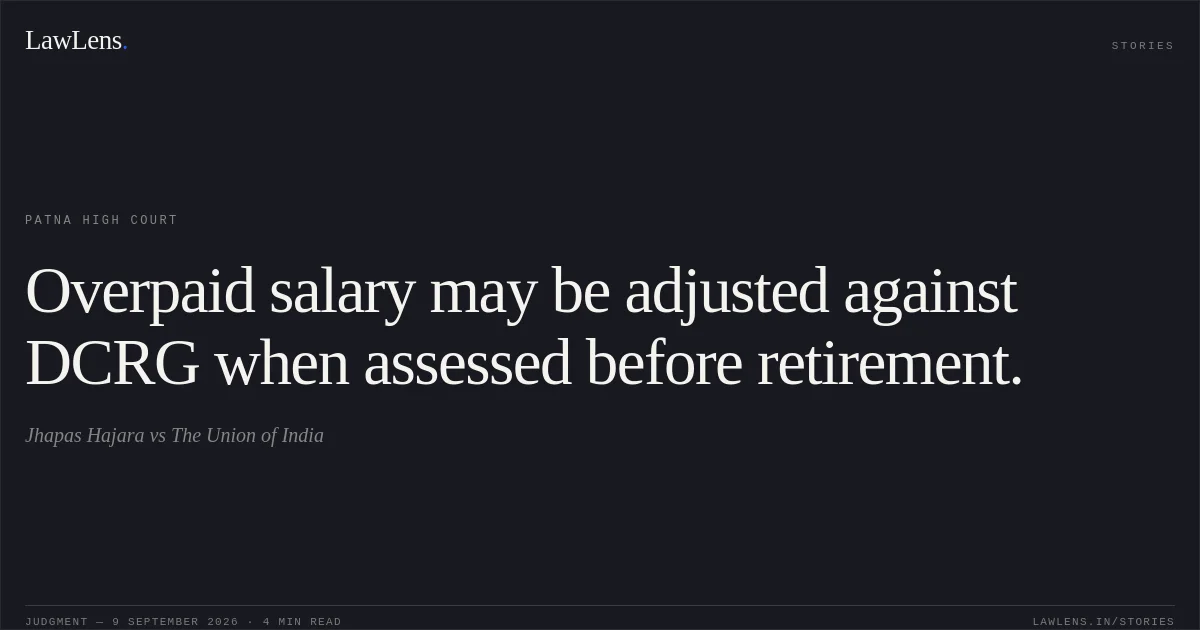
The petitioner, a retired Railway employee, superannuated on 30 April 2018 after serving as a Gang Mate/Track Man. At the time of settlement of his retiral benefits, the respondents deducted ₹30,000 towards the Retired Employees’ Liberalized Health Scheme (RELHS) and ₹2,39,001 from his Death-cum-Retirement Gratuity (DCRG), alleging excess payment of salary attributable to 1,727 days of leave without pay.
Source reference: p.2, para. 2The petitioner objected to the deductions and filed O.A. No. 050/666/2018 before the Central Administrative Tribunal (CAT), which directed the respondents to decide his representation. Thereafter, the Divisional Railway Manager (Personnel) passed a speaking order dated 26 October 2018, holding that the salary revision and recovery of ₹2,39,001 were justified on the basis of the petitioner’s leave without pay, and that the ₹30,000 RELHS deduction was based on his option for the scheme.
Source reference: pp.2–4, paras. 2–3The petitioner challenged that order before the CAT in O.A. No. 050/00089/2019, relying principally on State of Punjab v. Rafiq Masih and contending that the recovery was made without adequate details or a prior opportunity of hearing. The CAT dismissed the application on 12 May 2026, holding that the action was corrective rather than punitive and that no fresh penalty had been imposed.
Source reference: pp.1, 4, 6, paras. 1, 4, 6Issues
Whether the respondents were legally entitled under Rule 15 of the Railway Services (Pension) Rules, 1993, to adjust ₹2,39,001 from the petitioner’s DCRG towards alleged excess payment of salary arising from leave without pay.
Source reference: pp.4–5, 10–12, paras. 4, 10Whether the recovery was barred by the principles laid down in State of Punjab v. Rafiq Masih because the petitioner was a lower-level/Class III Railway employee and the recovery was made from his retiral benefits.
Source reference: pp.6–7, 10–12, paras. 6–7, 10Whether the deduction of ₹30,000 towards RELHS was lawful on the basis of the petitioner’s option for the scheme.
Source reference: pp.3–4, 5, 7, paras. 3, 5, 7Whether the CAT’s finding that the respondents’ action was corrective and not punitive disclosed any legal infirmity warranting interference under Article 226 of the Constitution.
Source reference: pp.1, 10–12, paras. 1, 10–11Law Applied
The Court applied Rule 15 of the Railway Services (Pension) Rules, 1993, which requires outstanding Government or Railway dues to be adjusted against retirement or death gratuity and expressly includes overpayment of pay and allowances within such dues.
Source reference: pp.4–6, para. 4It considered State of Punjab v. Rafiq Masih, (2015) 4 SCC 334, which restricts recovery of mistaken excess payments in specified situations, particularly where recovery from lower-level employees would cause undue hardship, but distinguished its application on the facts.
Source reference: pp.6–7, 10–12, paras. 6–7, 10The Court also relied on Registrar, Cooperative Societies, Haryana v. Israil Khan, (2010) 1 SCC 440, and Col. B.J. Akkara (Retd.) v. Union of India, (2006) 11 SCC 709, for the principle that protection against recovery is discretionary and equitable, not an absolute right, and generally applies where excess payment resulted from an erroneous method or interpretation adopted by the employer.
Source reference: pp.8–10, para. 8It further referred to Chandi Prasad Uniyal v. State of Uttarakhand, (2012) 8 SCC 417, and High Court of Punjab & Haryana v. Jagdev Singh, (2016) 14 SCC 267, in support of recovery of amounts wrongly paid where the governing rules or relevant circumstances justified such recovery.
Source reference: p.12, para. 10Reasoning
The Court found that the petitioner had availed 1,727 days of leave without pay and that his pay was revised by memorandum dated 3 April 2018. On that basis, the Railway authorities issued a no-dues certificate on 18 April 2018, before his retirement on 30 April 2018, directing that ₹2,39,001 be withheld from his final settlement.
Source reference: pp.7, 10–11, paras. 7, 10Since the excess payment had been identified and corrective action had been initiated before superannuation, the Court held that the case was not one of an unexplained or belated post-retirement recovery. The amount constituted outstanding Railway dues under Rule 15 and could therefore be adjusted against the DCRG.
Source reference: pp.10–12, para. 10The Court further held that Rafiq Masih did not apply because the petitioner was aware of the excess payment, the authorities had corrected the pay before retirement, and he had not voluntarily refunded the amount.
Source reference: pp.10–12, para. 10The ₹30,000 RELHS deduction was upheld because the petitioner had opted for medical-card preparation under the scheme in the relevant declaration form and the deduction was made pursuant to the applicable Railway Board instructions.
Source reference: pp.3–4, 7, paras. 3, 7Accordingly, the CAT’s characterization of the action as corrective rather than punitive was found to be legally sustainable.
Source reference: p.1, para. 1Holding
The Patna High Court held that the respondents were entitled to recover ₹2,39,001 towards excess salary payment caused by the petitioner’s leave without pay and to deduct ₹30,000 towards RELHS, and that the protection against recovery recognized in Rafiq Masih was inapplicable on these facts.
Finding no infirmity in the CAT’s order dated 12 May 2026, the Court dismissed the writ petition.
Source reference: p.12, para. 11Original Court PDF
Jhapas HajaravsThe Union of India
Click to open original judgment
Original judgment, available to read, download and summarize on LawLens.in