Facts
The original tenant, Gajinder Singh, occupied a residential portion of House No. 602, Santpura Road, Yamuna Nagar, at a monthly rent of ₹250 since 1982.
Source reference: paras. 3–12The respondent-landlord purchased the property on 12 June 2007 and filed an eviction petition under Section 13 of the Haryana Urban (Control of Rent and Eviction) Act, 1973 (“the Act”) on grounds of bona fide personal necessity, nuisance and non-occupation.
Source reference: paras. 3–12The ground of non-occupation was later withdrawn. The Rent Controller allowed eviction on the ground of bona fide personal necessity but rejected the nuisance ground; the Appellate Authority affirmed the finding of personal necessity and reversed the finding on nuisance.
Source reference: paras. 3–12It also dismissed the tenants’ applications for additional evidence. During revision, the tenants sought to introduce a municipal tax register allegedly showing that the landlord possessed separate residential accommodation.
Source reference: paras. 3–12Issues
1. Whether the High Court, in revision under Section 15(6) of the Act, could interfere with the concurrent findings of bona fide personal necessity and the Appellate Authority’s finding regarding nuisance, on the grounds of perversity, misreading of evidence or non-application of law.
Source reference: paras. 19–222. Whether the landlord had established bona fide personal necessity despite owning or allegedly occupying other properties and despite subsequent changes in his family circumstances.
Source reference: paras. 33–413. Whether the Appellate Authority correctly found that the tenant’s conduct constituted nuisance under the Act.
Source reference: paras. 42–464. Whether the landlord’s alleged non-disclosure of other properties and alleged undervaluation of the sale consideration rendered the eviction petition non-maintainable or established absence of clean hands or fraud.
Source reference: paras. 47–535. Whether the tenants were entitled to produce the municipal tax register and other additional evidence at the appellate or revisional stage under Order 41 Rule 27 CPC.
Source reference: paras. 23–27, 54–56Law Applied
Section 15(6) of the Haryana Urban (Control of Rent and Eviction) Act permits limited revisional scrutiny of the legality or propriety of the order; the revisional court cannot re-appreciate evidence merely because another view is possible, but may interfere where the finding is perverse, unsupported by evidence, based on misreading of material evidence or results in miscarriage of justice, as explained in Hindustan Petroleum Corporation Ltd. v. Dilbahar Singh.
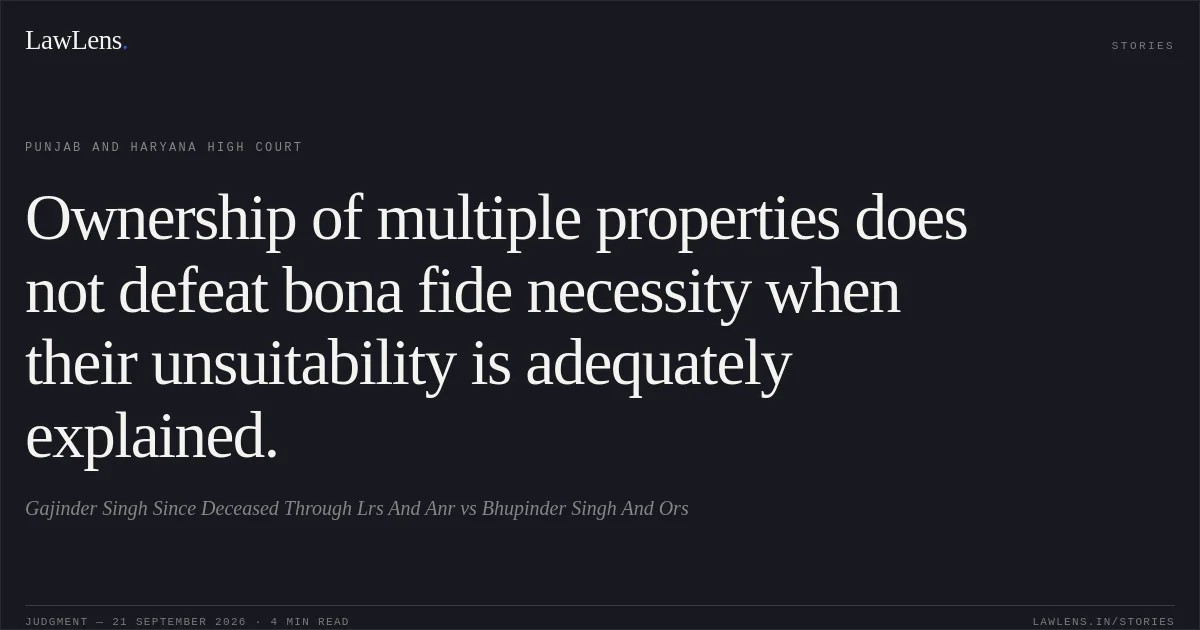
Source reference: paras. 19–20Under Section 13(3)(a)(i) of the Act, a landlord’s bona fide requirement is assessed with reference to his genuine need, and the landlord is ordinarily the best judge of the premises required for his residence; ownership of other properties does not by itself defeat the claim if their unsuitability is explained, as recognised in Siddalingamma v. Mamtha Shenoy and Suresh Chand Goyal v. Kali Charan.
Source reference: paras. 34–35, 48A bona fide requirement established on the date of the petition is not ordinarily defeated by delay or subsequent events, in accordance with Hukum Chandra v. Nemi Chand Jain and D. Sasi Kumar v. Soundararajan.
Source reference: paras. 38–40Additional evidence under Order 41 Rule 27 CPC is not a matter of right and is admissible only where the statutory requirements of due diligence or necessity for pronouncing judgment are satisfied.
Source reference: paras. 23–26, 54–56Allegations of fraud or tax evasion require cogent proof and cannot be presumed.
Source reference: para. 51Reasoning
The High Court held that the landlord’s testimony, corroborated by other witnesses, established that the hospital had expanded substantially, that the existing residential accommodation within the hospital was inadequate, and that he genuinely wished to reside independently near the market and Gurudwara.
Source reference: paras. 33–35The other properties relied upon by the tenants were either explained as unsuitable, vacant, or under compulsory requisition for a judicial officer; therefore, they did not establish that the landlord was occupying suitable alternative residential accommodation or had voluntarily vacated such accommodation without sufficient cause.
Source reference: paras. 36–37The deaths of the landlord’s wife and in-laws during the litigation did not extinguish the landlord’s independent need to live away from the expanding hospital.
Source reference: paras. 38–40On nuisance, the Appellate Authority was entitled to cumulatively consider the locking of the common entrance, obstruction by a vehicle, alleged abusive conduct and threats, and the tenant’s consequent litigation; the finding was therefore neither perverse nor unsupported by evidence.
Source reference: paras. 42–46The tenants themselves had disclosed the alleged properties and cross-examined the landlord about them, undermining the plea of concealment; compulsory requisition and letting of one property did not establish investment-oriented conduct, and the allegation of undervaluation lacked documentary proof.
Source reference: paras. 47–52The municipal register was rightly excluded because it could have been obtained earlier with due diligence and, in any event, its classification of portions of a hospital-cum-residential complex did not prove the existence of a separate suitable residence.
Source reference: paras. 23–27Holding
The High Court dismissed C.M. No. 8936-CII of 2024 and refused the proposed additional evidence.
It dismissed C.R. No. 4387 of 2019, upheld the Appellate Authority’s order dated 5 February 2019 and the Rent Controller’s eviction order dated 25 March 2014, and found no revisional error in the findings on bona fide necessity, nuisance, maintainability, clean hands or fraud.
Source reference: paras. 58–59The Court disapproved, though did not treat as outcome-determinative, the Appellate Authority’s remarks comparing the professional status of the parties’ legal heirs.
Source reference: paras. 58–59The tenants were directed to deliver vacant and peaceful possession by 30 November 2026 and to continue paying the admitted rent and other charges until then; coercive execution was deferred until that date.
Source reference: para. 60Acts & Sections Cited
1 provisions across 1 statute referred to in this judgment. Each provision opens on LawLens.
Code of Civil Procedure, 19081
Original Court PDF
Gajinder Singh Since Deceased Through Lrs And AnrvsBhupinder Singh And Ors
Click to open original judgment
Original judgment, available to read, download and summarize on LawLens.in