01Facts
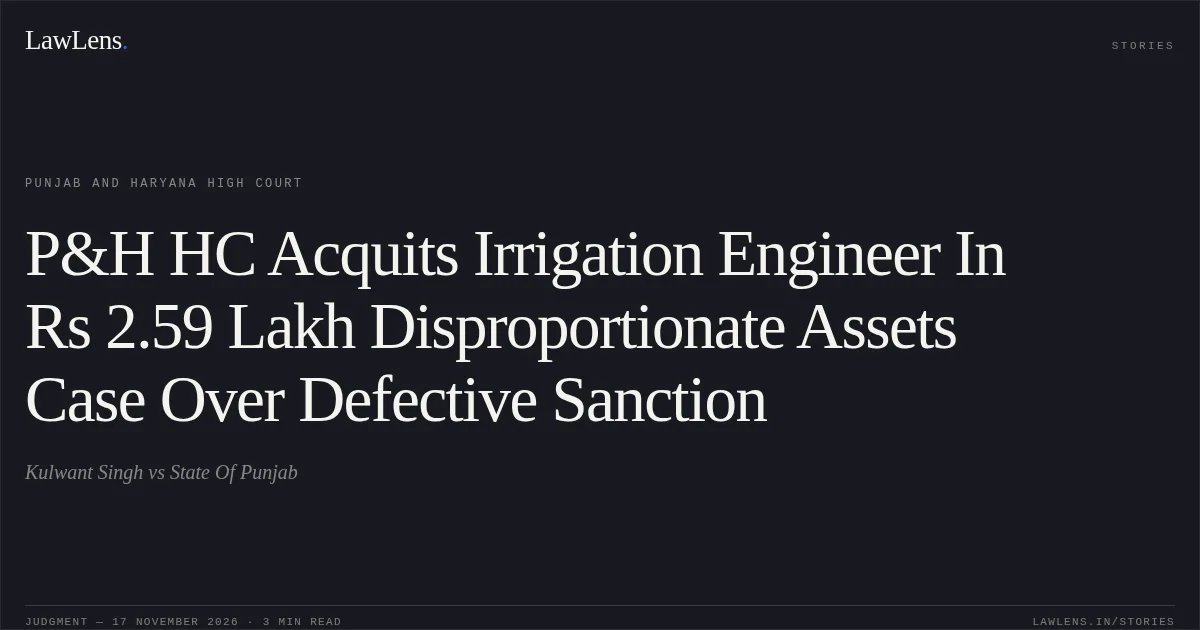
The appellant, Kulwant Singh, was a Junior Engineer/Sub-Division Officer in the Irrigation Department, Punjab.
An FIR (No. 12, dated 02.12.2008) was registered under Section 13(1)(e) r/w Section 13(2) of the Prevention of Corruption Act, 1988 (PC Act), alleging disproportionate assets.
¶ 3The check period was 01.04.2000 to 31.03.2006. Income was alleged at Rs 12,83,139 and expenses at Rs 15,42,432, an excess of Rs 2,59,293.
¶ 3, 4The prosecution alleged that the appellant built a house and shops, bought land in his son's name, and bought a car (Zen, PB30B/4138).
¶ 3, 5Sanction was first denied by the Chief Engineer (Drainage), the competent authority.
¶ 5(vii), 12Sanction was later granted by the Principal Secretary, Irrigation Department, and proved through PW-7, who had no personal knowledge of the case.
¶ 5(vii), 12PW-1 (XEN, Vigilance Technical Team-II) prepared assessment reports for the house and shops (Ex. PW1/A, PW1/B).
¶ 5(i), 15In cross-examination, PW-1 admitted he did not verify ownership of the land, used government rates, and destroyed his rough notes.
¶ 16The trial court convicted the appellant under Section 13(2) and sentenced him to four years' RI and a fine of Rs 10,000 by judgment dated 31.07.2014.
¶ 1, 8The defence proved a registered Will (02.07.2008), mutation entries, sale deeds, and a mason's testimony on construction timelines.
¶ 7, 9(D)02Issues
i.1. Whether the sanction for prosecution under Section 19 of the PC Act was valid and duly proved, given that the competent authority first refused it and a different authority later granted it.
¶ 12–13ii.2. Whether the assessment reports prepared by PW-1, without any prescribed methodology and with unverified ownership, could reliably establish the appellant's expenditure and disproportionate assets.
¶ 14–18iii.3. Whether the prosecution proved beyond reasonable doubt that the disputed properties and expenses were the appellant's, given the absence of ownership, khasra, and demarcation evidence.
¶ 17–18iv.4. Whether the statutory presumption under Section 20 of the PC Act could be invoked against the appellant on a charge under Section 13(1)(e).
¶ 1903Law Applied
Section 13 of the PC Act defines criminal misconduct, including illicit enrichment, with Explanation 1 creating a presumption where a public servant cannot satisfactorily account for assets disproportionate to known lawful income.
¶ 2The judgment reproduces the post-2018 text of Section 13(1)(b), while the charge was framed under Section 13(1)(e).
¶ 2, 4Section 19 of the PC Act requires valid prior sanction by the competent authority for prosecution.
¶ 12–13Section 20 of the PC Act raises a presumption only for offences under Sections 7 and 11, not Section 13(1)(e).
¶ 19The judgment cites no precedent. Counsel's reliance on Supreme Court authority regarding a 10% variation margin was recorded but not addressed.
¶ 9(F)Provisions in the judgment · 7 · Linked ones open on LawLens
Prevention of Corruption Act, 1988 Section 13Section 7Section 11Section 19Section 20
Code of Criminal Procedure, 1973 Section 161Section 313
04Reasoning
The court held the sanction defective. The competent authority had refused sanction, and the later grant by the Principal Secretary was unexplained. No new material was shown to justify the reversal, and PW-7 could not speak to the facts.
¶ 12–13The appellant was therefore denied any meaningful cross-examination on the sanctioning authority's findings.
¶ 12–13On the assessment reports, the court found no guidelines, approved formula, or authority for PW-1 to prepare them. The reports relied on government rates, ignored quality variations, lacked evidence of construction timelines and rates, and depended on destroyed notes.
¶ 14, 16On ownership, the court found that the house and shops were not shown to be the appellant's. Khasra numbers, demarcation, and revenue records were not collected, and the property was co-owned by family members under a Will.
¶ 17–18The court rejected the State's reverse-burden argument. Section 20 applies only to Sections 7 and 11, so the appellant bore no burden to disprove the charge under Section 13(1)(e).
¶ 19Because the prosecution's case rested on hypothesis, the court found "no substantial evidence" against the appellant.
¶ 18, 2005Holding
The sanction under Section 19 was defective and unproved, the assessment reports were unreliable, the ownership of the disputed assets was not established, and the Section 20 presumption was inapplicable.
¶ 12–19The appeal was allowed. The judgment of conviction and order of sentence dated 31.07.2014 were set aside, and the appellant was acquitted and discharged of the charges under Section 13(1)(e) r/w Section 13(2) of the PC Act.
¶ 20–21Pending miscellaneous applications were disposed of.
¶ 21Original Court PDF
Kulwant SinghvsState Of Punjab
Click to open original judgment
Original judgment, available to read, download and summarize on LawLens.in